Last of the Gunfighters
The F-8 Crusader was the United States Navy’s first supersonic jet fighter. It was also the Navy’s last dedicated, gun-armed fighter jet. This distinction leads many to call the Crusader, “Last of the Gunfighters”. The F-8s superior combat exchange ratio (18 enemy planes shot down vs. 3 lost) against Vietnamese MiGs lead to a Vought representative to call the F-8E the “Mig Master”, the name stuck. A direct descendant of the classic Vought F4U Corsair, the Crusader did the unheard of when the prototype went supersonic on its’ maiden flight.
The Vought F-8 Crusader was known as a “fighter pilot’s fighter.” It was challenging to fly, especially during carrier landings, but Crusader pilots loved their jet. The F-8 completed service in US Navy fighter squadrons in 1976, while the RF-8 (photo-reconnaissance version) served until 1987.

The French also flew the Crusader, but they do things differently and in the case of retiring the legendary fighter, I think they did it better.
F-8E(FN)
The French Crusader story begins in the early 1960s, when, seeking a fighter for the new carriers Clemenceau and Foch (commissioned 1961 and 1963, respectively), the Aéronavale (French Naval Aviation) selected a slightly modified version of the F-8E that is often designated F-8E(FN). The aircraft commenced operations in 1964. Known by French pilots as “Le Crouze,” they participated in routine deployments and combat operations for 35 years. Modifications and refurbishments maintained their effectiveness until they could be replaced by the Rafale.
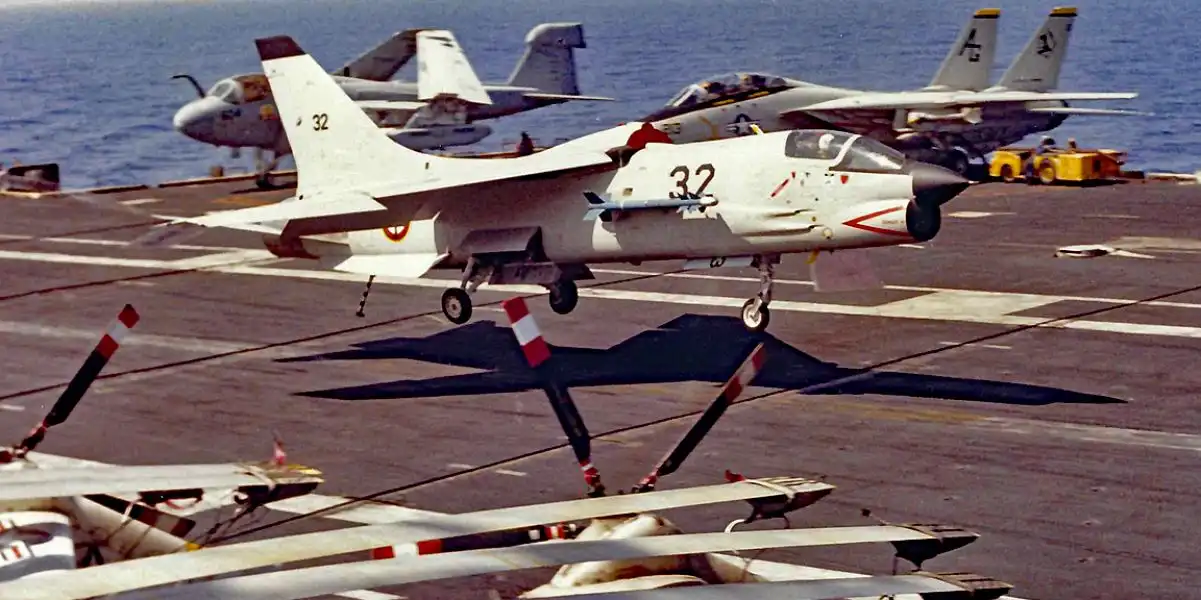
Aéronavale leaders waited until the end of the century, December 1999, for the retirement. The last squadron did not expect a crowd to come to a small base in western France in December. They were wrong. They received so many acknowledgments that they asked the American Crusader Association for help. I was the secretary of the association, so that meant me. Making arrangements for sixty senior citizens to get to Landivisiau, France, was an interesting, fun challenge. Thanks to Bruce Boland we even threw in a dinner in Paris sponsored by the American Embassy (Bruce was a former F-8 pilot in VF-13 with me in the 1960s and retired as a 2-star).
French Aéronavale Crusader retirement
At the big event, the French put on a small air show for the guests with four F-8s. Remember, this is December: it’s cold and windy. Standing outside the chain link fence by the taxiway are about sixty old, cold Americans waiting to see relics fly again. I looked at the group and I was so very proud to have been part of this scene. I hadn’t seen a Crusader fly in more than thirty years. For some in the group, it had been even longer. Then we heard a distinctive whine as four J57 engines started up. They went through their procedures and four wings were raised (The F-8 had that novel “variable incidence” feature to reduce speed on approach to landing). Soon they started to taxi from our left, across in front of us, and on to the runway. I turned around to shoot a few pictures of the group, and looked again: grown men were in tears. Tough, seasoned fighter pilots were unabashedly allowing tears to come out of their eagle eyes. All I could think of was, “I have done a very good thing.”

Last American to raise the F-8 Crusader wing
Towards the end of the festivities the squadron skipper, Antoine Guillot, asked me to come to the ready room. He then asked me to get into full flight gear. As we walked out to a waiting Crusader, he said the government did not allow any money for a gift for my efforts. Instead, he wanted me to start an F-8 and go through the full startup procedure. That would involve raising the wing. He continued, “I want you to be the last American to raise the wing.” No expensive gift would have meant more to me.

Myashishchev Mya-4 Bison
Myashishchev Mya-4 (M-4 and 3M) (Bison) was intended as the USSR’s first jet, strategic bomber. In this role, it was planned to be capable of flying 10,000-miles, with a single hydrogen bomb. It was designed during the early jet era of strategic and regional bomber – and had rather similar takeoff weight to the early US B-52 Stratofortress. The first prototype aircraft appears at the May Day 1954 Moscow air show – and created quite a sensation among Western diplomats and military observers.
It became the progenitor of a small family of bombers and refueling tankers, including the much-improved 3M and its versions.
Many of the intended versions never materialized, and the Bison had its share of problems, but it came at just the right time, providing a valuable nuclear deterrent.
Cuban Missile Crisis
As explained by Yefim Gordon & Dmitriy Komissarov in their book Myasishchev M-4 and 3M: The First Soviet Strategic Jet Bomber, despite the failure of the Bay of Pigs invasion (Operation Zapata) between Apr. 14 and 19, 1960, the US did not give up the idea of toppling the Cuban Communist government of Fidel Alejandro Castro Ruz. Actually, Castro feared that the US administration was planning a full-scale military operation. Knowing that the small Cuban Revolutionary Armed Forces were no match for the US war machine, Castro requested military assistance from the Soviet Union.
An agreement was soon reached whereby a 40,000-strong Soviet military contingent was deployed on Cuba, including three regiments of R-12 (izdeliye 8K63, NATO SS-4 Sandal) intermediate-range ballistic missiles and two regiments of R-14 (izdeliye 8K65, NATO SS-5 Skean) IRBMs. It was these weapons systems that triggered the infamous Cuban Missile Crisis of September—November 1962, which put the world on the brink of the Third World War.
Soviet bombers tasked to nuke Europe
Faced with the increasing probability of a hot war with the US, the Soviet MoD regrouped its forces hastily. Among other things, the 1096th and 1230th TBAPs, making up the 201st TBAD, were redeployed to a forward-operating location at Siauliai in order to reduce their 3M Bison strategic bomber’s target approach time. This was the only occasion when 3M bombers on quick-reaction alert (QRA) duty actually sat armed with nuclear bombs, ready to take off at short notice (in contrast, USAF B-52s prowling along the Soviet borders always had nukes on board in those days).

Two squadrons of each regiment were to strike at the continental US; the third squadron was equipped with hastily outfitted 3MS-2 tankers to support the operation. The bomber crews were issued sealed flight bags with route maps indicating their targets, and sealed envelopes with the nuclear bombs’ activation codes.
They never got to see the nukes proper, accepting the already bombed-up aircraft with security seals on the bomb bay doors. The Soviet air force’s tactical-aviation units and the DA’s Tu-16P Badger-J ECM aircraft (P = postanovshchik pomekh — ECM aircraft) were to help the bombers get unscathed past the NATO bases in western Europe, but later the Bisons would be on their own. The airmen were subjected to immense psychological strain, knowing that in the event of a nuclear war their own families would surely perish. Still, morale was high; `Do what you have to do, and come what may!’
Political solution
However, realising that an all-out war with the US would be a war of destruction, the Soviet leaders had the common sense to back down and seek a political solution. On Oct. 26, Nikita S. Khrushchov acknowledged the deployment of Soviet missiles to Cuba (which he had hitherto denied) but stated they would never be used against the US. He offered to US president John F. Kennedy to withdraw all Soviet offensive weapons from Cuba in exchange for a pledge of nonaggression against Cuba; he also demanded that the US ballistic missiles deployed in Turkey, which were causing great concern of the Soviet government, be withdrawn.
On Oct. 27, JFK replied that the USA guaranteed nonaggression and that the blockade of Cuba would be lifted on condition that the withdrawal of the Soviet offensive weapons be monitored by the United Nations. A day later, the Soviet government accepted this offer, making an appropriate statement. Between Nov. 5 and 9, all 42 IRBMs were shipped back to the USSR, and the launchpads were demolished. Hence the of state of heightened alert was cancelled, and the bombers of the 201st TBAD returned to their home base in Engels – much to the del relief of everyone concerned.
Myasishchev M-4 and 3M: The First Soviet Strategic Jet Bomber is published by Schiffer Publishing and is available to order here.

Photo credit: U.S. Navy
U-2
Built in complete secrecy by Kelly Johnson and the Lockheed Skunk Works, the original U-2A first flew in August 1955. Early flights over the Soviet Union in the late 1950s provided the president and other US decision makers with key intelligence on Soviet military capability.
The first U-2 flight over the USSR took place on July 4, 1956, and it brought back photos of Leningrad’s shipyards. Several more flights followed, and the photos they produced helped the US conclude that there was no “bomber gap” or “missile gap” in favor of the Soviets, as many feared. Eventually the CIA flew 24 U-2 missions over the USSR, and numerous flights over other communist nations.
In October 1962, the U-2 photographed the buildup of Soviet offensive nuclear missiles in Cuba, touching off the Cuban Missile Crisis.
Cuban Missile Crisis photographic intelligence
As told by Kevin Wright in his book We Were Never There Volume 2: CIA U-2 Asia and Worldwide Operations 1957-1974, one of the acid tests of photographic reconnaissance is, does it tell you what you need to know? During the Cuban missile crisis, a KH-4 Corona satellite was tasked to generate imagery of Cuba and serves as a useful qualitative comparison point between U-2 and satellite imagery of the day.

The decision was taken by COMOR (Committee on Overhead Reconnaissance) to use a Corona satellite, to image the western part of Cuba, already identified from the previous Agency U-2 missions, as the most developed part of the island and home to the majority of its military infrastructure. COMOR was well aware of the limitations of Corona imagery compared to the U-2, but its invulnerability was a decisive factor.
Corona Mission 9045 lifted off from Vandenberg AFB on Sep. 29, 1962. On its thirtieth orbit of the earth, it passed over western Cuba. Having looked over the imagery, academic Joseph Caddell has described that just frames 11 to 22 covered the western end of Cuba, which was partially obscured by cloud.
No significant photographic intelligence
This imagery was described in a later PFIAB (President’s Foreign Intelligence Advisory Board) chronology of the crisis: ‘the resulting photography was good by Corona standards, but not of sufficient quality to reflect significant photographic intelligence on MRBM (Medium Range Ballistic Missiles) or IRBM (Intermediate-Range Ballistic Missile) developments on the island.’ It was not just that the KH-4’s camera resolution was insufficient to see the missiles themselves, it was not detailed enough to identify the host of vital support vehicles and other equipment required by the SS-4 and SS-5 missile systems in the field.
Mission 9045 was in space for less than 72 hours before the film capsule was jettisoned as it passed close to Kodiak, Alaska and snatched out of the air near Hawaii by a modified C-119 from the 953rd Test Squadron on Oct. 2, 1962. Returned to Hickam AFB, the film capsule was immediately flown to the US, processed and the finished images despatched from there. Cuba was not the main objective of Mission 9045 – gathering imagery of Sary Shagan and Kamchatka peninsula was. The satellite was programmed to pass over those targets when the sun was in an optimal position for image collection. The pass over Cuba just had to fall in with the planning for the primary targets.

The PIs (Photographic Interpreters) that would have poured over the photography, believed to be from the 544th RTG at SAC HQ, would have concentrated on the Soviet imagery first before looking at the Cuba coverage.
No flexibility in KH-4 satellite images
The NPIC (National Photographic Intelligence Centre) report for Mission 9045 appears not to have been prepared until Oct. 7, 1962 and so the data was likely already a minimum of seven days old when they examined it. Hardly current by that stage.
Although Corona images produced wide-area coverage, there was no flexibility in what they covered. Its orbit pattern meant it was not possible to cover all of Cuba in a single mission. It was a pre-programmed system over which no control could be exercised once launched.
The U-2 had much greater flexibility in target selection and timing. Whilst re-planning U-2 operations was an expensive process, rearranging a Corona launch was many times more complex and took much longer to do. Neither could Corona photographic material be recovered, processed and assessed in the same timescale as U-2 imagery. Time-critical intelligence was much more likely to remain useful if it was collected by the U-2. However, the considerable advantages of U-2 imagery had to be balanced against the risk to its pilots once SA-2 sites became operational.

Identifying locations for further U-2 missions
After the crisis had ended SAC photographic interpreters later re-examined the Corona Mission 9045 imagery and determined that it was not possible to identify the SA-2s and other key sites from the space-based imagery. This was a clear limitation on the value of Corona photography until its quality significantly improved.
Over the next few years, the CIA and NPIC used Corona’s wide-area coverage, particularly of the PRC, as an aid to identify locations for further U-2 missions. As the Corona coverage improved it enabled NPIC interpreters to more accurately identify possible SA-2 sites along the routes of planned U-2 missions.
We Were Never There Volume 2: CIA U-2 Asia and Worldwide Operations 1957-1974, is published by Helion & Company and is available to order here.

Photo credit: National Reconnaissance Office and U.S. Air Force
The Rolls-Royce Merlin
Formed in 1906 to produce automobiles, Rolls-Royce was asked to begin designing and building aircraft engines at the outbreak of World War I in 1914. According to Smithsonian National Air and Space Museum, design of the Merlin began in 1933 following the similar Kestrel design. Early Merlin Mk II and Mk III engines, which produced about 7,457 kw (1,000 horsepower), powered Hawker Hurricanes and Supermarine Spitfires in the Battle of Britain.
Tolerances Rolls Royce allowed were Looser than Ford was Willing to Work With
According to ShortFinals.org, in 1941, in Trafford Park, Manchester, Ford UK had two assembly plants where they were told to build Rolls-Royce Merlins – lots of them! At the time, this engine was in the vast majority of British fighters and bombers, including the two which had just won the Battle of Britain, the Supermarine Spitfire and the Hawker Hurricane.
In his book Not Much Of An Engineer, Rolls Royce supercharger designer Stanley Hooker states that Ford UK looked at the Merlin engine drawings and said “we can’t build an engine to those tolerances.” Hooker said loftily (his words) “I suppose the tolerances are too tight for you?” ” No, they are much too loose – we use much tighter tolerances for car engines so all the parts are truly interchangeable without any hand adjustment needed.”
Ford UK built 400 Merlin engines a week

Ford re-drew the blue-prints for the Merlin, making it more suitable for mass production, and by 1944, over 400 engines a week were flowing out of the plants.
“And they were very good engines too” said Hooker.
The final total came to 30,428. This was only 2,000 less than the main Rolls-Royce plant at Nightingale Road, Derby (although there were several other plants producing Merlins in the UK).
The first Merlin engine developed 880hp but by the time the last mark of Merlin was produced the power output was 2030hp.
The Merlin engine was then enlarged still further and named the Griffon. Aircraft which were powered by the Merlin engine include the Lancaster, Spitfire, Halifax, Hurricane, Battle, Defiant, Whitley, Mosquito, Hornet, York, Lincoln and North American Mustang.
Hooker’s book is an excellent read about the development of the Merlin engine and then the early jet engines. Hooker eventually saved Rolls Royce after it went broke developing the RB211 three-shaft jet engine, which became today’s very powerful and very fuel-efficient Trent engine.

Photo credit: Crown Copyright
The strangest F-5 developments
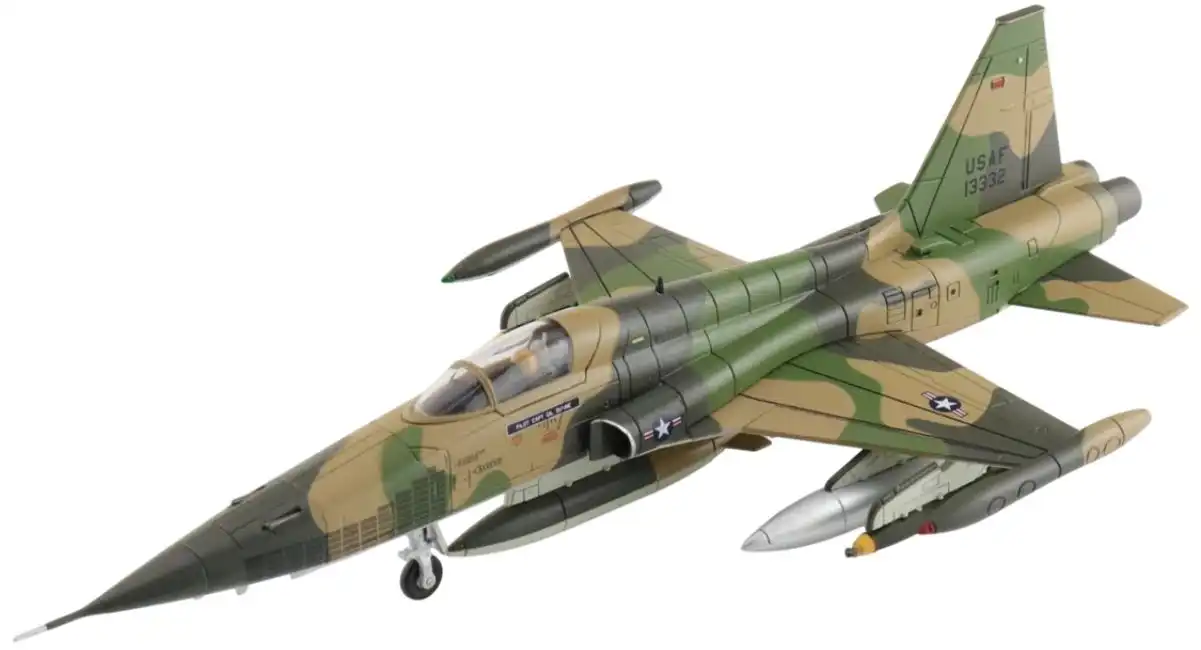
The F-5 was a supersonic fighter that combined low cost, ease of maintenance and great versatility. The US Air Force procured more than 2,000 of these aircraft for use by allied nations. The F-5, which closely resembled the Northrop T-38 trainer, was suitable for various types of ground-support and aerial intercept missions, including those conducted from unpaved fields in combat areas.
As explained in issue 19 – Northrop F-5 of Aviation Classic, the simple and lightweight F-5 airframe proved to be extremely adaptable to a variety of uses, some of which required extensive modifications to the airframe. The success of the fighter with international air forces also led to the development of an advanced version intended as a replacement. As well as the developments by Northrop, additional unlicensed life-extension and redesign programmes have been carried out by HESA in Iran to produce a viable fighter bomber for the Islamic Republic of Iran Air Force (IRIAF).
The Northrop F-20 Tigershark
The increasing capabilities of Soviet Bloc aircraft throughout the 1970s meant that several F-5E customers, especially Taiwan, pressed the US to provide greater capabilities for the fighter, such as an improved radar and the carriage of the semi-active radar guided AIM-7 Sparrow missile. The US Department of Defence requested that Northrop study the feasibility with which a suitable radar could be fitted to the F-5E, resulting in a design known as the F-5G. Changes in the US Government’s weapons export policy in 1977 meant that this study was never taken any further, but by the end of the decade, this policy had caused a number of US Allies to seek advanced fighter aircraft elsewhere, such as the aerospace industries of France and Britain.
On January 4 1980, a new competition for an export fighter, known as the Intermediate Export Fighter or FX, was begun by the State Department in order to recapture this market and appease America’s allies. Northrop reissued the F-5G proposal, General Dynamics responded with a lower powered, simpler version of the F-16, known as the F-16/79. With the inauguration of Ronald Reagan as US President in 1981, politics were again to interfere in the development of the F-5. Initially, the FX project was approved, then shelved, as the export of front line equipment was now allowed, then resurrected in 1982 as a fully-fledged programme. However, by 1980 Northrop realised that the new F-5 model would have to at least be on a par with the F-16 in terms of performance and capability, as the little fighter was now in direct competition with it.
F-5G
To meet these performance requirements the F-5G proposal was much modified, resulting in the new designation of F-20 and the name Tigershark being applied to the project in 1983. The redesign began with basing the aircraft on a single and much more powerful engine, a concept that had been under design study since the beginning of the F-5 programme. In order to surpass the F-16’s performance, the General Electric F404 was selected, as Northrop already had some experience with the original YJ101 version of this turbojet in the YF-17 Cobra prototypes. In fact, the F-5/404 concept had been put forward as early as May 1975 as a possible F-5E upgrade.
This choice alone called for wide ranging changes to the fuselage design, which had to be 5in longer with bigger inlet ducts and redesigned ramp doors to accommodate the greater amount of air the engine required at the greater than Mach 2 projected maximum speed. The wing did not change much, except for modifications to the leading edge extensions, which improved the lift performance for a minimum of increase in wing area, and internal strengthening to take the stress of 9G loading. A 30% larger tailplane was added to improve the pitch rates the aircraft could achieve and reduce its turning radius, an improvement assisted by the addition of a new fly-by-wire control system. Improved avionics and radar would allow the carriage and delivery of a greater range of weapons than previously.
F-5G-1
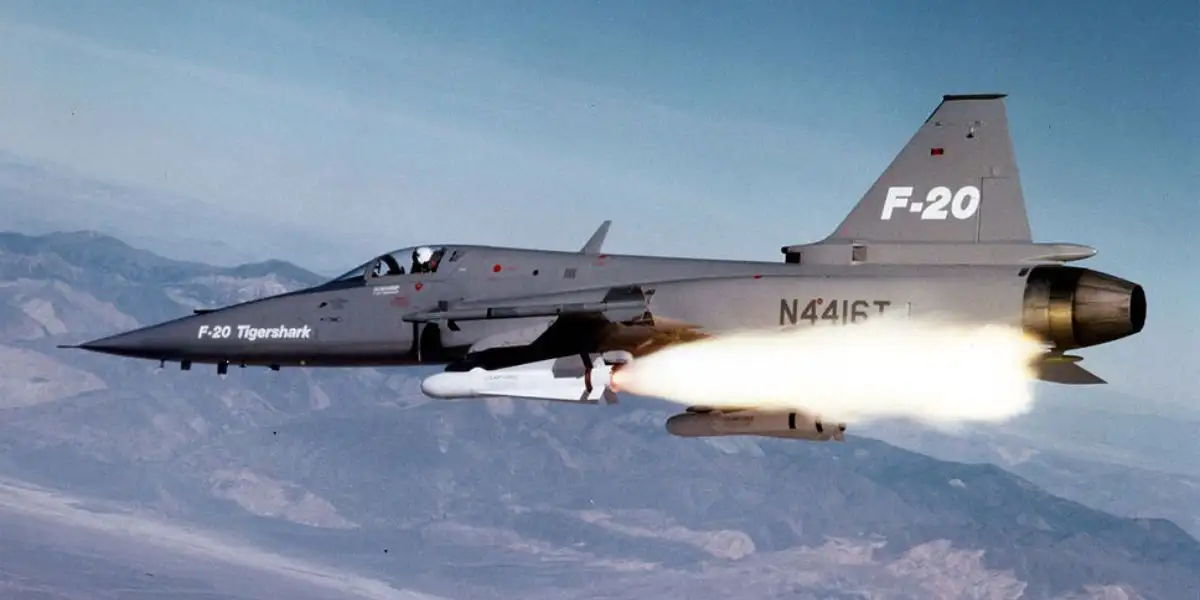
The first aircraft, initially known as the F-5G-1, was essentially a re-engined F-5E with a modified rear fuselage to accommodate the General Electric F404 of 16,000lb (7257kg) thrust. Little else was changed. It was given the serial 82-0062 and the civil registration N4416T and test pilot Russ Scott made the first flight for 40 minutes on August 30, 1982, from Edwards Air Force base in California’s Mojave desert. The performance that the 60% increase in thrust gave the fighter was astounding, enabling it to fly in excess of Mach 2 and reach an altitude of 55,000ft (16,800m). The lower fuel consumption of the F404 also gave an increase in range of 10% over the J85 engined version. The sustained turn rate was also improved to 11.5º per second at Mach 0.8, the supersonic turn rates were also improved by 47%.
The test flying proved so successful that an initial order had been placed by Bahrain in November 1982 and evaluation by 10 overseas customers had been completed by April the following year. In June 1983, the original F404 engine was replaced by an F404-100 with an additional 1000lb (454kg) of thrust which offered a further increase in performance, including the ability to reach 40,000ft (12,200m) in only 2.3 minutes from a cold start. On August 26, 1983, the second prototype, 82-0063 (N3986B) made its first flight, featuring a completely redesigned nose to accommodate the full advanced avionics suite and the General Electric G-200 radar.
Redesigned canopy
The canopy was also redesigned, featuring a bulged hood to give the pilot greater visibility. Known initially as the F-5G-1, this aircraft was followed by 82-0064 (N44671) with a similar full avionics suite and modified nose which first flew on May 12, 1984.
A fourth prototype was built using the intended production tooling, incorporating larger fuel tanks, improved flap and slat actuators, General Electric AN/APG-67 multi mode air-to-air and air-to-ground radar and yet another 1000lb (454kg) of thrust from an upgraded engine. The airframe was redesigned to incorporate composite panels and structure, improving still further the power to weight ratio. The F-20A had arrived, as all the aircraft were redesignated as such in the light of the extensive modifications to the original design.
F-20 cancelled
Northrop was in discussion with a number of potential customers when tragedy struck. Test pilot Darrell Cornell was killed on October 10, 1984, when demonstrating the first prototype, 82-0062, in South Korea. Less than five months later in May 1985, Northrop test pilot David Barnes was killed at Goose Bay in Labrador while en route to the Paris Air Show. He was practicing his display as part of a company demonstration and crashed under similar circumstances to Darrell Cornell. In both cases, no failure was found in the aircraft or its systems, but the crashes had an effect on the programme and delays were inevitable.
Despite its high performance, the USAF and the overseas customers increasingly favoured the F-16, so interest in the F-20 dwindled. Bahrain replaced its F-20A order with one for 10 F-5Es and two F-5Fs, and in 1986 the USAF announced it would be purchasing the F-16 for both the Air National Guard and the Aggressor squadrons, both roles envisaged for the F-20. Later that year, Northrop realised the hoped-for overseas market had been won over by the widely supported F-16 and the $1.2 billion F-20 was finally cancelled. The F-20 was a jewel of a high performance aircraft, completely privately funded by Northrop. Without doubt, its cancellation was a blow to the company, but it was already busy with the development of the B-2 Spirit stealth bomber.
The X-29

Two F-5A airframes, 63-8372 and 65-10573 were converted by Grumman to become the only X-29As, 82-0003 and 82-0049 respectively. These aircraft were extensively modified with canard foreplanes and 33º forward swept main wings and were intended to act as flying testbeds to investigate the aerodynamics of such a configuration. Since forward swept wings suffer from aerodynamic twisting forces which can be sufficiently strong to destroy them, only the extensive use of modern composite materials allowed the construction of a sufficiently strong wing to fully explore the performance.
The wing made the aircraft extremely unstable, and was only flyable by way of a triple redundant computerised flight control system. On December 14, 1984, Grumman’s chief test pilot, Chuck Sewell, took the first X-29A into the air at Edwards Air Force Base, four months after which NASA began an extensive test flying programme using both aircraft. The X-29s proved extremely reliable for such an advanced concept, reaching an unheard of angle of attack of 67º and becoming the first forward swept wing aircraft to fly supersonically, the latter achievement occurring on December 13, 1985.
The first aircraft was retired in 1986 after 242 successful flights, the second aircraft continuing to fly until 1991. They are both on display today, the first at the National Museum of the USAF at Wright Patterson Air Force Base in Ohio, the second at the Dryden Flight Research Centre at Edwards Air Force Base in California.
The SSBD: the strangest looking of the F-5 developments
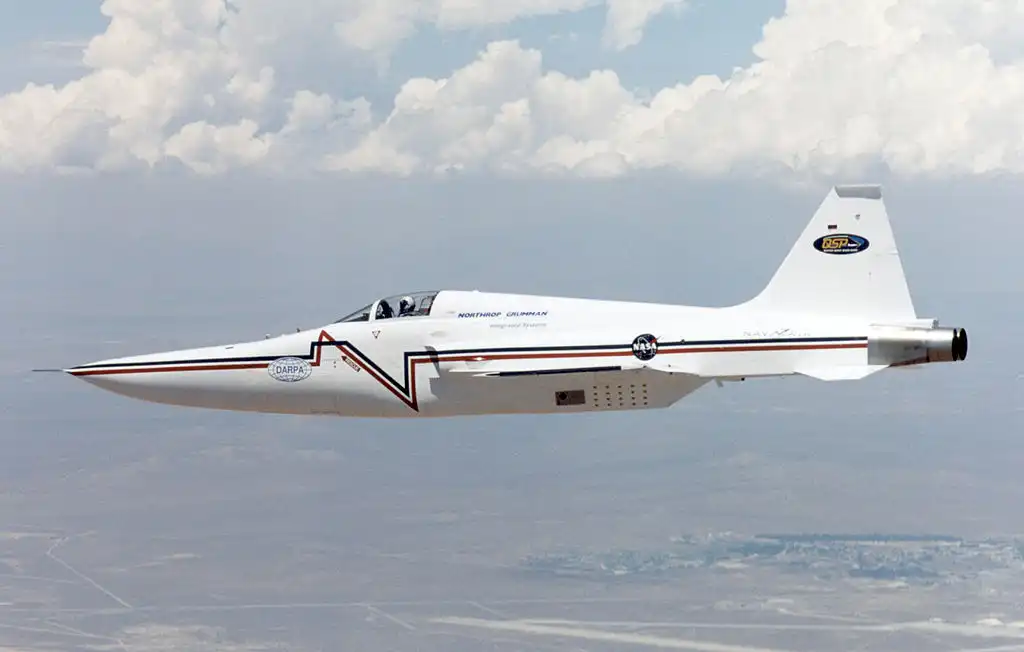
Without doubt the strangest looking of the F-5 developments, the Shaped Sonic Boom Demonstrator, or SSBD, was a modified F-5E with a bulged forward fuselage. The aircraft was to demonstrate that sonic booms created by aircraft could be substantially reduced by special shaping techniques and allow unrestricted supersonic flight over land. Northrop Grumman as the firm now was, Northrop having purchased Grumman in 1994, won the Defence Advanced Research Projects Agency (DARPA) competition to produce the test aircraft in July 2001 as part of the Quiet Supersonic Platform programme.
Northrop’s F-5 was considered ideal to modify to the required smoother equivalent area distribution as it was known, as it was a simple and reliable platform. A US Navy F-5E was restructured at Northrop Grumman’s St Augustine facility in Florida, using modified components constructed at the company’s El Segundo plant in California. The first part of the flight testing was aimed at establishing the flight envelope of the modified aircraft before the SSBD flights could begin. Making its first flight on July 24, 2003, from St Augustine and Cecil Field in Florida, the envelope was expanded with a T-38 in support to include supersonic flight at Mach 1.1, before the aircraft was flown to Palmdale in California.
Reduced sonic boom
With the support of a NASA F-18 from the Dryden Flight Research Centre, the flight envelope tests were completed and the SSBD flights began at Edwards Air Force Base throughout August 2003, several occurring on August 27. These were conducted over an area strewn with ground sensors under the aircraft’s flight path and to either side to record sonic boom and pressure wave generated by the aircraft. On three flights a standard F-5E from VFC-13 at NAS Fallon in Nevada flew 45 seconds apart from the SSBD to provide a comparison shock wave. Both aircraft were flying at 32,000ft and Mach 1.4 in the USAF High Altitude Supersonic Corridor. Two more flights were conducted with a NASA F-15B fitted with a pressure measurement probe to assess the shockwave near the SSBD.
These flights showed the SSBD did indeed have a reduced sonic boom, and a second series, known as the Shaped Sonic Boom Experiment or SSBE, was then conducted in January 2004, again over Edwards, by NASA. Altogether 21 flights recording the sonic boom pressures in varying flight conditions and turbulence were conducted, eight with the standard F-5E and four with the F-15B. In addition, a Blanik L-23 glider from the USAF Test Pilots School was fitted with several sensors and was flown 10,000ft below the SSBD on 13 of the flights. More than 1300 sensor recordings were made and 45 probe data sets were compiled, the aim being to allow future aircraft designers to control the sonic boom produced by their aircraft.
The F-5 SSBD is now on display at the Valiant Air Command Warbird Museum at Titusville in Florida, and will eventually be placed in the National Museum of Naval Aviation at Pensacola.
Tiger 2000/2001
The Republic of China Air Force (ROCAF) had purchased the F-5A and B as early as 1964 and by 1975 the Aerospace Industrial Development Corporation of Taiwan was producing the F-5E and F locally in their hundreds. The aircraft were replaced by the Mirage 2000, F-16 and the AIDC F-CK-1 Ching-kuo, also known as the Indigenous Defence Fighter (IDF) during the 1990s, but at least 40 were still in service in training roles into the 2000s, with between 90 and 100 maintained in reserve.
AIDC began the Tiger 2000/2001 programme with a view to upgrading these second line aircraft, using the GD-53 radar from the F-CK-1 fighter. The GD-53 was a development of the General Electric AN/APG-67 multi mode radar intended for the F-20, which was itself originally a development to meet Taiwanese defence needs. A single prototype flew for the first time on July 24, 2002, but official disinterest ended the programme. The prototype remains on display at AIDC in Taiwan.
Azarakhsh, Saeqeh, Simorgh and Kowsar

With the Iranian Islamic Revolution of 1979, support for the many US aircraft purchased by the deposed Shah was no longer available. Since then, the Iranian Ministry of Defence, the Islamic Republic of Iran Air Force (IRIAF), its Owj Industrial Complex (OIC) and the Iran Aircraft Manufacturing Industrial Complex (HESA) have undertaken modification and upgrades using existing equipment as a basis.
The first of these, the Azarakhsh (Thunder) was first announced in April 1997 and is believed to be a Northrop F-5E Tiger II with a Russian developed radar which extended the nose by some 6.6in (17cm). This entered series production in June 1999, with between six and nine being built by 2001 against an order for 30. A second prototype flew in February 2001 with strengthened wings, wide use of composites throughout the airframe, uprated J85 engines and the ability to carry locally manufactured weapons.
Little is known about the use of these aircraft, but two single seat and a two seat aircraft based on an F-5F took part in the National Army Day flypast at Tehran on April 17, 2008. An enlarged version of the F-5E, also known as the Azarakhsh, was planned, using Russian engines and radar, but was not built as far as can be ascertained. The next version was revealed in 2008, and was a major redesign having its wing mounted in the centre of the fuselage, above the air intakes, to increase its ability to carry underwing loads. The wing was also fitted with a leading edge extension to improve manoeuvrability.
Precision targeting
The Saeqeh (Lightning or Thunderbolt) first flew on May 30, 2004, having begun development in 1998. Confusion over the prototypes of this aircraft comes from the use of the name Azarakhsh-2 in relation to the first prototype. The Saeqeh has fins, canted outboard, similar to the F-18, and two different versions are known to exist, one with similar intakes to the F-5, others with enlarged square intakes, possibly representing a second version of the type, first seen in August 2006. The intended production version of the aircraft is believed to feature an advanced radar and a full glass cockpit. Three of the fighter bombers took part in the National Army Day flypast at Tehran in both 2007 and 2008, but it is unknown how many have been built.
The Simorgh is another Iranian F-5 development, driven by the lack of two seat training aircraft. HESA is undertaking the conversion of the remaining Northrop F-5A Freedom Fighters in storage into two seat versions, similar to the F-5B.
The Kowsar is the last Iranian F-5 development. Hailed as a new indigenous fourth generation fighter, the Kowsar is a carbon copy of the American F-5F. According to state media, the Kowsar can be used for “short aerial support missions” and is equipped with systems that “promote precision targeting.”
Northrop F-5 is published by Aviation Classic and is available to order here.
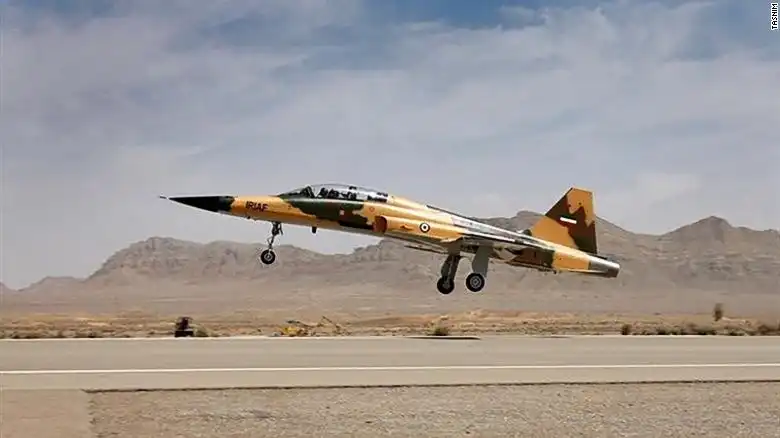
Photo credit: U.S. Air Force, NASA / DFRC / Larry Sammons, NASA/Carla Thomas, Shahram Sharifi via Wikipedia
Jug
Affectionately nicknamed “Jug,” the P-47 was one of the most famous AAF fighter planes of World War II. Although originally conceived as a lightweight interceptor, the P-47 developed as a heavyweight fighter and made its first flight on May 6, 1941. The first production model was delivered to the AAF in March 1942, and in April 1943 the Thunderbolt flew its first combat mission — a sweep over Western Europe.
Used as both a high-altitude escort fighter and a low-level fighter-bomber, the P-47 quickly gained a reputation for ruggedness. Its sturdy construction and air-cooled radial engine enabled the Thunderbolt to absorb severe battle damage and keep flying. During WWII, the P-47 served in almost every active war theater and in the forces of several Allied nations. By the end of WWII, more than 15,600 Thunderbolts had been built.
P-47N
As told by James S. Corum in his book Okinawa 1945, when the 19th Fighter Squadron arrived on Okinawa, it was equipped with an amazing new model of the P-47 fighter.
The P-47N model was especially designed for the Pacific theater, where long range was essential. The N-model had thick, squared wings that allowed for large fuel tanks. The P-47N was a heavy aircraft – more than eight tons when loaded. But its Pratt and Whitney R2800 engine produced over 2,000hp and, despite the weight, gave the aircraft a top speed of 467mph and allowed it to easily carry a ton of bombs or rockets.

It was the ultimate in fighter design in 1945.
On May 25, 1945, the US Army Air Corps, 19th Fighter Squadron, based on Ie Shima, was flying a strike mission to Kyushu when it ran into heavy rainstorms. The squadron aborted the mission, dropping their bombloads in the Pacific and turned around to return to base.
The poor weather was also ideal for a kamikaze attack, with heavy clouds and intermittent rain squalls providing the right conditions for kamikazes to slip through American defenses. That day also happened to be one of the major Japanese mass “wave” attacks against the US fleet.
First Lt Richard Anderson of New York and his wingman Second Lt Donald Kennedy of San Antonio, Texas, became separated from their squadron. Through a break in the clouds, they spotted a formation of approximately 30 Zero kamikazes headed for the US fleet at 2,000ft. Reporting their position, the two Army pilots flying their P-47N aircraft then dove at the Japanese formation approaching the bomb-laden Zeros from the rear.
Only one bullet left

The minimally-trained kamikazes did not even notice the threat from the two Americans until a few had been shot down. The P-47N was armed with eight .50cal machine guns and carried 3,400 rounds, as compared to 2,400 rounds for the Navy Hellcat or Marine Corsair fighters. It could literally hose the lightly built Zeros with bullets. Of his own combat, Anderson reported that “the first four were easy since I was on their tail… I got the fifth on a deflection shot as he was turning. When I pressed the trigger on the sixth in my sights, I found I had only one bullet left and he got away.”
Meanwhile, Lt Kennedy dropped three Zeros into the sea. Soon, the rest of the 19th Squadron appeared and destroyed the rest of the kamikaze formation. The 19th Squadron was credited with 34 Japanese aircraft destroyed that day, with no losses to themselves.
Lt Anderson was awarded the Distinguished Service Medal for becoming an “ace in a day” for downing five enemy aircraft. These were Anderson’s only aerial victories of the war, indeed, his only air-to-air combat. By June, Japanese air operations dropped dramatically and, for the next two and a half months, Anderson continued to fly strike missions against Japanese targets on Kyushu.
Okinawa 1945 is published by Osprey Publishing and is available to order here.

Photo credit: U.S. Air Force and misawa own work via Wikipedia
Not normal flights
In an instant, US military units around the nation switched from routine training to a real-world missions on Sep. 11, 2001.
However, not all the units assumed responsibility for alert missions as former US Navy F/A-18 and EA-6B pilot John Parker recalls;
‘My last active-duty tour in the Navy was performing post-depot maintenance check flights of the F/A-18 at the Boeing facility at Cecil Airport, formerly NAS Cecil Field (before the BRAC closure). Taking that job was not the smartest move on my part, or the Navy’s. I had only about sixty hours in Hornets at the time. Nearly all of my 3,000 flight hours were in the EA-6B and other aircraft from my time at Pax River serving as a test pilot. In a normal squadron, I would never have been allowed to perform functional check flights with that little time in the model.
‘And these were not normal flights.
‘These jets had been torn apart down to the airframe and then reassembled. Every flight was an adventure in malfunctions. Something almost always failed. Something almost always surprised me.
First day on the job
‘My first day on the job was Sep. 11, 2001.
‘I had just returned from NAS Lemoore where I had been getting refresher training and simulator time, practicing the FCF A-profile checklist and as many emergency procedures as the instructor could throw at me. That morning, as I was getting settled into my new office at Cecil, the Boeing manager stopped by and casually said that someone had accidentally flown into one of the buildings in New York.
‘I remember thinking that didn’t make sense. I pulled up the weather for New York City. It was crystal clear.
‘I walked down to the front office where a small group had gathered around a television. Nobody was talking. We just stood there watching the footage replay, over and over again. It was obvious to everyone in the room that this was no accident. You could feel the air change. The room got very quiet in a way I had never experienced before.
‘At the time we had more than twenty aircraft in the hangar undergoing various modifications. One of them belonged to a Marine VMFA squadron in Beaufort. That afternoon they called and said they needed their jet back immediately to meet a deployment requirement.
‘There was one problem. The cockpit was in pieces, and the modification wasn’t complete.
The Boeing team worked through the night putting it back together. Panels were still off, tools still scattered around the jet, when I coordinated with my chain of command to get approval to fly the next day. All civilian flights were grounded and the US airspace was closed. It took time, but eventually I received an IFF transponder code directly from the Pentagon authorizing me to ferry the aircraft from Cecil to MCAS Beaufort.
The morning of Sep. 12, 2001
‘On the morning of Sep. 12, I called the Cecil tower and explained what was about to happen, giving them the code. The hangar felt oddly still as I walked out to the jet. The airplane looked like it had been hurriedly stitched back together. You could tell it had been a long night for the maintenance crew.
‘I don’t remember sleeping much the night before. This would be my first flight following the re-qualification at Lemoore.
‘After takeoff I switched to Jacksonville Departure frequency. I heard nothing. No chatter. No background noise. Just the faint hiss of an open radio. I called again. And again.
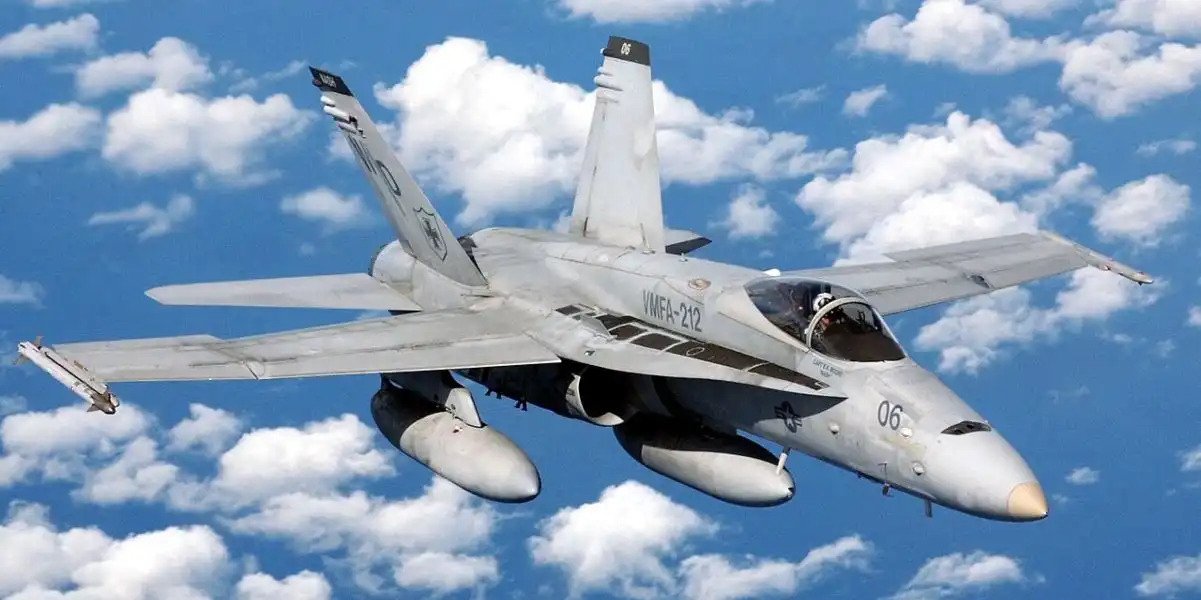
‘Finally, someone answered. It sounded almost like they had forgotten how to do this. After some back and forth about what I was doing, they eventually cleared me to continue on the short flight.
‘There were no other airplanes in the sky. No contrails; no traffic calls; no other voices on the frequency.
‘When I asked for clearance to climb to my planned altitude, the controller replied, “The sky is yours. Do whatever you want to.”
‘I had never heard anything like that on the radio before.
‘I pushed the throttles into afterburner and the jet surged forward, pressing me into the seat as the engines roared. The airplane leapt upward into a perfectly empty blue sky. As I climbed, I found myself scanning the horizon out of habit, looking for traffic that wasn’t there.
‘For the first time in my career, I became aware of just how alone I was.
‘This was also the first time I had ever flown in a true single-seat aircraft. I had flown solo many times before, but there was always another seat behind me or beside me, even if it was empty.
Inside a paused world
‘Not this time.
‘There was no one else in the jet. No one else in the sky. And the day before, the entire country had changed.
‘It all felt surreal, like flying inside a paused world.
‘I ran through as many FCF checks as I could during the short flight.
‘As I approached Beaufort, the contrast was striking. The tower frequency was alive with voices. The pattern was full. I counted roughly a dozen Hornets in the FCLP pattern working to get carrier qualifications back as quickly as possible. The military had clearly shifted into motion overnight, and many of the aircraft would soon be on their way to Afghanistan.
‘Having never been to Beaufort before, I had to ask ground control for directions to the correct hangar. I shut down in front of a squadron that was very eager to have their jet back. I checked in with their maintenance control and they sent a duty driver to take me into town to pick up a rental car for the drive back to Jacksonville.
‘It wasn’t until I was alone in that car, driving south on the highway, that the weight of the previous two days really settled in. The silence in the sky. The urgency in the hangar. The strange calm in the cockpit. The feeling that the rules had changed overnight.
‘I had spent years flying military aircraft, but I had never experienced anything like flying on Sep. 12, 2001, in a jet that had been rebuilt overnight, in a sky that belonged to no one.’

Photo credit: Cpl. Calah Thompson and LCPL John Mcgarity / U.S. Marine Corps
Blackbird
From the shadows of the Cold War emerged an espionage platform that expanded the limits of human possibility and made the theoretical thrillingly real.
The fastest manned aircraft in the history of flight, the Blackbird family and its best-known member, the SR-71, streaked across the stratosphere faster than a bullet and delivered stunning intelligence data to the West.
According to the bookazine Lockheed SR-71 Blackbird, the futuristic image of the Blackbird conjures up notions of science fiction, literally pushing the envelope in speed, stealth, and high-altitude performance.
Major Brian Shul was a Vietnam combat veteran who flew 212 missions and was badly burned, but he defied the odds and returned to duty to fly the world’s fastest plane. After a 20-year career in the USAF, Shul wrote four books including Sled Driver: Flying the World’s Fastest Jet.
Operation El Dorado Canyon
In 1986, after Libyan leader Muammar Gaddafi had increased his country’s support of worldwide terrorism and his proxies were found guilty of bombing the La Belle discotheque in Berlin, resulting in the death of an American serviceman, the US was determined to retaliate. Gaddafi declared “a line of death” at the Gulf of Sidra in the Mediterranean, daring the Americans to respond.
Operation El Dorado Canyon was initiated and bombing raids were directed at targets in the Libyan capital of Tripoli and some of the 22 terrorist training camps in the country.
Along with other assets, the SR-71s of Detachment 4, 9th Strategic Reconnaissance Wing, participated in pre- and post-attack surveillance over Libya. Majors Shul and Watson took part.

The pilot remembered pressing the Blackbird to his fastest personal speed when Libyan crews fired a pair of surface-to-air missiles (SAMs) in his direction while on a damage assessment mission:
“On the morning of April 15, I rocketed past the line [of death] at 2,125mph. We crossed into Libya and were approaching our final turn over the bleak desert landscape when Walter informed me that he was receiving missile launch signals. I quickly increased our speed, calculating the time it would take for the weapons – most likely SA-2 or SA-4 SAMs capable of Mach 5- to reach our altitude.
SR-71 outrunning Gaddafi’s SAMs
“I estimated that we could beat the rocket-powered missile to the turn and stayed our course, betting our lives on the plane’s performance. After several agonizingly long seconds, we made the turn and blasted toward the Mediterranean.
“’You might want to pull it back,’ Walter suggested. It was then I noticed I still had the throttles full forward. The Plane was flying a mile every 1.6 seconds, well above our Mach 3.2 limit. It was the fastest we would ever fly.”
Shul concludes;
“I pulled the throttles to idle just south of Sicily, but we still overran the refueling tanker awaiting us over Gibraltar.”
Lockheed SR-71 Blackbird is published by Key Publishing and is available to order here.

Photo credit: Lockheed Martin and U.S. Air Force
Fighter pilots are not allowed to carry music players
Fighter pilots are not allowed to carry electronic devices with them. That includes music players. The chances of a gadget interfering with onboard avionics are rather slim, but it could happen.
However, many fighter pilots break that rule. Especially on long (and boring) ferry flights. They just get earbuds that won’t conflict with the radio earphones in the helmet.
Listen to music aboard A-10 Warthog during cross Country Flights
Lynn Taylor, former A-10 Pilot, Joint Firepower Course Instructor and ALO at U.S. Air Force (1995-2005), recalls on Quora;
‘I… er, “someone I know”… had a “patch cord” (courtesy of a savvy comm guy in exchange for a case of his favorite). It plugged in between the oxygen hose communications connection and the jet comm receptacle. It had a toggle switch that allowed me to patch a music player into the headset.
‘I only ever used it a few times, and even then, only on cross country flights where the only thing to do was enjoy the scenery. We had an interflight frequency that I could transmit over to share tunes with wingmen, but it required holding the mic button continuously. Whenever we started getting close to congested airspace, I’d turn it off to make sure we didn’t miss anything from Air Traffic Control.

‘Any other time, you really don’t want anything distracting. Any other kind of mission, training or otherwise, is very task intensive. Especially in combat, you don’t want any more distractions than already get thrown at you.’
Taylor concludes;
‘One other note… whenever we had a tanker dragging us across the pond, it was nice when we had a KC-10. They often had music they’d patch into the formation frequency, which really helped on the long flights.’
The A-10 Warthog
The A-10 Warthog is the first US Air Force (USAF) aircraft specially designed for close air support of ground forces. They are simple, effective and survivable twin-engine jet aircraft that can be used against light maritime attack aircraft and all ground targets, including tanks and other armored vehicles.
The aircraft can survive direct hits from armor-piercing and high explosive projectiles up to 23mm. Their self-sealing fuel cells are protected by internal and external foam. Manual systems back up their redundant hydraulic flight-control systems. This permits pilots to fly and land when hydraulic power is lost.
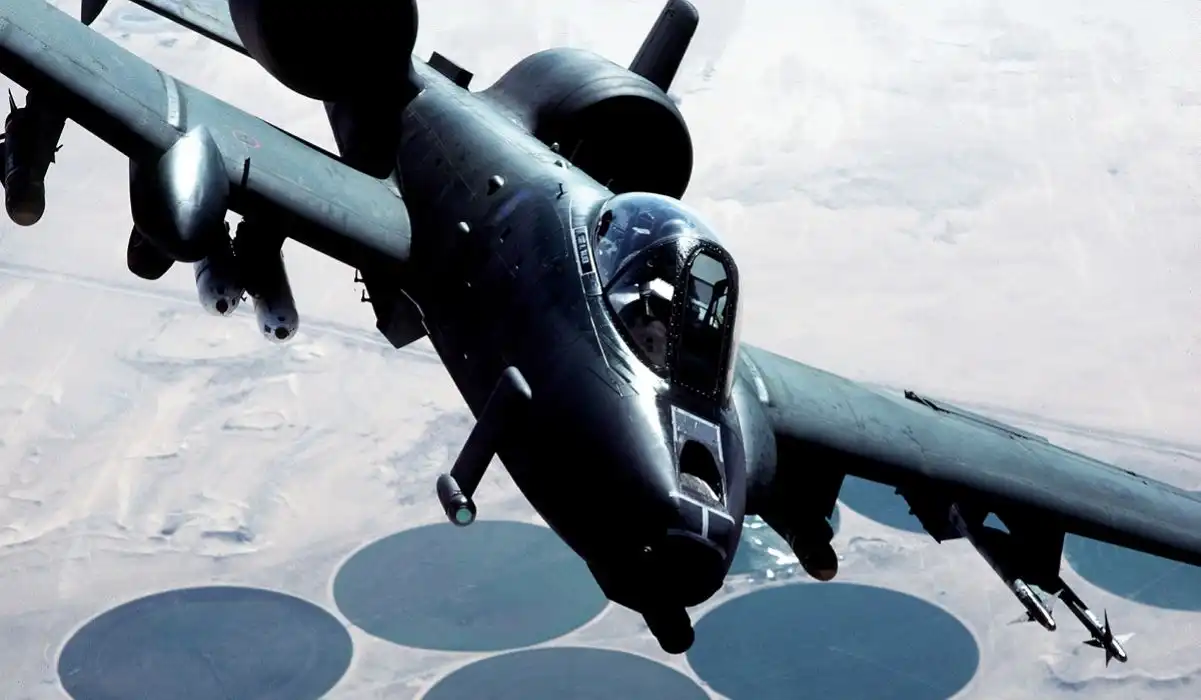
Photo credit: Ken Hackman / U.S. Air Force
Flying “Fortress in the sky”
The Germans thought it was a Superplane! The Boeing B-17 Flying Fortress flew in every combat zone during World War II, but its most significant service was over Europe. Along with the B-24 Liberator, the B-17 formed the backbone of the USAAF strategic bombing force, and it helped win the war by crippling Germany’s war industry.
While it lacked the range and bomb load of its contemporary B-24 Liberator, the B-17 became the more famous of the two due to the many tales of B-17s bringing their crews back home despite heavy damage. With up to thirteen machine guns, the B-17 seemed to be genuine flying “fortress in the sky.”
Coupled with RAF Bomber Command in its night bombing campaign, USAAF heavy bomber daylight strikes attempted to force Nazi Germany into surrender by crushing domestic industry, war production and the German peoples will to resist. Heavy fighting brought massive causalities among US bomber crews making participation in the Combined Bomber Offensive one of the most dangerous missions of World War II, a claim confirmed by the so called “Piggyback Flight” a very unusual accident happened on Jan. 1, 1945.
B-17s becoming hooked together: the Piggyback Flight
‘Pilot Glenn Rojohn survived what became one of the miracles of the war when his’ says Troy Dugo (whose father loaded ordinance on B-17’s at RAF Deopham Green during World War II) on Quora. ‘My dad, who loaded ordinance on B-17’s at RAF Deopham Green, became friends with Rojohn in their Pittsburgh social group in the 90s.’
As reported by the Pittsburgh Tribune, Rojohn was piloting a B-17 Flying Fortress in the New Year’s Eve attack on a synthetic oil factory in Hamburg when all hell broke loose. Besieged by heavy anti-aircraft flak near the target and wave after wave of strafing by German fighters, 12 of 37 planes were downed and 100 crewmen were killed.
Dugo explains;
‘Rojohn’s B-17 collided mid-air with a bomber below it and became hooked together in what has become known as the “Piggyback flight.” A propeller and top guns of the lower B-17 were jammed into Rojohn’s B-17 and he and his co-pilot, William Leek, were unable to free their plane.
‘Rojohn’s crew, part of the 8th Air Force’s 100th Bomb Group, were awakened in the middle of the night and told they were to fly across the English Channel and the North Sea to participate in a massive bombing raid. A fighter escort they were supposed to meet over the English Channel never materialized because of heavy fog, so they were flying the bombing mission against German targets without protection during the Battle of the Bulge.
‘They were sitting ducks for the German fighter planes.’
Conjoint Landing
It is not known why the lower plane collided with Rojohn’s B-17 at about 19,000 feet as its aircraft flew to fill a gap in the “V” formation caused by other planes being shot down. It is believed the pilots of the other plane were incapacitated. While the lower plane’s engines kept operating and cut into Rojohn’s B-17, Rojohn and his co-pilot turned off their plane’s engines and turned south toward Germany to try to land the plane.
Unfortunately, some crew bailed out over water, unaware they had not reached land. Three crew members died and the survivors were captured.
Dugo continues;
‘Rojohn and his co-pilot landed the conjoined planes on German soil near Wilhemshaven. Rojohn’s plane slid free upon impact, and the lower plane exploded and burned. Rojohn would undergo two weeks of interrogation by the Germans. They thought Rojohn was piloting a new eight-engine warplane the Allies had developed rather than it being the accidental joining of two planes in mid-air! The Germans thought it was a Superplane!’
He concludes;
‘For their heroic actions, Rojohn and his co-pilot, William Leek, were awarded the Distinguished Flying Cross. At the petitioning of my dad and his fellow veterans, we were all there when Rojohn was inducted into the Hall of Valor at the Soldiers & Sailors Memorial Hall & Museum in Pittsburgh where the paint [featured in this post] hangs.’
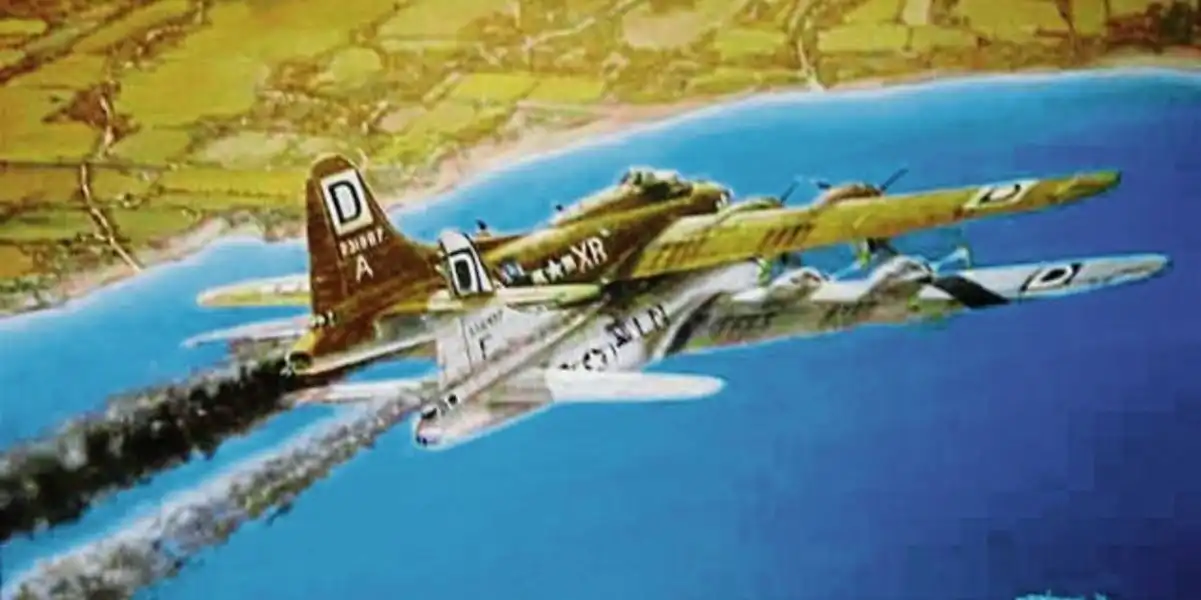
Photo credit: Hall of Valor at the Soldiers & Sailors Memorial Hall & Museum and War Thunder
The Stratojet
The B-47 Stratojet was the world’s first swept wing bomber and the first to use a bicycle arrangement landing gear, which was necessary because of the thin wings. It was also the first plane built solely for the delivery of nuclear weapons. The B-47 first flew on December 17, 1947 and the first B-47A was delivered to the USAF in 1951.
In May 1951 the B-47 began replacing the propeller-driven B-29s and B-50s in SAC’s medium bomber units. While it could carry about the same bomb tonnage as the aircraft it replaced, the B-47’s top speed was more than 200 mph faster. Since the B-47 did not have the range of SAC’s heavy bombers (the B-36 and later the B-52), Stratojet units regularly deployed to forward air bases around the world on temporary duty.
In addition to its role as a nuclear strike bomber, the Stratojet’s speed and payload made it a useful strategic reconnaissance aircraft in the form of the RB-47.
A milestone in aviation history
According to the National Museum of the US Air Force, between 1947 and 1957, Boeing, Douglas and Lockheed built over 2,000 Stratojets. At its peak use in 1958, the USAF operated 28 B-47 bomb wings and four RB-47 reconnaissance wings, totaling 1,357 B-47s and 175 RB-47s.
The Boeing B-47 Stratojet represented a milestone in aviation history and a revolution in aircraft design. In fact it incorporated many advanced features for the time, including swept wings, jet engines in underwing pods, fuselage mounted main landing gear and automated systems that reduced the standard crew size to three.
The two, cool videos in this post clearly show why B-47 crews loved this aircraft’s maneuverability and sweet handling for good reason.’
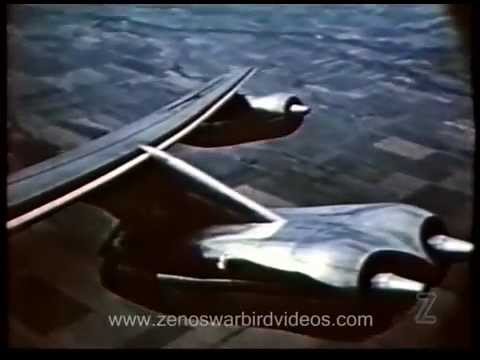
B-47 Stratojet bombers doing Immelmann Turns and Barrel Rolls
In 1954 the US Air Force (USAF) conducted a series of maneuver tests that showcased the B-47’s outstanding agility. These tests were specifically designed to explore the B-47s ability to “toss bomb.” The aircraft would approach the target low and at high speed, pull up sharply, open bomb bay doors, use momentum to literally fling the bomb towards the target and then execute the rest of a half loop Immelmann turn so that they were flying back in the opposite direction at the top of the loop.
This maneuver allowed the bomber to drop nuclear and high explosive weapons at low altitudes without danger of blast damage or flying directly over heavily defended targets. Seeing the big, sleek B-47 execute this maneuver (and barrel rolls too!) is truly memorable.
Cameras located all over the aircraft give unique views during the test flights.

LM-100J Super Hercules doing a loop
However, this is not the first time that we saw such a large aircraft performing aerobatic maneuvers: on Jul. 17, 2018 at Farnborough Airshow Test pilot Wayne Roberts, flying the Lockheed LM-100J Super Hercules, showed the aircraft amazing flying qualities (the aircraft in fact also did a loop!). CLICK HERE to watch the video!
The Blackbird
The SR-71, unofficially known as the “Blackbird,” was a long-range, Mach 3+, strategic reconnaissance aircraft developed from the Lockheed A-12 and YF-12A aircraft.
The first flight of an SR-71 took place on Dec. 22, 1964, and the first SR-71 to enter service was delivered to the 4200th (later 9th) Strategic Reconnaissance Wing at Beale Air Force Base, Calif., in January 1966.
Throughout its nearly 24-year career, the SR-71 remained the world’s highest-flying and fastest operational aircraft. From 80,000 feet, it could survey 100,000 square miles of Earth’s surface per hour.
Today the Blackbirds remain the world’s fastest and highest-flying production aircraft ever built. The Blackbirds were designed to cruise at Mach 3.2, just over three times the speed of sound or more than 2,200 miles per hour and at altitudes up to 85,000 feet.
There are many rumors about just how fast the SR-71 could go. As we have explained in a recent article, the late former Blackbird pilot David Peters pointed out that the SR-71 limiting speed was Mach 3.55.
The record flight
Former SR-71 pilot Raymond E. (“Ed”) Yeilding who, along with Lieutenant Colonel Joseph T. (“J.T.”) Vida as reconnaissance systems officer (RSO), on Mar. 6, 1990 established four National Aeronautic Association and three Fédération Aéronautique Internationale speed records during Lockheed SR-71A Blackbird serial number 61-7972 final flight from Air Force Plant 42 (PMD) at Palmdale, California to Washington Dulles International Airport (the aircraft was turned over to the Smithsonian Institution National Air and Space Museum), adds some interesting details on Blackbird limiting speed.
‘About Dave Peters flying Mach 3.4+ and a limit of Mach 3.55.
‘I’ll start by saying that I had great respect and admiration for Dave Peters and have no doubt that he flew Mach 3.4+ in an area of extreme cold. I certainly miss Dave!!!
‘On our speed record coast-to-coast flight, I allegedly said we didn’t exceed Mach 3.2 for fear of running out of fuel before landing at Dulles airport. I am certain that I have never said that to anyone. Our cruise speed was Mach 3.3 on that record flight. Fuel certainly was a limiting factor. We didn’t have enough fuel to cross the coast lines at top speed Mach 3.3, but most of the distance was at Mach 3.3.
Temperature almost always minus 56.5 degrees centigrade
‘I am very pleased with my narrative of that coast-to-coast speed record flight in Rich Graham’s SR-71 Blackbird Stories, Tales, and Legends published 2002, pages 221 – 227. I gave details about our speeds, fuel considerations, speed record times with average speeds, and conveyed the excitement that JT Vida and I experienced that special day.
‘In Graham’s book, I stated that our cruise speed was Mach 3.3, and at all my talks about our speed record flight, I always say that our cruise speed was Mach 3.3. Of our four records that day, our fastest average speed was 2,190 mph between St Louis and Cincinatti, only 3 mph slower than the absolute aircraft speed record set in 1976 and still stands.’
He continues;

‘Most of all our missions were in the stratosphere where the temperature is almost always minus 56.5 degrees centigrade. At that temperature, the speed of sound is 660 mph, so Mach 3.2 was usually 3.2 x 660 mph = 2,112 mph (not “more than 2200 mph” as in the article). However, as Dave said, big temperature deviations sometimes happened in the Arctic, Barent Sea, region. I personally never experienced extreme cold that required greater than Mach 3.2.
SR-71 Not designed to go faster than Mach 3.3
‘I have no doubt that Dave heard about a Mach 3.55 limit, but I never heard that. I checked with high time SR pilot and Test Pilot School graduate, BC Thomas, and he never heard that either. Our flight manual had no mention of speed above Mach 3.3.
‘When I asked the Skunk Works about their opinion of a one time last flight above Mach 3.3, three engineers lead by Von Wright drove up from Burbank to meet with me and JT in person. They said that the SR was not designed to go faster than Mach 3.3, it was never flight tested above Mach 3.3, and with an unstart above Mach 3.3, we might not be able to keep the pointed end forward. It might pitch up and break apart. They also said there is no fuel flow data above Mach 3.2 (not 3.3 as in the article).’
Yeilding concludes;
‘It turned out that fuel economy at Mach 3.3 and slightly higher altitude seemed exactly the same as at Mach 3.2 at best altitude for aircraft weight.’
Be sure to check out Linda Sheffield Miller (Col Richard (Butch) Sheffield’s daughter, Col. Sheffield was an SR-71 Reconnaissance Systems Officer) Twitter X Page Habubrats SR-71, Instagram Page SR71Habubrats and Facebook Page Born into the Wilde Blue Yonder Habubrats for awesome Blackbird’s photos and stories.

Photo credit: Stuart Freer and U.S. Air Force
The Hunt for Red October
The Hunt for Red October is a compelling and exciting Cold War thriller.
A new technologically-superior Soviet nuclear sub, the Red October, is heading for the US coast under the command of Captain Marko Ramius. The American government thinks Ramius is planning to attack. Lone CIA analyst Jack Ryan has a different idea: he thinks Ramius is planning to defect, but he has only a few hours to find him and prove it – because the entire Russian naval and air commands are trying to find Ramius, too.
The movie premiered on Mar. 2, 1990 and starred Alec Baldwin, former Royal Navy sailor Sean Connery, and US Marine Scott Glenn. The film was based on the novel by Tom Clancy published by the Naval Institute Press. The Naval Institute had never published original fiction but decided to take a chance on the unknown Clancy who was working as an insurance agent at the time. The novel became a national bestseller and the film earned a worldwide gross of over $200 million.
Every submarine geek has seen the movie and every submarine geek recalls when after Red October fails to appear for the exercise Captain Viktor Tupolev (the Commander of The Konovalov, a Soviet Alfa class submarine) orders:
“Go to 105% on the reactor.”
Navy Nuclear Propulsion Operator: ‘Sub reactor can run at higher than 100%’

Can a nuclear submarine reactor be run at higher than 100% like Tupolev does with the Konovalov to chase the Red October?
‘The answer is yes,’ E Franc, former US Navy Nuclear Propulsion Plant Operator (1988–1995), says on Quora.
‘Here’s the thing… on American subs, the captain has done every other officer’s job on the boat to get to that job; sub captains are extremely knowledgeable and competent technicians. (They usually lack people skills, however. The burden of the job simply destroys their personalities. I worked for submarine and surface commanders and by far sub commanders were the most difficult; so much so that if I were to encounter a former sub commander out and about on the town, I would excuse myself ASAP. We would not get along. I’ve been out 25 years and it hasn’t happened yet!) So, the captain is WELL aware of the precise design criteria of the plant and would not have to consult with the engineer concerning a decision like that.
Safety margins
‘Also, sub captains have Eyes Only documents to which they, and only they, are privileged. One of these docs is the actual capacity of the power plant and how to utilize that capacity if needed. Design operating safety margins (not test margins or max pressure and temperature margins) are usually 110–115% of actual practicable operating parameters simply to avoid stressing equipment. THESE SPECS ARE KNOWN BY THE CREW: THESE ARE NOT WHAT THE CAPTAIN IS PRIVY TO.’
He continues;
‘Now, if a captain of any nuclear-powered vessel of the American Navy were to order operation of a power plant to these classified parameters it had better be for a DAMN good reason or said captain will most certainly be relieved of command post haste. We are talking extreme time of war kind of stuff. The good news for the boat skippers is that the parameters for authorizing operating a reactor plant above practicable design limits is well defined by NAVSEA 08 (which is the Naval branch of the Department of Energy).
105% on reactor
‘All that being said, going to, “One hundred and five on the reactor” would not have achieved enough extra speed to be worth any risk to the ship and crew. The skipper would have ordered a specific turn speed of the main shaft with a “do not exceed 105%” order. For example, “All ahead flank so many turns, do not exceed xxx%.” This is because water temperature and depth will make a big difference concerning how many turns you get for such and such level of power.
‘Colder water is denser and makes for more resistance on the screw and therefore more power to achieve a given number of turns on the screw. However, due to the higher density of the water, slightly more distance is achieved per turn. There are charts to accommodate this. Also, at such high underwater speed, the sub would have made so much noise that EVERYBODY in the Atlantic would know exactly where that sub was and where to go to avoid it, especially Red October, and the Alpha could not have heard anything due to the flow noise, especially Red October.’
Franc concludes;
‘That stuff was not in the book (Tom Clancy knew better) but it made for great drama. Still one of my favorite movies.’
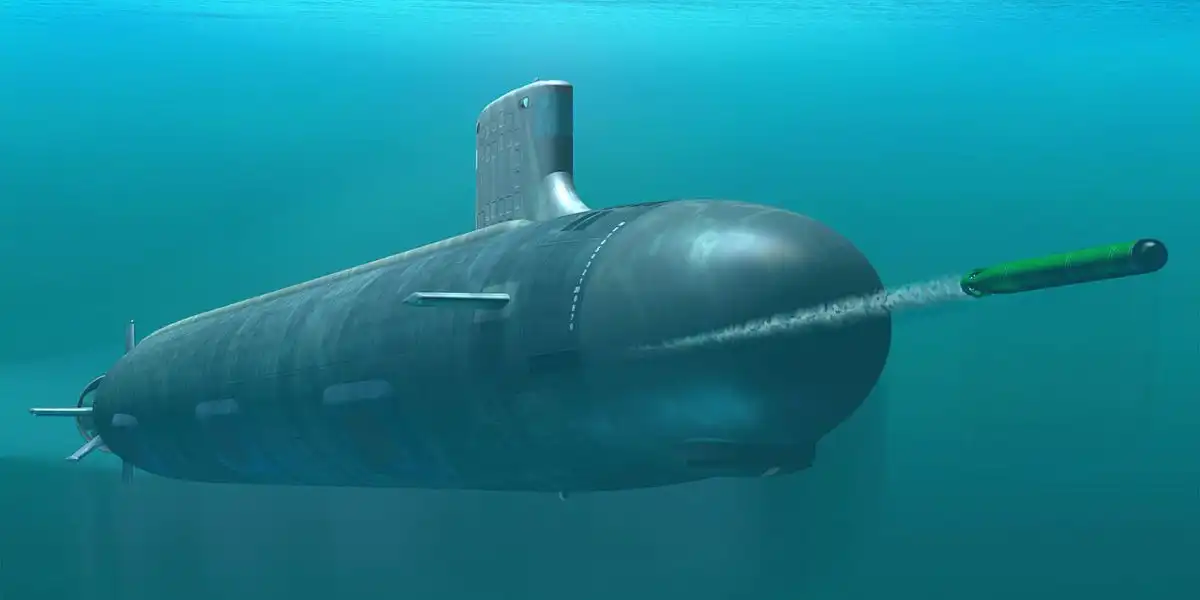
Photo credit: Paramaount Pictures and U.S. Navy
Flying the Line
Jay Lacklen is a retired Air Force reserve pilot with 12,000 military flying hours. He grew up in Arlington, VA, and graduated from the University of North Carolina-Chapel in 1969. He entered service in 1970 and retired in 2004 as a Lt Col with 12,500 flying hours. Lacklen taught Air Force T-1 pilot training simulators at Columbus AFB, Mississippi from 2005-2014. He grew up in Arlington, VA and graduated from the University of North Carolina-Chapel Hill in 1969. In addition to pilot training aircraft, he flew 330 hours in the C-7 Caribou, 2000 hours in the B-52 bomber, and 9,500 hours in the C-5 Galaxy transport.
He flew in all major military actions from Vietnam to the Iraq War. Lacklen lives in northern Virginia and is married with four adult daughters and two granddaughters.
Lacklen is also the author of three books, Flying the Line: An Air Force Pilot’s Journey, Flying the Line: An Air Force Pilot’s Journey Volume Two: Military Airlift Command and Flying the Line: An Air Force Pilot’s Journey Volume Three: Air Mobility Command. The following story comes the last book of the trilogy.
B-52 bomb run during Vietnam War
When asked if I killed anyone during the Vietnam War, I have to answer that I don’t know. I may have, and probably did, since my B-52 bomber crew dropped many thousand pounds of bombs on the Cambodian jungle, but I will never actually know.
I only flew two live bombing runs in August 1973, before President Nixon’s final bombing halt prior to the negotiations that ended our involvement in the war a few months later. But the first mission captured all the terror, anticipation, wonder, and angst of flying into a war.
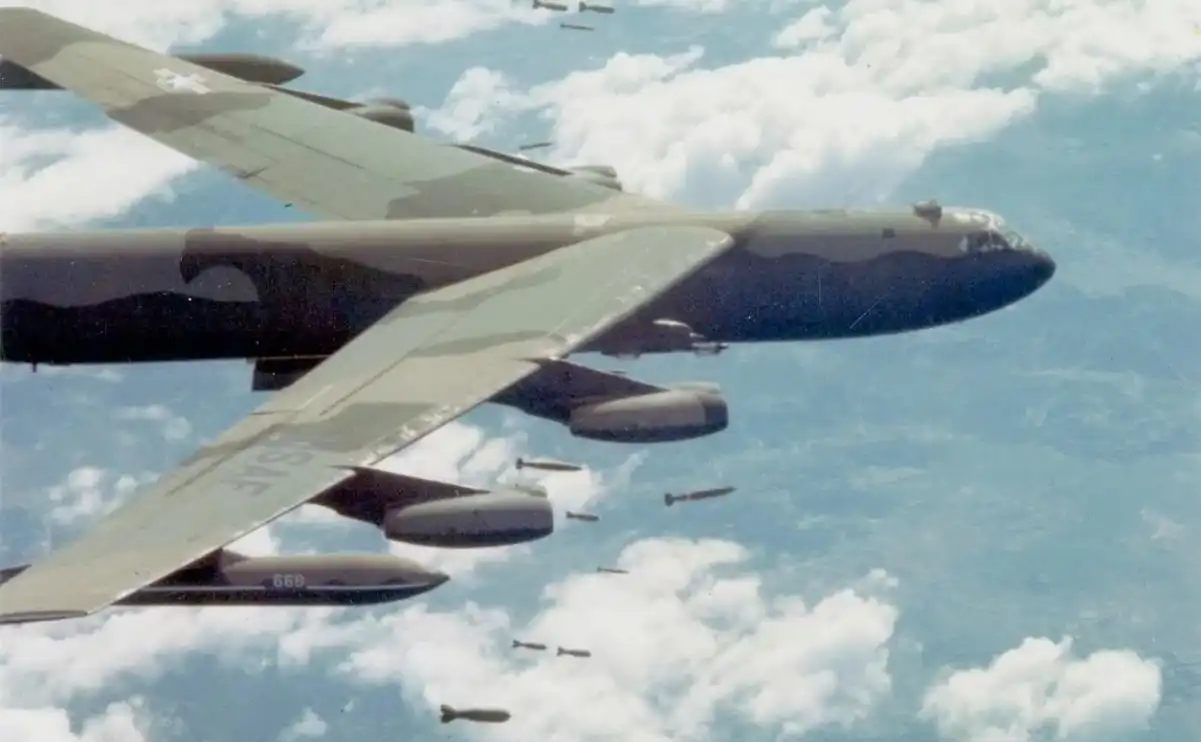
The mission began after dark at Andersen AFB, Guam, in the western Pacific Ocean. The crew bus dropped us at the hot loading zone on a far corner of a field, a remote location that would provide some protection for the base if something went wrong while loading over fifty thousand pounds of bombs in the bomb bay and on wing pylons of our B-52D.

A full moon painted the bristling black war bird in a ghostly light, a formidable metal dragon that would righteously drop explosive mayhem onto America’s enemies, or so I thought at the time. I paused and slowly put down my flight bag to stare in awe. Was I really a part of this? What was I about to do?
Six hours after takeoff, we approached the target area over the Parrot’s Beak region of Cambodia as one of a half-dozen three-ship bomber formations. Each cell was named for a tree. We were Oak Flight; others were Pine, Maple, and Birch.
Approaching the target area
As the lead aircraft copilot for my cell (for some unknown reason, I got to be lead on my first mission), I had to announce the impending bomb drop on “Guard,” the international radio frequency all-aircraft monitor. This would allow aircraft in the vicinity to vacate the area and avoid the “rain” of our falling bombs. (As an aside, this is the same rain referenced in the Creedence Clearwater Revival song “Have You Ever Seen the Rain?”)
I had been warned to switch my radio toggle from the interplane frequency to the Guard channel before transmitting the warning. Being a raw rookie, however, I gave the entire two-minute spiel on interplane, to the great amusement of the other copilots. “Hey, lead, want to try that on Guard?” they snickered on the interplane frequency.
Then the bomb run began in the early morning darkness over an Asian jungle. Our three-abreast, triangular-shaped formation banked steeply, ominously, onto the bomb run heading. The radar navigator, who would throw the switch to drop the bombs, informed the crew we were approaching the IP, or Initial Point, to begin the run.
Just as we passed the IP, a male Asian voice began transmitting in Cambodian on our radios. He sounded as if he were babbling in an opium den, and his voice disturbed and frightened me. I feared he might be an apparition warning us off our task, a voice of doom giving a last opportunity to save ourselves, or a soon-to-be victim in the target zone making his last hopeless statement to his slayers. He continued talking, as if relating a story to a fellow opium smoker, while our formation approached the target. No matter what I did to my radio controls, I couldn’t make the voice stop.
Bombs away!
In the near distance 33,000 feet below us, the ground glowed red, eerily, from explosions from preceding bomber formations. A mist hung over the terrain that gave the area the look of a graveyard in a horror movie.
The radar navigator began the countdown, “Ten . . . nine . . . eight,”—the apparitional voice continued his drunken soliloquy on the radio—“Three . . . two . . . one . . . bombs away!”
The aircraft shuddered lightly as the bombs unhooked from the wings and dropped from the bomb bays of our three aircraft in a ten-second release sequence that would obliterate an area equal to three football fields and unleash a shock wave that would kill any unshielded creature within half a mile. North Vietnamese soldier and author Bao Ninh later wrote that the immediate aftermath of such a strike resulted in “a rain of arms and legs dropping before him on the grass.
We waited as the radar navigator counted down to detonation, about fifty seconds for the bombs to fall 33,000 feet, “Three . . . two . . . one . . . impact!” The thin clouds around our aircraft reflected hundreds of small bursts of light from below. It was done.
The radar navigator announced the closing of the bomb bay doors.
We flew on in the darkness in silence as I pondered what we had done. I ponder it still.”
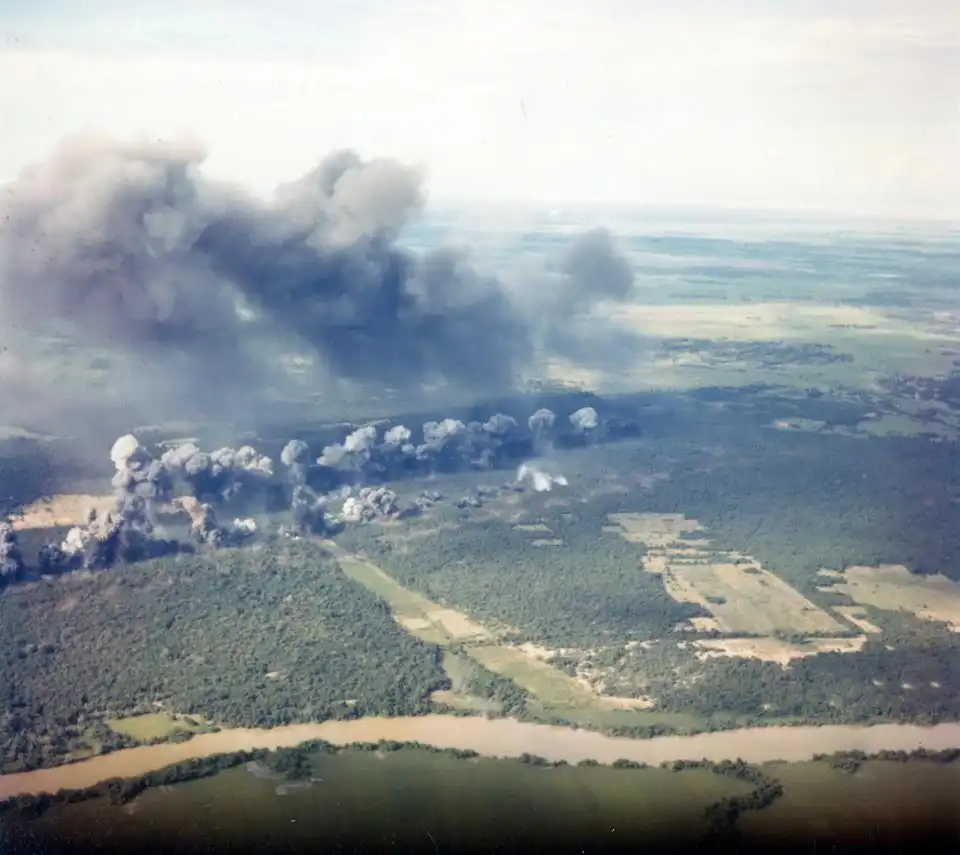
Photo credit: U.S. Air Force
Ejection seat
When an ejection seat may represent a crew member’s last chance to survive, there can be no compromise.
Ejection seats are placed into the cockpit and usually attach to rails via a set of rollers on the edges of the seat. During an ejection, these rails guide the seat out of the aircraft at a predetermined angle of ascent. Like any seat, the ejection seat’s basic anatomy consists of the bucket, back and headrest.
In most designs, the aircraft canopy comes off and the seat is propelled out of the aircraft by an explosive charge or rocket motor, carrying the pilot with it. Once clear of the aircraft, the ejection seat deploys a parachute. In two seat aircraft, the seats are ejected at different angles to avoid a collision.
Before ejection seats, pilots would have to remove the aircraft canopy manually to climb and jump out.
Ejection seats can save lives.
But does a military pilot get some kind of “punishment” if he ejects from a plane?
F-4 pilot punished for not ejecting
‘Other than the physical punishment, none that I know of. I was once punished for not ejecting from an F-4,’ Charlie Noak, former USAF F-4 Phantom II pilot, recalls on Quora. ‘In 1987 my right-engine had a massive overspeed due to its Fuel Flow Controller (this had never occurred in an F-4 before) failing to the full flow position. The engine’s exhaust gas temperature (EGT) went from normal to over 1,500 degrees F so quickly that by the time I pulled the throttle back to the close position, the engine had already exploded due to the high heat causing the turbine blades expanding and breaking off as they chewed into the engine’s protective casing.

‘The fireball extended from 100+ feet in front to 300+ feet out the back. The broken off turbine blades were twinkling in the afternoon sunshine. There was no continuing fire, so I headed back in a slow turn to land at the airfield I had just left. During my approach, the utility hydraulic pressure, which makes most every control surface of the plane work, began dropping in fits and starts, going to zero pressure slightly before I landed.
The most dreaded of all F-4 emergency procedures
‘Single engine failure with loss of utility hydraulic failure was the most dreaded of all F-4 emergency procedures – if you get low on glideslope on final, you would need to use afterburner on the good engine to climb back to the correct glideslope. If you apply afterburner, however, the plane will flip over, and drive you into the ground.
‘I stayed on the correct glide slope, and made a smooth landing (I was motivated). The deputy commander for operations (DCO) wanted to give me an article-15 (nonjudicial punishment) for not ejecting. However, the Phantom (F-4) fleet was grounded worldwide for FFC inspections, and seven were found to be on the verge of failure. Those were all replaced, and a new item was added to all major inspections. Twelfth Air Force thought I should be recognized for saving the airplane so that the problem was identified. As is usual in such cases, the “bad boy,” and the “atta boy” canceled each other out.’
Noak concludes;
‘Faced with the same problem today, I would do the exact same thing.’

Photo credit: U.S. Air Force and Michael Pereckas from Milwaukee, WI, USA via Wikipedia
DHC-4 Crashing after Take Off with Controls Locked
The shocking footage in this post is the result of A Poor (or no) Preflight: a crew of three was on board the DHC-4 Caribou, and no one checked the controls free and clear before starting t/o roll. It hurts to watch this video, but it’s a dramatic reminder that there really are good reasons to do a thorough preflight and to make sure the controls are free.
This happened just north of Winnipeg, and the DHC-4 aircraft was the first version with PT-6-67 Turboprops. (‘Modernized’ Caribou.) The Canadian DOT concluded that the control locks were still locked when the aircraft took off.
According to the video description it is physically impossible to advance the throttles (past 1800 RPM) aboard the Caribou with the gust-lock in — but this aircraft had been modified (still Restricted Category) and the throttle quadrant was not properly rigged to accommodate the throttle levers for the turbine engines.
US Army: Caribou largest operator
The DHC-4 Caribou was designed to provide military operators with a twin-engine STOL cargo transport aircraft with greater capacity than the Otter. The type also offered a rear loading capability.

The prototype DHC-4 Caribou (CF-KTK-X) was flown for the first time on Jul. 30, 1958.
The US Army was the largest operator of the DHC-4 Caribou. In 1961 De Havilland delivered the first 22 out of a total of 159 C-7s to the Army. Originally designated AC-1, the aircraft was redesignated CV-2 in 1962, and it retained that designation for the remainder of its Army service.
C-7
In January 1967, when responsibility for all fixed-wing tactical transports was transferred to the US Air Force, the Caribou received the designation C-7. During the Southeast Asia War, the Caribou’s STOL capability made it particularly suitable for delivering troops, supplies, and equipment to isolated outposts.
Some aircraft have been modified to turboprop power (two PWC PT6A-67T) by Pen Turbo Aviation and remain active in civilian and commercial hands.

U-2G
The US Air Force (USAF) jointly managed U-2 Dragon Lady development, testing and missions with the CIA from the start. Pilots for overflights of the USSR, though, were civilians working for the CIA. President Dwight D. Eisenhower believed sending military pilots over the USSR would be perceived as an act of war, so USAF Reserve fighter pilots voluntarily quit the service and went to work as CIA pilots. Officially, they were Lockheed test pilots.
Eventually the CIA flew 24 U-2 missions over the USSR, and numerous flights over other communist nations.
However, in the 1960s, U-2s could not reach certain remote targets because political difficulties prevented basing the aircraft in some foreign nations. The CIA and US Navy, therefore, studied the idea of launching U-2s from aircraft carriers.
Project Whale Tale fitted a few U-2s with arresting hooks at the rear of the fuselage. The hooks would snag cables strung across aircraft carrier decks and “capture” aircraft, bringing them to a quick stop.
To withstand rough carrier landings, Project Whale Tale U-2s were given stronger landing gear, and also wing spoilers to overcome the U-2’s tendency to glide instead of landing on the carrier deck. Aircraft thus modified were designated U-2G.
The first U-2 takeoff from a carrier took place on Aug. 5, 1963, from the USS Kitty Hawk, off San Diego, Calif. The first U-2 carrier landing occurred on March 2, 1964, aboard the USS Ranger.
U-2 aircraft carrier operation concept
As told by Kevin Wright in his book We Were Never There Volume 2: CIA U-2 Asia and Worldwide Operations 1957-1974, little more than two months later in May 1964, the US Navy and the CIA conducted the only operational use of the U-2 carrier operation concept under the unclassified code name Fish Hawk.
Det H commander Colonel William Gregory, was on board USS Ranger for the voyage, having selected personnel and much of the required equipment for the mission. The U-2s had quietly flown to Hickham AFB, Hawaii. Then the two U-2Gs (Art 348 and 362) flew out to join USS Ranger, piloted by Jim Barnes and Buster Edens. Arriving from Hawaii the two flew approaches and trapped landings onto USS Ranger to renew their carrier qualification. Their aircraft were equipped with the newly delivered 112B/Delta II and B cameras.
The aircraft had made radio silent arrival onto USS Ranger in an attempt to hide the operation. Even on the carrier, the two U-2s were kept in a secure area protected by Marines. Representatives from Eastman Kodak and NPIC were on board Ranger to process and assess the tracker camera imagery. The main mission film was to be returned to San Diego by A-3B Skywarrior as soon practicable.
French Polynesian nuclear test site at Mururoa atoll
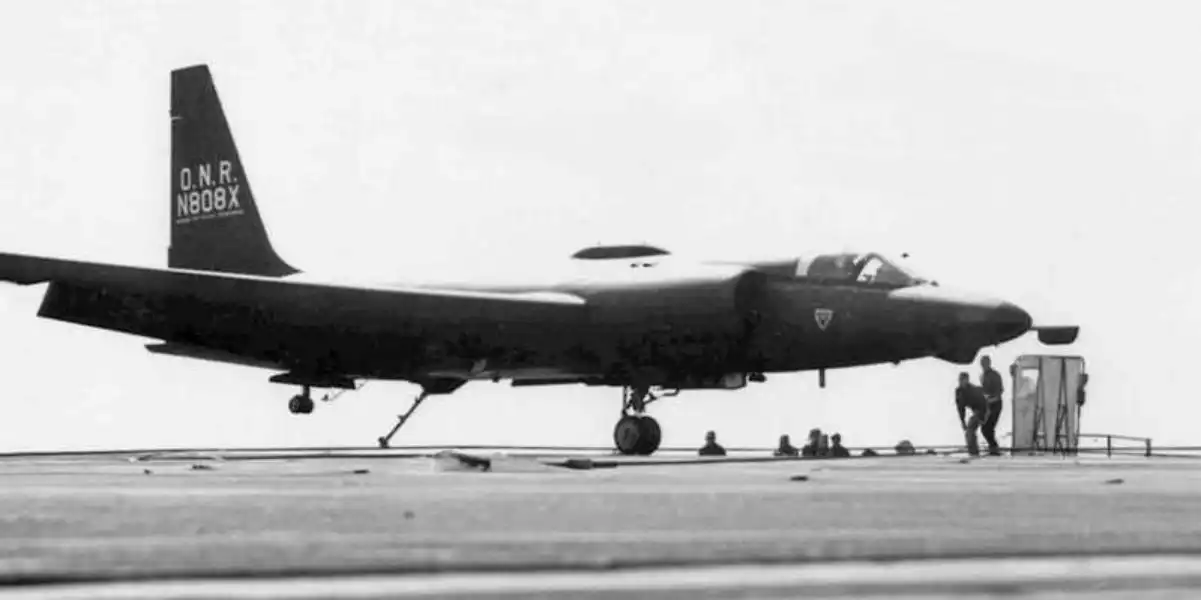
Their target was the newly constructed Polynesian nuclear test facility at Mururoa atoll in the Tuamotu archipelago. The French switched to the south Pacific after abandoning their original nuclear test site in Algeria.
US intelligence development agencies monitored the development of the French weapons programme. Following an announcement that Prime Minister Georges Pompidou would visit the site in July 1964, the CIA seized the opportunity to photograph the new facilities in the period before nuclear tests began.
The mission plan called for a single sortie, with the new 112B camera, and a small ELINT payload, with two backup flights in case of weather or technical issues. As USS Ranger approached 800 miles from the archipelago the aircraft was readied for the first flight. Two missions were planned. W224A flown by James Barnes on May 19, 1964 with Colonel Gregory recording W224A’s departure at precisely 0700L.
U-2 missions that spied over French Polynesian nuclear test site
Ranger’s radar soon lost contact with him as Barnes climbed to 68,000ft. His task was to cover the primary objective on Mururoa, and several secondary targets, mostly other atolls including Hoa which became an advanced support base. No opposition was expected as Barnes broke the usual cardinal rule of aerial opposition photo-reconnaissance and passed over the main target area twice. He flew over other atolls before imaging the settlement at Papeete, then turned north-eastwards to rendezvous with USS Ranger. He began his let down 100 miles before reaching the carrier and landed straight on.
The second mission, W234A, a repeat of the first, was flown on May 22 by Buster Edens. There had been significant cloud over some of the first mission’s target areas, but by combining both days imagery coverage of all the primary and secondary target areas was achieved.
After the completion of operations, USS Ranger headed to San Francisco. The U-2s departed as they arrived within range of land to touch down at NAS Almeda, then flying on to Edwards AFB.
Crash during aircraft carrier landing practice
On Apr. 26, 1965 veteran CIA pilot Buster Edens died when his U-2G crashed at Edwards AFB. He was due to carry out carrier landing practice on the simulated deck constructed there. On his first approach, he was told to cut power and extend spoilers by the LSO. On touchdown, his left wing touched the runway and dragged along it for some 50ft. Edens applied power and got airborne again and was told to gain altitude and check his aircraft. Just two miles from the control tower he appeared to enter a low-level spin and hit the ground.
We Were Never There Volume 2: CIA U-2 Asia and Worldwide Operations 1957-1974, is published by Helion & Company and is available to order here.

Photo credit: CIA, U.S. Air Force and U.S. Navy