In this article:
Barry Goldwater flying the two seat A-10
The silent 1970’s color film in this post depicts the prototype, two seat Fairchild Republic A-10 Warthog trainer jet aircraft (technically known as the YA-10B) developed for the US Air Force (USAF), during test flight takeoffs and landings. Flying in the second seat is USAF Major General and Arizona Senator Barry Goldwater, who was an advocate of aviation and the A-10 program. Many A-10s were based at Davis-Monthan AFB in Tucson, Arizona and the nearby test range is named in Goldwater’s honor. The YA-10B shown was the only one of its kind produced.
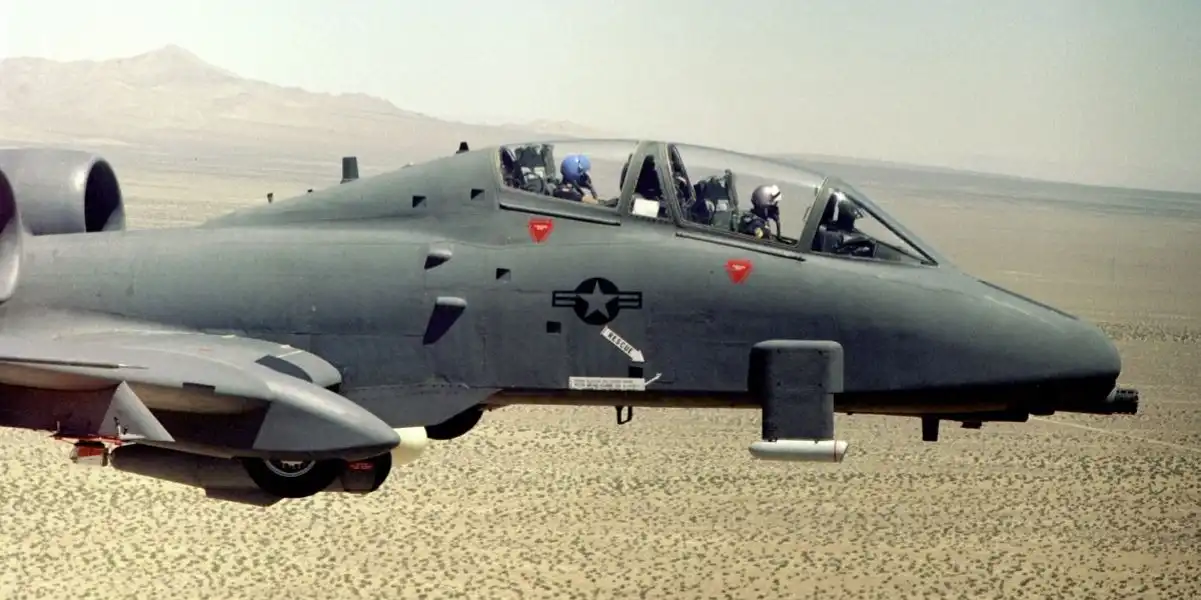
As we have already explained, in March 1979, the first preproduction A-10A (S/N 73-1664) was returned to the Republic factory for conversion to a prototype two-place variant of the A-10. The modifications took about three months and when complete, the aircraft was re-designated Night/Adverse Weather A-10. As the name suggests, the A-10 N/AW was designed to operate at night and during weather conditions unsuitable for the A-10A.
The only two seat A-10 Warthog ever produced

According to the National Museum of the United States Air Force, the modification work consisted of rebuilding the forward airframe to accommodate a second cockpit equipped with dual controls for the Electronic Warfare Officer. The canopy was changed from the clamshell type to a side-opening type divided between the cockpits by an “A-frame” structure. The A-10 N/AW was equipped with ACES-II type ejection seats designed to fire “thru-the-canopy.” A large cockpit fairing was added to house additional avionics components.
The Head-Up Display system was upgraded. A Forward Looking InfraRed system was added as well as a Low Light Level Television. Additional components added to support the night/adverse weather mission included a laser ranging device, terrain following radar, inertial navigation system, radar altimeter and an electronic moving map display. The FLIR and laser ranger were housed in an external pod mounted on pylon six (the center fuselage station). The terrain following radar was also housed in an external pod, in this case hung from station four (center wing closest to the left main landing gear). The LLLTV replaced the Pave Penny pod. The vertical stabilizers were rebuilt with a 20-inch extension added to the top. The aircraft retained the GAU-8/A 30mm Gatling Gun, but had a smaller ammunition drum with a capacity of 750 rounds.
Barry Goldwater
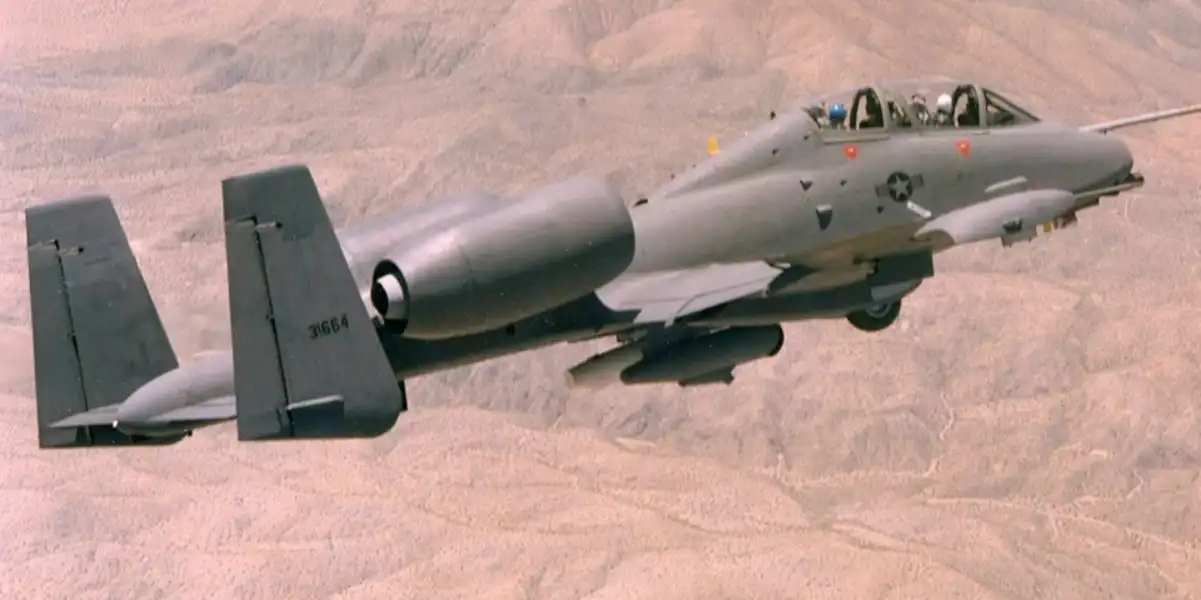
Flight testing of the A-10 N/AW, serial number 73-1664, began on Oct. 23, 1979, at the Air Force Flight Test Center, Edwards Air Force Base, Calif. During the Air Force Preliminary Flight Evaluation, which ended on Dec. 4, 1979, the aircraft was flown for a total of 48.6 hours during 28 missions. About one-third of the missions were conducted at night. Although the A-10 N/AW test program was successful, the program was canceled because of advancements in night attack equipment (i.e. LANTIRN). The A-10 N/AW was redesignated the YA-10B in the early 1980s.
Besides the A-10 N/AW, the USAF investigated the conversion of a limited number of A-10As into two-place trainer aircraft. These trainers were to be designated A-10B, but the program was canceled before any aircraft were modified.
The A-10 Thunderbolt II had its first flight in May of 1972, and was introduced into service in October of 1977. It remained in production until 1984. The A-10 was designed for close air support of ground troops, and is the only production-built aircraft that has served in the USAF for this purpose.
Barry Goldwater trained as a pilot and was assigned to the Ferry Command in WWII, including missions flying over the “Hump” into China. Following the war, Goldwater served in the reserves and eventually retired as a Command Pilot with the rank of major general. By that time, he had flown 165 different types of aircraft.
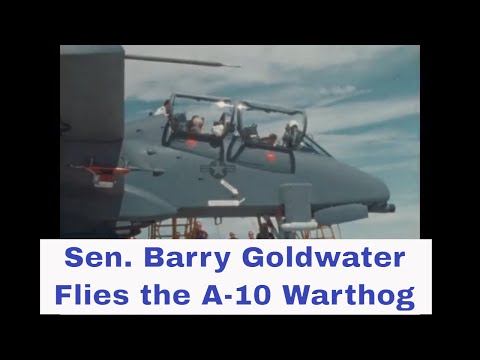
Photo credit: U.S. Air Force