
In this article:
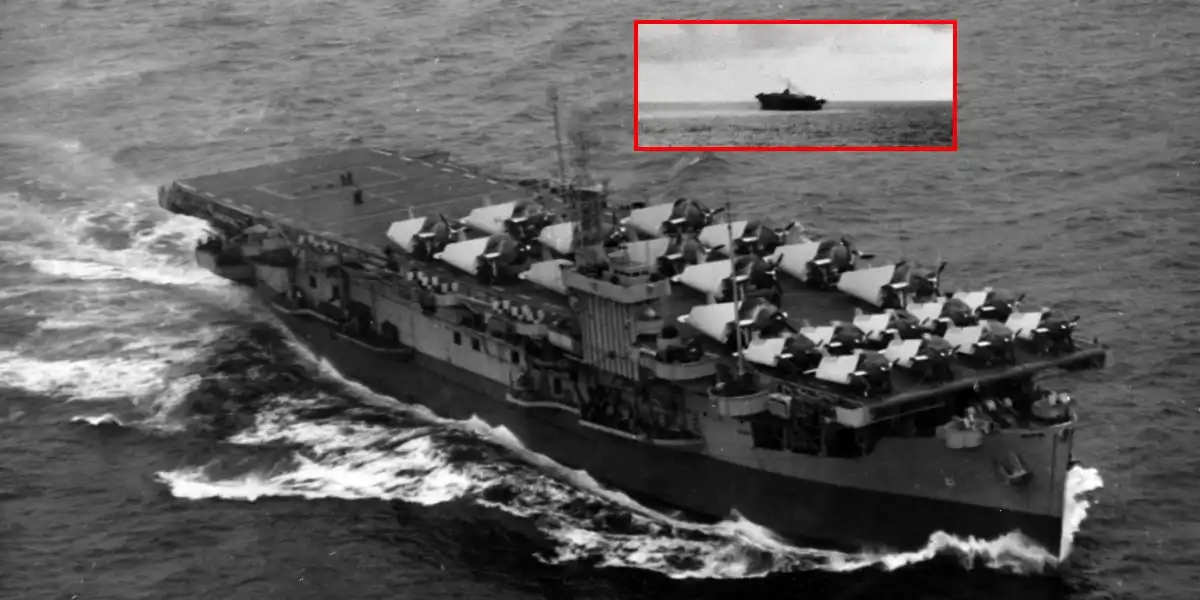
USS Block Island (AVG-21) was laid down under a Maritime Commission contract without a name on 19 January 1942 at Tacoma, Wash., by the Seattle-Tacoma Shipbuilding Co. The ship was named Block Island on 19 March 1942, launched on 6 June 1942; reclassified as an auxiliary aircraft carrier (ACV-21) on 20 August 1942 and commissioned on 8 March 1943.
After fitting out at the Puget Sound Navy Yard, Bremerton, Wash., USS Block Island exercised in Puget Sound for ten days and on 3 April sailed for San Diego, Calif. She made a two-day stop at San Francisco before pushing on to San Diego, where she moored on 9 April. Underway on 17 July with a convoy of eight troopships and escorts, USS Block Island (AVG-21) was detached on 26 July and tied up at Siddenham Airport, near Belfast, Northern Ireland.
On 5 November, Block Island and her escorts entered Casablanca, Morocco, to refuel, take on provisions, and share tactical intelligence. While Bogue (CVE-9) and Card (CVE-11) pioneered new antisubmarine warfare (ASW) techniques in the Battle of the Atlantic in mid-1943 USS Block Island (AVG-21) drew the task of ferrying aircraft to England. Mooring at Staten Island on 8 July, the warship took on board the shrouded hulks of Republic P-47 Thunderbolt fighters to be delivered to Europe. While there, she was reclassified an escort aircraft carrier (CVE-21).
As told by Mark Stille in his book Battle of the Atlantic (3), The Final Collapse of the U-Boats, 1943–45, for her third Atlantic combat cruise, USS Block Island was sent to the Atlantic to head one of the US Navy (USN)’s hunter-killer groups. Previously, Block Island made four deployments during which its aircraft and escorts sank four U-boats. Block Island’s final patrol, with three destroyer escorts, was made to the Central Atlantic.
Even late in the war, German U-boats remained dangerous and operating slow escort carriers in the middle of U-boat concentrations was not without its dangers.
Operating off the Canary Islands, it was sighted by U-549, which was conducting its second war patrol, on 29 May 1944. The U-boat evaded the escorts and was able to get a good firing solution on the carrier and fired three G7e torpedoes. Two hit the carrier, which was built on a cargo ship hull and did not possess extensive underwater compartmentation.
The damage was fatal, but only six crewmen were killed in the attack. The remaining 951 men were rescued by escorts. Block Island went down by the stern after being torpedoed by U-549. Two escorts stood by to rescue the crew: the destroyer escort Ahrens, a Buckley-class ship and Eugene E. Elmore, a Rudderow-class destroyer escort.
Shortly after Block Island sinking, Ahrens gained sonar attack on U-549 and guided Eugene E. Elmore to the scene to make an attack. Using Hedgehog launchers and depth charges, the destroyer escort destroyed U-549. The submarine sank with all 57 aboard.
Block Island was the only US Navy escort carrier lost in the Atlantic during the war.
Battle of the Atlantic (3), The Final Collapse of the U-Boats, 1943–45, is published by Osprey Publishing and is available to order here.
Photo credit: U.S. Navy

