
In this article:
Lack of fighter escorts for B-29s was a concern for the US Army Air Forces (USAAF) as their missions approached mainland Japan. According to Boeing website, one idea was to have fighters launched from aircraft carriers located closer to Japan to protect the bombers during the bombing raid. At the time no US Navy fighters had enough range to support the mission. The North American P-51 Mustang had become the premier long-range escort fighter by late 1943, but was not designed for carrier-based operations.
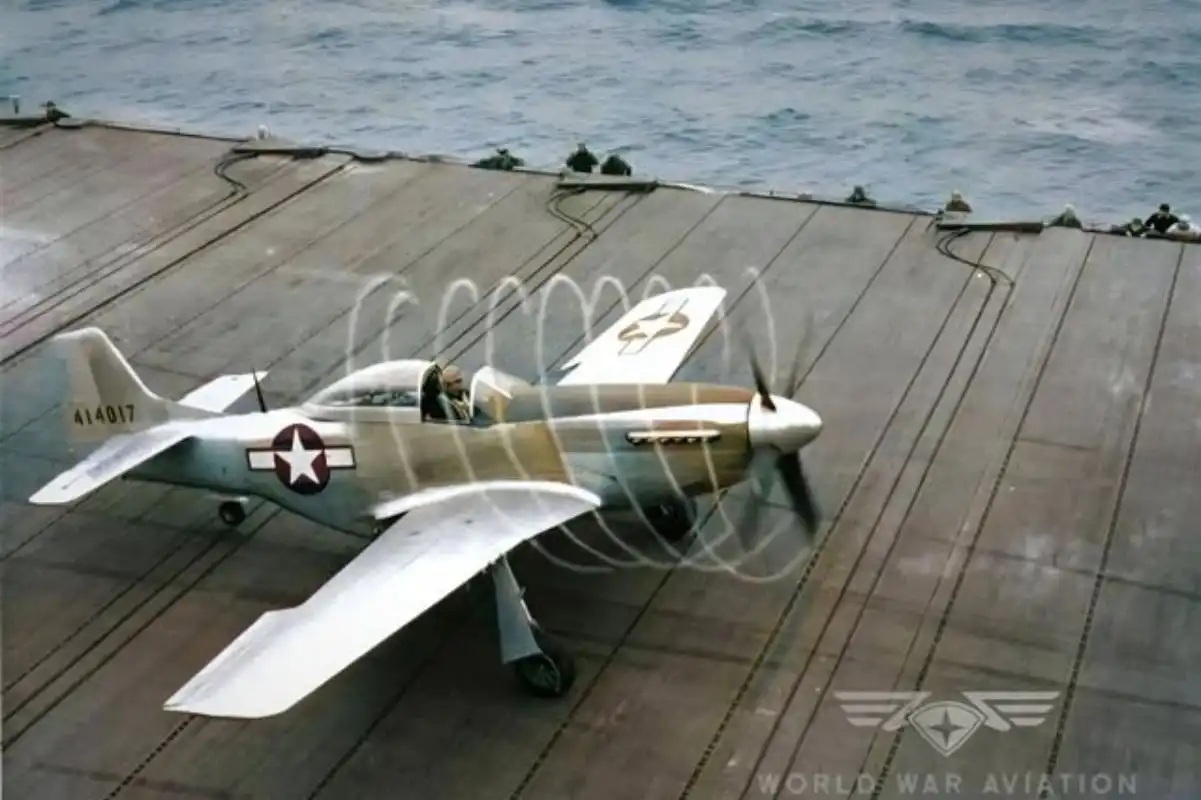
A classified program “Project Seahorse” was approved in 1943 and P-51D-5-NA, serial number 44-14017, was retained by North American Aviation in Dallas, Texas for modifications to create a navalized version of the P-51.
As told by Mark A. Frankel in the book North American Aviation Jet Age The Columbus Years 1941-1988, three components of flight testing include a location, one or more pilots, and an airplane. Mustin Field (1926-1963) was adjacent to the naval aircraft factory at Philadelphia. The object under evaluation was a barrowed P-51D Mustang bearing the tail number 44-14017. The date was October 1944, and Allied forces were finally starting to make headway in a two-front global war.
Areas on the runway were marked out, simulating the deck of an aircraft carrier. The simulation was made more realistic with installation of catapult and arresting cables. Unlike an aircraft carrier at sea, an airfield cannot maneuver into the wind (or accelerate) to gather additional headwind.
Seasoned Navy combat pilot Lt. Robert M. “Bob” Elder (1918-2008) was at the controls as over and over he rehearsed landings and takeoffs from the painted outline. Elder was born in Canada and attended the University of Washington in Seattle on a naval ROTC scholarship. Naval aviator wings were earned at Pensacola. Bob Elder became a champion of naval aircraft development, initially while still serving in uniform, and then as an aerospace executive later in life. His thumbprint remains on naval aviation to this day.
The ability of the B-25 Mitchell to take off from an aircraft carrier was demonstrated with Doolittle’s audacious raid on Tokyo in April 1942. When asked about the source of the attack, President Roosevelt responded with his biggest grin and a whimsical reference to “Shangri-la.” The warlords of Japan had picked the wrong Navy to embarrass in December 1941. By 1944, the US Navy fearlessly told the world the source of the Tokyo raid. Further, pending unconditional surrender, the empire of Japan should expect hell on earth, with ongoing mayhem on a massive scale.
Elder was not told of the purpose for this apparently dubious exercise. We know of it because of a typewritten report submitted to Los Angeles headquarters by the North American Aviation (NAA) Philadelphia factory field service representative. The event was further corroborated by photographs and an entry into the ship’s log of Shangri-La which was without air wing and on sea trials from Norfolk on Nov. 15, 1944.
Two aircraft participated. This time, the B-25 landed and brought a small team aboard the aircraft carrier. A tight-lipped Navy admiral observed the testing but said nothing.
Ship’s log- Shangri-La:
15 November 1944, 1220 hours
Lt, Robert M. Elder, USN, made the first carrier landing
of P-51 type fighter plane #414017, followed by three
landings and four takeoffs all successful.
The arresting cables were utilized for the gentle (low speed) landing. Takeoffs were without catapult assist. This Mustang, now dubbed “Seahorse” by the sailors, was taken below deck by elevator, and crew members were invited to take a closer look (Seahorse saw postwar service with the Pennsylvania Air National Guard).
An entirely new airplane, the ultra-long-range P-82 Twin Mustang, was in development at North American but behind schedule. Later in life, Elder postulated that the Mustangs aboard aircraft carriers were being evaluated to escort B-29 bombers over the Pacific on their way to Japan. This proved unnecessary, because close-in islands were captured and airfields hastily carved out; however. equipped with drop tanks and the aft fuselage fuel tank modification, the Mustang could fly unrefueled for 7.5 hours. Others speculate the Mustang was needed by the Navy because the early jets were fuel hogs lacking in combat range. In any case, as built, the P-51D Mustang was unsuited for service aboard an aircraft carrier.
The wings did not fold, a catapult connection was lacking, the airframe and systems were vulnerable to salt- induced corrosion, and the aft fuselage was insufficient to absorb arrested landings; however, after the deteriorating relationship with Curtiss, Navy brass were becoming enamored with a new provider. Jets were in the offing, and the North American-built solution was to be the FJ Fury.
North American Aviation Jet Age The Columbus Years 1941-1988 is published by Schiffer Publishing and is available to order here.
Photo credit: U.S. Navy and World War Aviation Facebook Page

