
In this article:
From the aircraft graveyards of Arizona to the defence of Ukrainian airspace: General David Deptula’s proposal has reopened the debate over the remaining capabilities of American fighter aircraft and the possibility of restoring a fleet of heavy interceptors to counter Russian air incursions.
Fifty, perhaps sixty F-15 Eagles. That is the number of aircraft the United States could theoretically make available to Ukraine under a proposal put forward by retired Lieutenant General David A. Deptula, a former senior figure in the US Air Force. Published on Forbes on 23 November 2026, the proposal is based on a straightforward consideration: while Kyiv is looking to expand its combat aviation fleet, the United States is gradually retiring some of its oldest F-15C/D fighters. A number of these aircraft have already been transferred to the Aerospace Maintenance and Regeneration Group (AMARG) facility at Davis-Monthan Air Force Base in Arizona.
Deptula suggests assessing how many of these aircraft could be recovered, upgraded and handed over to the Ukrainian Armed Forces. This is neither a decision by the US government nor an agreement already under way with the Pentagon. It is a proposal aimed at making use of an existing pool of aircraft rather than waiting for the production and delivery of new Western fighters.
The operational reasoning is straightforward. The Ukrainian Air Force has to sustain a particularly demanding mission tempo, alternating between national airspace defence, cruise missile interception, countering unmanned aerial vehicles and supporting ground operations. Yet the number of aircraft delivered does not necessarily reflect the number actually available for combat. Maintenance requirements, spare parts shortages, scheduled inspections and repairs can significantly reduce the number of fighters ready for operations. The same problem affects the Western F-16s already in Ukrainian service.
President Volodymyr Zelenskyy has repeatedly stressed the need for a substantially larger combat aviation component. According to Deptula, Ukraine would need approximately two and a half times as many fighters as it can currently keep airborne at any one time. The aim would be to compensate for maintenance requirements while ensuring a more persistent air presence.
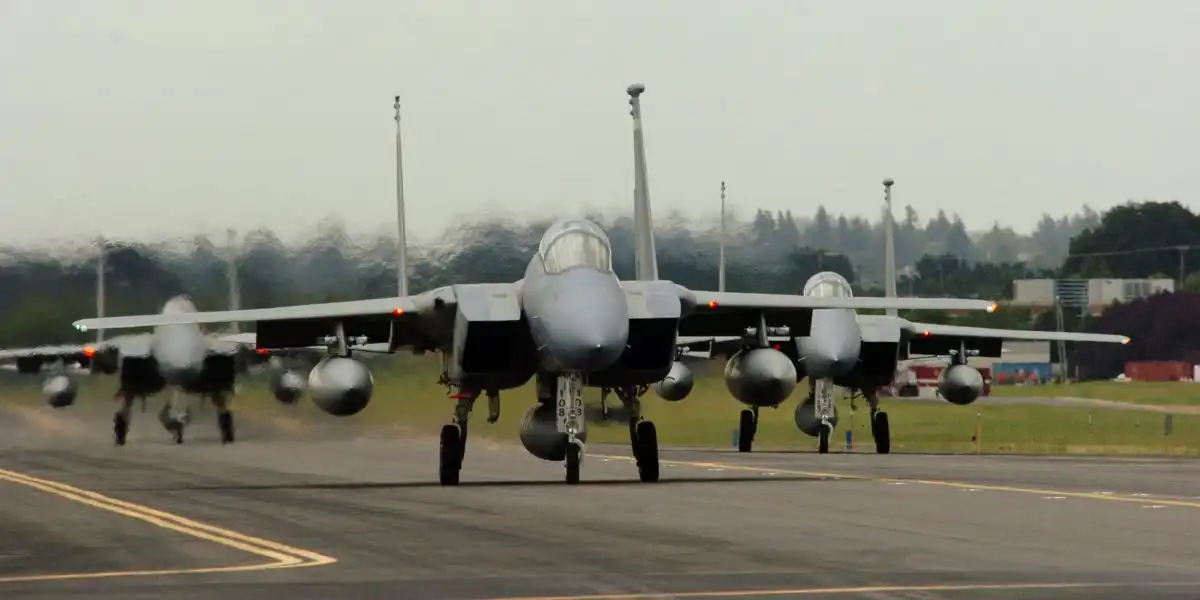
To understand the reasoning behind the proposal, it is worth looking at the F-15 itself. Introduced into service in the 1970s, the McDonnell Douglas F-15 Eagle was primarily designed as an air superiority fighter. Its twin-engine configuration, high thrust-to-weight ratio, maximum speed exceeding Mach 2 and impressive operational ceiling have made it one of the most important combat aircraft in the US Air Force inventory.
The single-seat C and two-seat D variants are the main versions dedicated to air superiority. They should not be confused with the F-15E Strike Eagle, developed for multirole missions and ground attack. In the Ukrainian scenario, Deptula is primarily referring to the interception capabilities of the C/D variants.
Armament is one of the aircraft’s most interesting features. The F-15C/D can carry up to eight air-to-air missiles, including AIM-9 Sidewinders and AIM-120 AMRAAMs, alongside an M61A1 Vulcan 20 mm cannon with a 940-round ammunition supply. That last figure is particularly noteworthy when compared with the F-16, whose cannon carries 511 rounds.
The difference is not merely a matter of ammunition capacity. A heavy interceptor such as the Eagle offers greater range, a substantial weapons payload and the potential to engage multiple targets during a single sortie, depending on operational conditions and the performance of the weapons employed.
Another important aspect is the radar. According to Deptula, a number of Air National Guard F-15Cs have been equipped with the APG-63(V)3 AESA radar. This active electronically scanned array system improves target detection, tracking and engagement capabilities compared with the mechanically scanned radars fitted to earlier generations.
Not every available F-15 necessarily has this configuration. Selecting the right aircraft would therefore be crucial. Transferring fighters with different avionics configurations without first standardising their systems could turn an initial advantage into a logistical headache.
Deptula’s proposed role for the aircraft is primarily defensive. F-15s could take on a substantial share of air defence missions, intercepting cruise missiles, jet-powered drones and other targets penetrating Ukrainian airspace.
The distinction also matters from an economic perspective. Using a relatively expensive surface-to-air missile to destroy a target worth considerably less presents a serious challenge for any air defence system operating on a daily basis. A fighter can offer an alternative, particularly when conditions allow an interception using its cannon or less expensive weapons.
This does not mean that the F-15 could replace ground-based missile systems. The two components have different capabilities and would need to operate as part of an integrated defence network. A fighter requires radar information, target identification, coordination with air traffic control and careful management of engagement zones. Its advantages become more apparent when it operates within a broader network comprising ground-based sensors, surveillance systems and missile batteries.
Integration with Ukraine’s existing air defence architecture would therefore be one of the essential conditions for the programme to succeed.
Deptula also envisages a redistribution of tasks within the Ukrainian fleet. By assigning a larger share of air interception missions to the F-15, the F-16s could be employed more flexibly in multirole operations. This would amount to a division of labour between different platforms rather than a straightforward replacement of one aircraft type with another.
The F-15 could also provide a way to absorb some of the personnel currently operating Soviet-designed MiG-29s and Su-27s, aircraft that are increasingly difficult to keep in service as wear and tear take their toll.
One of the most interesting aspects of the proposal is the potential availability of American aircraft withdrawn from active service. According to Deptula’s analysis, more than 240 F-15C/Ds are stored at AMARG.
The Davis-Monthan facility is widely known as the American military aircraft boneyard. It houses retired aircraft preserved for possible reactivation, stripped for spare parts or eventually sent for disposal.
However, the presence of an aircraft at this facility does not mean that it can immediately return to operational service. Storage procedures involve deactivating and protecting numerous systems. Bringing an aircraft back to flying condition requires inspections, work on onboard equipment, structural checks and thorough assessments of its engines.
The main concern is the remaining service life of the airframe. The F-15C/Ds being considered for transfer have accumulated decades of operational use. Flight hours, pressurisation cycles, structural loads and previous maintenance work would all have to be assessed individually. There would be little point in transferring an aircraft that, once restored, required structural work disproportionate to its remaining operational life.
There is, however, another possibility: recovering aircraft currently being withdrawn from Air National Guard units.
The Department of the Air Force has already approved the replacement of 54 F-15C/Ds assigned to three units: the 104th Fighter Wing in Massachusetts, the 144th Fighter Wing in California and the 159th Fighter Wing in Louisiana. These units are scheduled to receive F-35As and F-15EXs, depending on the relevant procurement and transition plans.
These aircraft could represent a more attractive option than some of those that have been sitting in storage for years. Even so, their actual suitability would have to be established through a comprehensive technical assessment programme.
The most demanding part of the operation might not be transferring the aircraft, but building the entire support system required to keep them operational.
Ukraine already has experience introducing Western aircraft into its inventory, but every new platform comes with its own requirements. The F-15 uses different engines, avionics, hydraulic systems, ground support equipment and maintenance procedures from those of the F-16.
A conversion programme for pilots would have to be established, specialist technicians trained, spare parts stocks organised and a continuous supply of engines guaranteed. Ground support equipment, technical documentation, test benches and facilities capable of carrying out higher-level maintenance would also be required.
Weapons supply is another issue. AIM-120 AMRAAMs and AIM-9 Sidewinders, together with the avionics configurations needed to employ them, would have to remain available throughout the programme. Delivering fifty aircraft without an adequate supply chain would mean creating a sizeable fleet that might prove difficult to sustain.
Maintenance could be divided between Ukrainian facilities and specialist centres located abroad. The latter option would reduce the need to concentrate all technical capabilities in territory exposed to Russian attacks. However, it would also introduce additional delays when transporting components and returning aircraft to operational service.
The main advantage of Deptula’s proposal is time. Production of new Western fighters is already constrained by demanding delivery schedules and growing international demand. The F-16, Gripen and Rafale are all potential options for Kyiv, but expanding the fleet requires industrial agreements, funding and available production capacity.
Retired F-15s could help reduce at least some of these delays, provided the selected aircraft can be restored and Washington is willing to finance the entire operation.
The question remains: how much would it cost to bring fifty or sixty aircraft back into service, including pilot training, spare parts, infrastructure and long-term logistical support? Without a comprehensive cost assessment, comparing the proposal with the purchase of new fighters would be misleading.
There is also a political dimension. Transferring an aircraft fleet of this size would require a major decision by the United States, with implications for relations with Moscow and for the management of the US Air Force’s own resources. The availability of retired airframes does not automatically translate into a political willingness to hand them over.
Deptula’s proposal nevertheless deserves serious consideration because it addresses a tangible problem: Ukraine’s difficulty in maintaining a continuous air presence while Russian pressure on infrastructure and urban areas continues to increase.
Fifty F-15s would not automatically change the balance of the war. They would not guarantee air superiority or eliminate the threat posed by Russian missile systems and combat aircraft. They could, however, significantly strengthen Ukraine’s interception capabilities, particularly if integrated into a wider air defence network and supported by a reliable logistics chain.
The question, then, is not simply how many Eagles are still available in the Arizona desert. It is how many could return to flight, for how long and at what cost. The difference between a fleet of fifty aircraft on paper and fifty interceptors actually ready for combat lies entirely in those answers.
Photo credit: U.S. Air Force
Military Aviation

