
In this article:
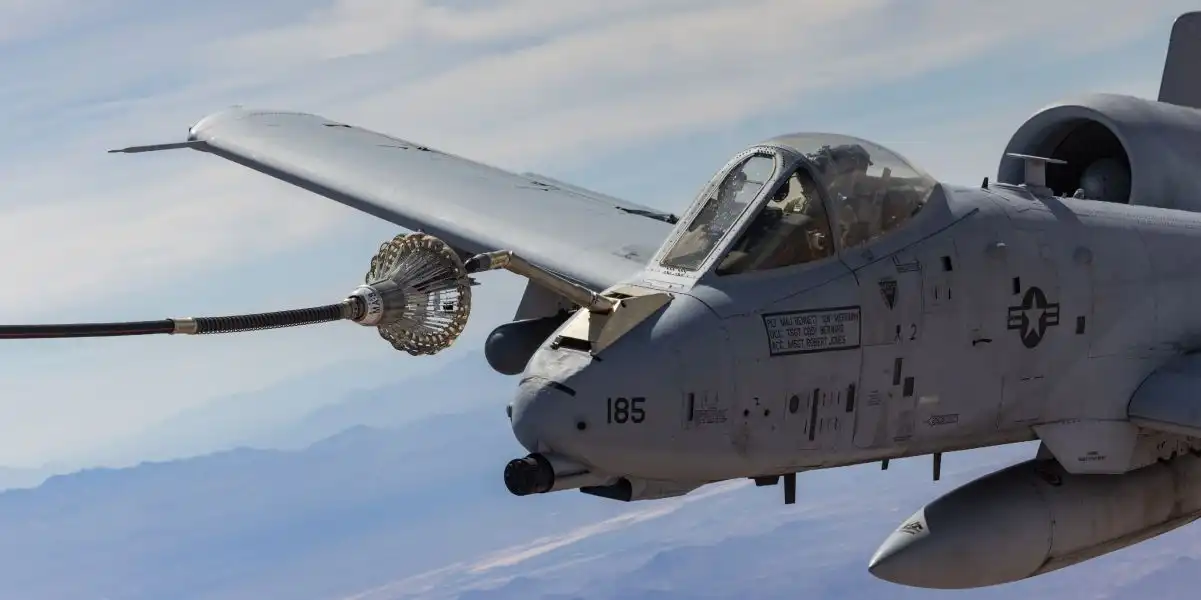
The Air National Guard Air Force Reserve Command Test Center led a rapid multi-organization effort that delivered probe and drogue air refueling capability to the A-10 Thunderbolt II, responding to an urgent combatant command requirement.
The Probe Refueling Adapter addresses operational availability of aerial refueling in theater, expanding refueling options for deployed A-10 units.
The adapter fits into the air refueling receptacle on the nose of the A-10, converting the aircraft from its standard boom refueling configuration to a probe and drogue system. The modification allows A-10s to refuel from HC-130 tankers, significantly expanding refueling options for deployed units.
The capability gap emerged from limited aerial refueling pairing options available to mission planners. With KC-10 tankers retired and KC-46 certification pending, A-10 units remained dependent on KC-135 aircraft for aerial refueling. The probe adapter enables A-10s to refuel from C-130 tankers, whose airspeeds and altitudes prove more compatible with A-10 operations and whose mission sets align more closely with close air support and combat search and rescue operations.
As reported by, SMSgt Charles Givens, Air National Guard Air Force Reserve Command Test Center, in the article AATC leads multi-organization team, fields refueling probe for A-10s in record time, AATC coordinated the effort across multiple organizations to compress development timelines. An industry partner developed and built the probe adapter while the A-10 System Program Office provided engineering oversight for aircraft integration.
ARCWERX enabled rapid contract acquisition, and Luke Air Force Base fabricated supporting components to accelerate delivery. The 418th Flight Test Squadron provided the HC-130 tanker and crew for the first refueling mission.
“Once the combatant command issued the requirement, all of the standard acquisition processes began immediately, but everyone involved understood the urgency,” said Lt. Col. Luke Haywas, Director of Test for AATC. “The SPO, ARCWERX, industry partners, and supporting units each brought critical expertise to the effort. Nothing was shortcut or compromised from a technical or safety standpoint. We just accelerated every step we could.”
The probe adapter represents a field-configurable solution designed for installation by operational flight line personnel. Units can install or remove the adapter in a matter of hours, allowing aircraft to be reconfigured between boom and probe refueling capability based on mission requirements.
The compressed timeline reflects an operational reality where the speed of capability delivery increasingly determines whether the Air Force maintains its warfighting advantage.
The chairman of the Joint Chiefs of Staff, USAF Gen. Dan Caine, said on Mar. 19 that the US Air Force (USAF) A-10 Thunderbolt II close air support (CAS) aircraft were being used to engage in maritime interdiction operations along the southern flank of Operation Epic Fury, targeting Islamic Revolutionary Guard Corps (IRGC) fast-attack watercraft in the Strait of Hormuz.
The A-10 also supported Operation Epic Fury by conducting strafing runs over Iranian-backed PMF (Popular Mobilization Forces) positions at Mosul.
Additionally, A-10 Warthogs performed the Sandy role for the CSAR mission aimed at finding the WSO of the downed F-15E over Iran on Apr. 3. During such mission, an A-10 crashed in the Persian Gulf.
Noteworthy, the Congress has moved to save the mighty Warthog from the USAF divestment efforts. In fact, the service’s plan to retire the remaining fleet has been blocked by the National Defense Authorization Act for Fiscal Year 2026 that mandated a minimum inventory of 103 A-10s through Sep. 30, 2026, and requiring detailed transition planning.
Moreover, as already reported, more A-10s joined Operation Epic Fury after on Mar. 30, 12 Warthogs were spotted landing at RAF Lakenheath, Suffolk, UK, before heading towards the Middle East.
The A-10C (dubbed Warthog by her aircrews) offers excellent maneuverability at low airspeeds and altitude while maintaining a highly accurate weapons-delivery platform. They can loiter near battle areas for extended periods of time, are capable of austere landings and operate under 1,000-foot ceilings (303.3 meters) with 1.5-mile (2.4 kilometers) visibility. Additionally, with the capability of carrying precision guided munitions and unguided munitions, they can employ above, below and in the weather. Their wide combat radius and short takeoff and landing capability permit operations in and out of locations near front lines. Using night vision goggles, A-10C pilots can conduct their missions during darkness.
Thunderbolt IIs have Night Vision Imaging Systems (NVIS), goggle compatible single-seat cockpits forward of their wings, Helmet Mounted Cueing Systems, and a large bubble canopy which provides pilots all-around vision. The pilots are protected by titanium armor that also protects parts of the flight-control system. The redundant primary structural sections allow the aircraft to enjoy better survivability during close air support than previous aircraft.
The aircraft can survive direct hits from armor-piercing and high explosive projectiles up to 23mm. Their self-sealing fuel cells are protected by internal and external foam. Manual systems back up their redundant hydraulic flight-control systems. This permits pilots to fly and land when hydraulic power is lost.
Photo credit: SMSgt Charles Givens / U.S. Air Force

