
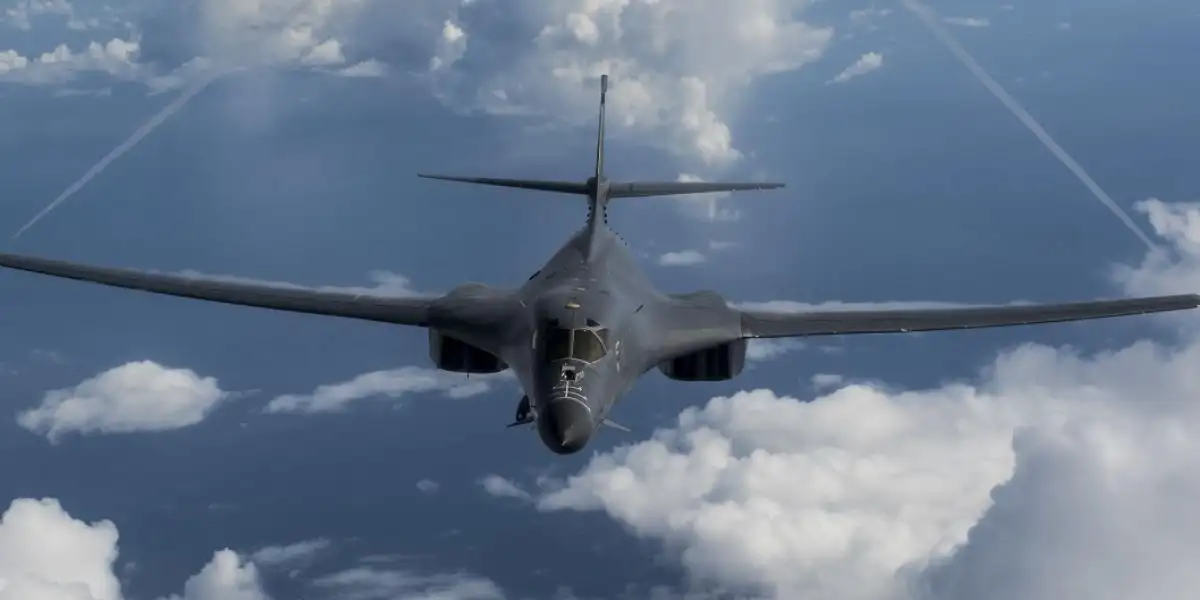
On Oct. 2, 2017, two U.S. Air Force (USAF) B-1B Lancer strategic bombers based at Andersen Air Force Base (AFB), Guam, conducted a bilateral integration training mission with the Royal Australian Air Force (RAAF) as part of Exercise Black Dagger near Townsville in North-Eastern Australia.
The 12-hour mission, included the use of simulated and inert weapons directed by Australian Joint Terminal Attack Controllers (JTACs).
“The Australian and U.S. air forces continue to work toward safeguarding security and stability in the region with missions focused on integrated operations,” said Brig. Gen. Stephen Williams, Pacific Air Forces Director of Air and Cyberspace Operations. “Joint exercises like these validate our ability to train and operate together seamlessly and ensures our ability to collectively respond cohesively if necessary.”
As explained in the article U.S. Air Force bombers integrate with RAAF in Exercise Black Dagger, during the drill, the B-1 aircrews maintained contact with RAAF JTACs on the ground in order to safely and effectively deliver firepower when and where determined by the Australian team.
“Participating in tactical training with our American counterparts continues a legacy of combined military training activities that stretches back several decades,” said Air Vice Marshal Roberton, DSC, AM, the Royal Australian Air Force Air Commander Australia. “This exercise, and others like it, demonstrate our commitment to continuing to hone our skills as airmen.”
Carrying the largest conventional payload of both guided and unguided weapons in the Air Force inventory, the multi-mission B-1 is the backbone of America’s long-range bomber force. It can rapidly deliver massive quantities of precision and non-precision weapons against any adversary, anywhere in the world, at any time.
Photo credit: Airman 1st Class Gerald R. Willis and Tech. Sgt. Richard Ebensberger / U.S. Air Force
Artwork courtesy of AircraftProfilePrints.com
Military Aviation