In this article:
The Moon is Ours

A four-word phrase, accompanied by an image of the Moon and the American flag, may seem like nothing more than a slogan. But when it is published by the President of the US, in the midst of a new phase of the space race, it inevitably becomes something more interesting to analyze.
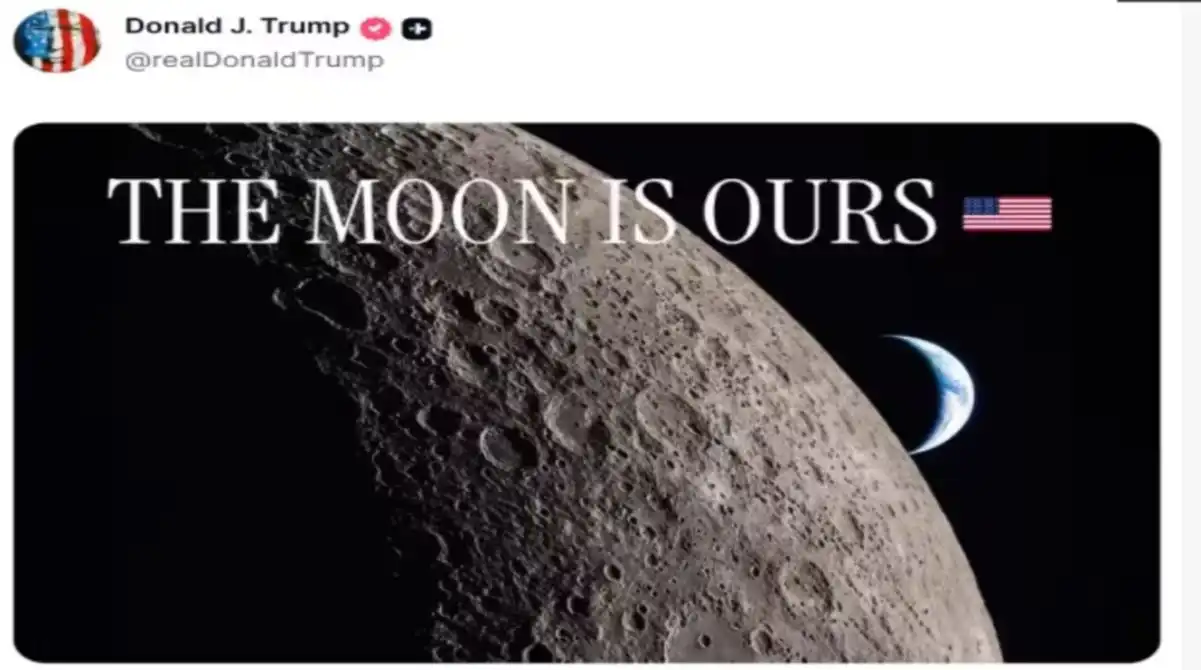
On Sep. 6, 2026, Donald Trump published on Truth Social an image of the lunar surface with the words “THE MOON IS OURS” and an American flag. The content is documented both by the archive of presidential communications and by the archive of the original post.
The first thing to clarify is therefore also the most important one: there is no declaration by which the United States has transformed the Moon into its own territory, nor does that phrase in itself constitute a legal proclamation of sovereignty. If, however, we were to take it literally as a territorial claim, the problem would be immediate: international space law says exactly the opposite.
The starting point is the 1967 Outer Space Treaty, which still constitutes the fundamental framework of international space law today. Its Article I establishes that the exploration and use of outer space, including the Moon and other celestial bodies, shall be carried out for the benefit and in the interests of all countries and that outer space is free for exploration and use by all States, with free access to all areas of celestial bodies. Article II is even more explicit: the Moon and other celestial bodies cannot be subject to national appropriation by means of a claim of sovereignty, occupation, use or by any other means.
Commercially using space resources
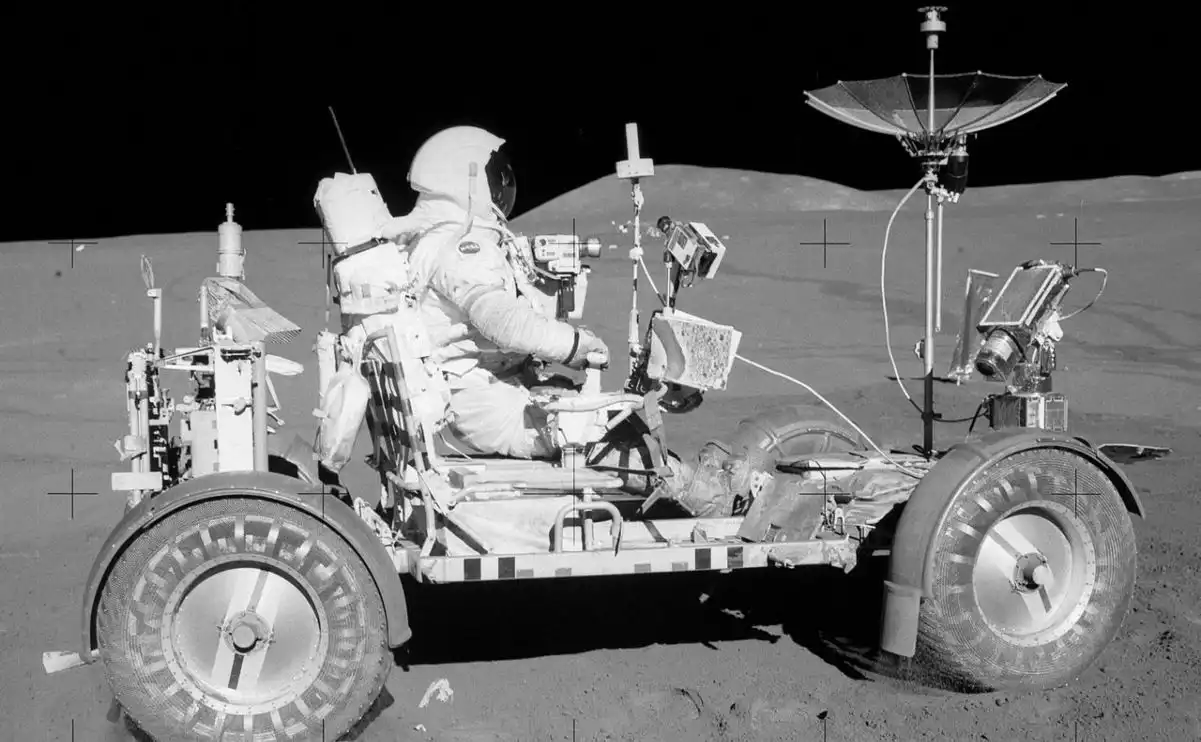
In other words, no one can arrive on the Moon, plant a flag and say: “from here to there is national territory.” The American flag on the Moon may represent a mission, a technological achievement or a human presence; it does not transform the ground into United States territory.
This, however, does not mean that the Moon is legally irrelevant or that all of its resources automatically belong to some world authority. And this is precisely where the most interesting part of the story begins.
The United States has in fact developed for years a precise position on the possibility of commercially using space resources. In 2015, the United States Congress passed the Commercial Space Launch Competitiveness Act, introducing into Title 51 of the US Code Chapter 513 on the commercial exploration and utilization of space resources. The law defines space resources as abiotic resources in situ in outer space, explicitly including water and minerals, and establishes that a United States citizen engaged in the commercial recovery of a space resource may possess, transport, use and sell the resource obtained, consistent with applicable law and the international obligations of the United States.
And there is a significant detail: the same law specifies that, through that legislation, the United States does not assert sovereignty, sovereign rights, or exclusive jurisdiction over, or the ownership of, any celestial body.
The distinction is fundamental: one thing is to own territory; another is to extract a resource from territory that cannot be appropriated.
Moon Agreement
In 2020, during the previous Trump administration, Executive Order 13914 reinforced this approach, supporting the need to encourage the exploration and commercial use of space resources, including lunar water and certain minerals. The order also emphasized that the United States did not regard outer space as a “global commons” in the sense of collective property subject to a common management regime and instructed the State Department to promote international agreements concerning the use of resources.
The issue, however, is not legally settled. There is in fact the 1979 Moon Agreement, which adopts a more restrictive approach toward lunar resources. Article 11 considers the Moon and its natural resources to be the “common heritage of mankind” and provides that natural resources in place shall not become the property of States, organizations or natural persons. The same article provides for the establishment of a future international regime to govern their exploitation when this becomes practically possible.
The United States has not ratified the Moon Agreement and its international participation is much more limited than that of the Outer Space Treaty. For this reason, different interpretations currently coexist concerning the relationship between the non-appropriation of celestial bodies and ownership of extracted resources. The United States position is that extracting a resource is not equivalent to appropriating the celestial body; other scholars and States have expressed more restrictive interpretations. There is therefore no simple formula according to which “the Moon belongs to everyone” or “whoever extracts owns everything”: the legal framework is more complex and will probably continue to be tested by the first large-scale commercial activities.
And this is precisely the point: the real lunar contest is not necessarily about ownership of the Moon. It is about access to the Moon.
Moonlight Mile
Because today we are not returning to our satellite merely to plant a flag. We are returning because the Moon can become infrastructure.
The change compared with the first space race is enormous. In the 1960s, the Moon represented above all a destination. Today it can become a node in a future cislunar economy, meaning that region of space between Earth and the Moon and including the orbits, gravitationally interesting points, stations, communication systems and infrastructures that could connect our planet to its satellite.
NASA’s Artemis program represents one of the principal architectures of this new phase. The Artemis Accords, established in 2020, constitute a set of principles for civilian cooperation in the exploration of the Moon and beyond. NASA identifies among their fundamental elements peaceful exploration, transparency, interoperability, assistance to astronauts, sharing of scientific data, utilization of space resources, prevention of harmful interference and debris management.
This is a fundamental step.
Before building cities on the Moon, it is necessary to build invisible roads: communications, navigation, synchronization, data relay, positioning capabilities, orbital transport and logistics.
This is where the concept of the “Moonlight Mile” becomes interesting as an interpretive model. It is not the official name of a single international infrastructure, but it can describe a future “cislunar highway” composed of many interconnected infrastructures: communication and navigation satellites, orbital stations, transport systems, propellant depots, scientific bases, energy facilities, landers, rovers and connections with Earth.
NASA is developing Gateway, a lunar-orbiting station designed as a platform for surface missions, scientific research and future deep-space exploration. The station involves international partners including ESA, JAXA, CSA and MBRSC.
The Moon, therefore, is beginning to look less like an isolated destination and more like a logistics system.
China’s International Lunar Research Station
And this also explains why the new lunar race is not merely American.
China is developing its own architecture, the International Lunar Research Station, ILRS, together with Russia and with the expected participation of other partners. CNSA describes the ILRS as a complex scientific facility, consisting of surface and/or lunar-orbit elements, intended for multidisciplinary research, resource utilization, observation and technological verification. The Chinese roadmap envisages a construction and development phase aimed at a basic configuration by 2035 and subsequent expansion.
It is particularly significant that energy, communications, navigation and transportation systems appear in the same Chinese description. In other words, Beijing also sees the Moon not simply as a place where experiments will be conducted, but as an environment in which permanent infrastructures will have to exist.
Artemis and ILRS are not simply two competing scientific programs. They are two different international architectures, capable of attracting countries, industries, universities and technological capabilities around different standards, infrastructures and logistical chains.
Russia maintains a role in the ILRS project, but its overall capabilities must be considered in the context of the difficulties and changes that have affected the Russian space sector. India, on the other hand, has demonstrated particularly significant autonomous lunar capabilities through the Chandrayaan program, including attention to the polar regions. Chandrayaan-2, for example, specifically targeted the study of the lunar south pole, and its orbiter continued operating well beyond the initially planned duration.
Europe: a different position
Europe finds itself in a different position. It does not possess the same level of autonomous strategic lunar capability as the United States or China, but it has fundamental expertise in satellites, robotics, telecommunications, navigation, planetary science, support systems and components of Artemis missions. The Moonlight project and future European robotic missions, such as MAGPIE, demonstrate precisely this strategy: developing specific capabilities that can become elements of a broader international lunar infrastructure. MAGPIE, planned for 2029, will be dedicated to studying the lunar south pole, with instruments to detect water and other volatiles and analyze the geology of the subsurface.
And then there is a resource that has fueled fascination with the Moon for decades: helium-3.
Helium-3 is a rare isotope of helium, present in much greater quantities in lunar regolith than on Earth because the solar wind has bombarded the lunar surface for billions of years. Recent studies have even investigated the mechanisms through which helium becomes trapped in iron particles produced by space weathering.
The reason helium-3 attracts so much interest is nuclear fusion.
A deuterium-helium-3 reaction can mainly produce charged particles and reduce the neutron flux compared with deuterium-tritium fusion. In theory, this could have advantages in the engineering of a future reactor. But here it is essential to distinguish possible physics from real-world economics.
There is currently no industrial lunar helium-3 supply chain and there is no commercial D-³He fusion reactor that can be fueled with material extracted from the Moon.
The technological chain would be enormous: regolith extraction, concentration, heating, helium release, recovery, isotopic separation and transport. A scientific review published in 2026 specifically emphasizes that, despite progress in the study of individual stages, a continuous supply chain from lunar regolith to high-purity helium-3 has not yet been demonstrated.

The oil of the Moon
Estimates of the overall quantity of helium-3 must also be treated cautiously: its concentration in regolith is extremely low and its distribution varies according to lunar geology. The global estimates available are therefore potential resources, not economically demonstrated reserves.
For this reason, helium-3 should not be presented as “the oil of the Moon.” It is more accurate to consider it a possible very long-term strategic resource, whose real economic viability will simultaneously depend on the evolution of fusion, mining technology, the cost of cislunar transportation and the economics of the entire system.
The immediate value of the Moon, in fact, could be much simpler: water, oxygen, energy and location.
Location is perhaps the most underestimated resource.
A lunar base located near an area with favorable illumination can produce solar energy for very long periods; a few kilometers away there may be permanently shadowed craters containing ice. The particular geometry of the south pole makes it possible to imagine a combination of energy production and access to resources. NASA and ESA are specifically studying this interaction between illuminated areas and permanently shadowed regions.
From here comes an even more ambitious possibility: using the Moon as an energy platform.
Solar panels, storage systems, robotic infrastructure and, in the future, possibly nuclear systems could power continuous lunar activities. Part of the energy could be used directly on the surface; in much more advanced scenarios, the transmission of energy toward other cislunar infrastructures or, theoretically, toward Earth could be studied.
But here too it is necessary to distinguish existing technology from future prospects. Solar generation on the Moon is real; a large-scale lunar energy network, and especially commercial transmission of energy to Earth, are still concepts to be developed and economically demonstrated.
Infrastructural dependence
The fundamental point is another: who controls an energy source and the systems that make it possible to distribute it acquires an infrastructural advantage.
And this is precisely where the lunar issue becomes geopolitical.
It is not necessary to own the Moon to have enormous influence over its economy.
Imagine, in a still hypothetical future, a situation in which a particular coalition possesses the main lunar navigation satellites, communication networks, propellant depots, refueling stations, logistical platforms and principal operational corridors toward the south pole. Formally, none of those systems would necessarily constitute national territory. But anyone wishing to operate on the Moon could depend on those infrastructures.
It is a form of power very different from territorial sovereignty.
It is the power of interoperability, standards, logistics, access to data, energy and transportation.
On Earth, we have already learned how strategic it can be to control infrastructure without formally owning the territory through which it passes. In space, this dynamic could become even more evident, because the number of alternative infrastructures could initially be very small.
The future risk, therefore, is not necessarily a “territorial conquest” of the Moon. It could be the emergence of infrastructural dependence.
And here the issue of law becomes central again.

The Outer Space Treaty does not prohibit commercial activity. On the contrary, it expressly provides that States are responsible even for the activities of their non-governmental entities and that these activities are subject to authorization and continuing supervision by the State.
This means that large private companies do not operate in a legal vacuum. Behind a private company building a lander, a robotic mine or a satellite there is still a State that must assume international responsibility for national activities.
Dual-use character
It is one of the most important aspects of the new space economy: privatization does not eliminate geopolitics. It shifts it.
And it also increases the importance of cooperation.
Article IX of the Outer Space Treaty requires States to act with due regard to the interests of others and to avoid harmful contamination and potentially harmful interference with the activities of others.
When we have dozens of landers, rovers, mines, habitats, antennas and energy facilities on the Moon at the same time, these rules will have to be translated into concrete procedures: who communicates their operations? Who coordinates landings? How do we prevent a vehicle from raising a cloud of regolith that damages a nearby facility?; how are scientifically sensitive areas managed?; how are the historic sites of the Apollo missions protected?; how is access for different operators guaranteed?
The Artemis Accords attempt to address some of these problems through transparency, interoperability, information sharing and coordination of activities.
But the real challenge will be to transform general principles into operational rules shared by an ever-growing number of actors.
Because the Moon will have another problem: dual-use.
A lunar communication network can be used for scientific research, but communications are also strategically important. A navigation system is useful to a scientific rover, but navigation is a strategic capability. An orbital station can serve to transfer astronauts and samples, but it also constitutes a logistical node. An observation system can be used to study the lunar surface, but it can also provide information useful for situational awareness.
This does not automatically mean that a civilian facility is a weapon.
It means that modern space infrastructures often have a dual-use character.
The Moon is Ours: not a legal formula
The Outer Space Treaty prohibits the placement of nuclear weapons and other weapons of mass destruction in outer space and establishes that the Moon and other celestial bodies shall be used exclusively for peaceful purposes; it also prohibits military bases, installations and fortifications, the testing of weapons and the conduct of military maneuvers on celestial bodies. At the same time, it does not prohibit the use of military personnel for scientific research or other peaceful purposes, nor the use of equipment necessary for peaceful exploration.
Here too, therefore, the framework is more complex than a simple “military versus civilian” opposition.
The real strategic problem of the future could be the ability of a power to keep its cislunar network operational, protect its communications, guarantee energy and logistical resupply, and maintain access to its infrastructures in a crisis.
The Moon could thus become an element of international security without necessarily becoming a battlefield.
And all of this brings us back to the initial phrase.
“THE MOON IS OURS” is not a legal formula assigning the Moon to the United States. It does not modify the Outer Space Treaty and does not cancel the principle of non-appropriation. But it would be equally simplistic to dismiss it as a phrase devoid of meaning in the context of the new lunar race.
Because the United States is building, together with its partners, an architecture that includes Artemis missions, Gateway, commercial landers, lunar infrastructures, communications, navigation, resource utilization systems and international agreements. China is developing the ILRS and its own network of missions, infrastructures and partners. Europe, India, Japan and other actors are building specific capabilities that can enter this future economy.
The question
The question, therefore, is changing.
During the Cold War, people asked:
Who will reach the Moon first?
Today the question is:
Who will manage to stay there?
And tomorrow it could become:
Who will control the infrastructures that allow others to get there?
It is a fundamental difference.
The first space race had as its symbol the astronaut leaving a footprint on the lunar surface. The new race could have as its symbol something much less spectacular but much more important: an antenna that never stops transmitting, a satellite providing navigation, a propellant depot, a plant producing oxygen, a rover extracting ice, an energy facility, an orbital station or a logistics network capable of connecting Earth to the Moon.
The Moon, in short, may not be conquered by whoever plants their flag highest.
It may be “won” by whoever first builds the network of infrastructures without which everyone else finds it harder to operate.
And here a possible consequence for Earth also emerges.
If the cislunar economy were, in the long term, able to use extraterrestrial resources to produce propellant, materials, energy or components directly in space, it could reduce part of the need to continuously launch everything from Earth’s surface. It could also open new possibilities for industry, research, astronomical observation and exploration of Mars and asteroids.
But this perspective must not be transformed into an automatic promise of clean energy or an immediate solution to the climate crisis.
Lunar activities will require enormous amounts of technology, energy, transportation and infrastructure. Their economic and environmental sustainability will have to be demonstrated, not simply declared. The possible role of helium-3 in fusion remains far in the future; industrial extraction of lunar resources is still at an early stage; building a true cislunar economy will probably require decades.
The Moon is Ours: two completely different ways
But precisely for this reason it is important to talk about it today.

Because the rules, standards and infrastructures that will be defined over the coming decades could determine the structure of the space economy for a very long time.
The real paradox is that no one will probably be able to own the Moon, at least according to the non-appropriation principle of the Outer Space Treaty.
But someone could eventually come to own, manage or control a significant part of the capabilities necessary to use it.
And this is a difference that international law will have to learn to manage.
The Moon is not an American state. It is not a Chinese state. It is not private property. And it is not simply a rock suspended in space, devoid of strategic value.
It is a celestial body regulated by an international legal system, a unique scientific laboratory, a possible source of resources, a potential energy and logistics node and, above all, the first major extraterrestrial environment in which humanity could develop a continuous presence.
For this reason, the phrase “THE MOON IS OURS” can be read in two completely different ways.
As a territorial claim, it is incompatible with the fundamental principle of space law: the Moon cannot be appropriated by a nation.
As a snapshot of the technological competition of the 21st century, however, it contains a much more concrete question:
who will build the road to the Moon, who will control the infrastructures along that road, and under what rules will others be allowed to travel it?
Perhaps the real lunar race will therefore not be a race to own the Moon.
It will be a race to build the future around it.
And this time, the game has only just begun.
SOURCES AND REFERENCES
- 1. United Nations Office for Outer Space Affairs (UNOOSA), Treaty on Principles Governing the Activities of States in the Exploration and Use of Outer Space, including the Moon and Other Celestial Bodies (Outer Space Treaty), 1967. Primary source for the principles of freedom of exploration, free access, non-appropriation, peaceful use of outer space, and State responsibility.
- 2. United Nations Treaty Collection (UNTC), Treaty on Principles Governing the Activities of States in the Exploration and Use of Outer Space, including the Moon and Other Celestial Bodies, UNTS Vol. 610, No. 8843, 1967. Official text of the treaty and information concerning its international status.
- 3. United Nations Office for Outer Space Affairs (UNOOSA), Space Law Treaties and Principles. Official overview of the five principal United Nations space treaties and the related legal principles.
- 4. United Nations Office for Outer Space Affairs (UNOOSA), Travaux Préparatoires of the United Nations Space Treaties. Collection of documents relating to the negotiations that led to the adoption of the principal international space-law instruments.
- 5. United Nations Treaty Collection (UNTC), Agreement Governing the Activities of States on the Moon and Other Celestial Bodies (Moon Agreement), 1979. Primary source for the legal regime governing the Moon, the principle of the “common heritage of mankind,” and provisions concerning lunar resources.
- 6. United Nations Office for Outer Space Affairs (UNOOSA), Status of International Agreements relating to Activities in Outer Space. Official database on the status of ratification, accession, and participation in international space treaties.
- 7. United States Congress, 51 U.S. Code, Chapter 513 – Space Resource Commercial Exploration and Utilization. United States legislation concerning the exploration, extraction, possession, use, and commercialization of space resources. Particularly relevant for distinguishing the appropriation of a celestial body from ownership of an extracted resource.
More SOURCES AND…
- 8. The American Presidency Project, Executive Order 13914 – Encouraging International Support for the Recovery and Use of Space Resources, April 6, 2020. Key document for understanding the official United States position on the commercial use of space resources and its interpretation of international law in this field.
- 9. National Aeronautics and Space Administration (NASA), Artemis Accords – Principles for a Safe, Peaceful, and Prosperous Future in Space. International agreements concerning civilian cooperation in the exploration and use of the Moon, Mars, and other celestial bodies. They include principles concerning interoperability, transparency, space resources, coordination of activities, and the preservation of outer-space heritage.
- 10. National Aeronautics and Space Administration (NASA), Gateway. Official documentation on the Gateway lunar space station, its function within the Artemis missions, and its role in the cislunar architecture.
- 11. European Space Agency (ESA), Moonlight – Lunar Communications and Navigation Services. European program for the development of a satellite infrastructure dedicated to lunar communications and navigation, particularly significant for the development of a future cislunar infrastructure.
- 12. China National Space Administration (CNSA), International Lunar Research Station (ILRS) – Roadmap and Cooperation Framework. Official Chinese documentation concerning the International Lunar Research Station, its planned development, and the international cooperation associated with the project.
- 13. National Aeronautics and Space Administration (NASA), Artemis III Landing Regions. Scientific and technical documentation concerning candidate regions for human exploration of the lunar south pole and the characteristics that make them strategically interesting.
- 14. National Aeronautics and Space Administration (NASA), ShadowCam – Permanently Shadowed Regions of the Moon. Documentation concerning the study of permanently shadowed regions of the Moon, particularly important for investigating deposits of water ice and other volatile resources.
… More REFERENCES
- 15. NASA Jet Propulsion Laboratory (JPL), Lunar Flashlight.
Mission dedicated to investigating the presence of water ice in permanently shadowed regions of the lunar south pole through spectroscopic observations. - 16. National Academies of Sciences, Engineering, and Medicine, A Strategic Plan for the Exploration of the Moon and Cislunar Space.
Independent analysis of the scientific, technological, and strategic priorities associated with lunar exploration and the development of cislunar space. - 17. National Academies of Sciences, Engineering, and Medicine, Origins, Worlds, and Life: A Decadal Strategy for Planetary Science and Astrobiology 2023–2032.
Scientific reference for planetary-science research priorities, lunar missions, and the study of bodies throughout the Solar System. - 18. International Institute of Space Law (IISL), Position Papers and Studies on Space Resources and Space Law.
Specialist reference for the legal interpretation of the extraction and use of space resources, with particular attention to the relationship between commercial activities and the principle of non-appropriation. - 19. European Space Agency (ESA), In-Situ Resource Utilisation (ISRU) and Lunar Resources.
European technical documentation concerning the use of local resources, the extraction of water and oxygen, and their potential use in supporting future lunar infrastructure. - 20. NASA / Lunar and Planetary Institute (LPI), Lunar Resources and Lunar Science.
Scientific and technical material concerning lunar regolith composition, lunar water, mineral resources, helium-3, and the prospects for utilizing local resources.

Photo credit: Truth, NASA