
In this article:
The F-15 Eagle still holds a combat record for achieving 104 air-to-air kills to no losses.
It’s an impressive fighter in all respects, and it’s big!
The top surfaces of the F-15 are so large that it was nicknamed ‘The Tennis Court’.
In production since the early 1970s, the aircraft is still in service with the US Air Force (USAF), which is just starting to operate the latest incarnation, the F-15EX Eagle II.
Popular with pilots, weapon system operators, maintainers, and enthusiasts alike, the F-15 Eagle remains at the leading edge of US defence.
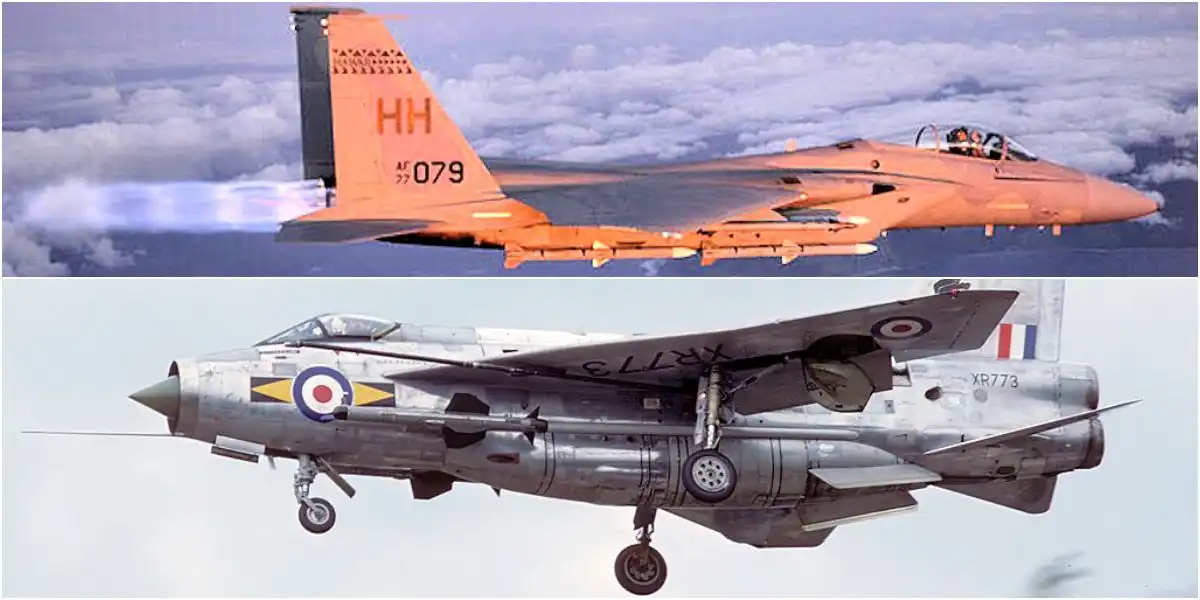
Royal Air Force (RAF) officer Bob Bees share his experience of flying the F-15 on exchange tour with the USAF.
Bees arrived at Tyndall toward the end of 1987. He completed three months of transition training with the 2nd Tactical Fighter Training Squadron, then IP conversion with the 95th and then served with the 1st as a newly qualified F-15 instructor pilot.
Describing his initial impressions of the F-15, Bob said in Key Publishing Bookazine Inside The F-15 Eagle: “The power and acceleration of the F-15 were very similar to the Lightning, but it wasn’t as slippery as the Lightning. Overall the F-15 was brilliant to fly, but it did hang on its thrust, so if you came out of afterburner when airborne, you were pulled into your straps, you soon learned to make sure you didn’t tighten the straps that well. The visibility was fantastic. If you turned and looked behind you could see between the tails.’
As Bob adopted the American way of instructing, he realised that US Air Force instructors taught students everything from instrument flying to their instrument rating to doing tanking and gunnery. By comparison, in the RAF a qualified flying instructor taught a student how to fly and undertook instrument ratings, before a weapons instructor taught them how to employ the aeroplane as a weapons system, so slightly different.
Discussing his job with the 1st Tactical Fighter Training Squadron, Bob said “Lieutenant Colonel Richie Smith, who became a two-star general, was my new boss and we and we were teamed up to do a lot of flying together because he was new to the F-15. He nominated me to become assistant director of operations, third in command with four flight commanders under my watch. I had responsibility for the scheduling and running the flight schedule and making sure we got plenty of days away at weekends to meet the monthly and annual flight hour requirements.
“We flew to Ellington Air National Guard Base, Texas, where the resident 111th Fighter Interceptor Squadron was converting from the F-4D Phantom to the Block 15 F-16A The squadron wanted us to work with them. Some of the squadron’s pilots flew with NASA including the first space shuttle commander who was the general.
‘Our big mission plan involved flying combat air patrols and intercepting low-level targets. A KC-135 tanker, led by an RAF exchange officer, was tasked to fly on a tow line that was positioned such that we would not be able to aerial refuel and get to our points for the next CAP timings. We explained the tactical situation to him and asked if he could fly south to meet us. With me leading four F-15s and another RAF pilot leading the tankers, we made the manoeuvre just as we would in the UK, with the tankers flying towards us. During the manoeuvre, I told them when to turn so we could run in behind them.
‘We got the first F-15 plugged straight away, followed by the other three, all four aerial refuelling contacts were conducted with a faster fuel flow rate. Everyone involved in the mission thought it was a great manoeuvre, made possible because of the way the two lead RAF pilots had been trained and were allowed to fly the manoeuvre.’
Bob flew his last F-15 flight at Tyndall in December 1990 and soon after returned to the UK to serve as the Typhoon Operational Requirements Liaison Officer, the ORLO, based in MoD main building in London. When that assignment ended, Bob served as the BAE Systems de facto flight operations officer for Eurofighter, and then left the military and joined Virgin Atlantic to fly Boeing 747s.
Inside The F-15 Eagle is published by Key Publishing and is available to order here.
Photo credit: Mike Freer – Touchdown-aviation via Wikipedia and U.S. Air Force

