
In this article:
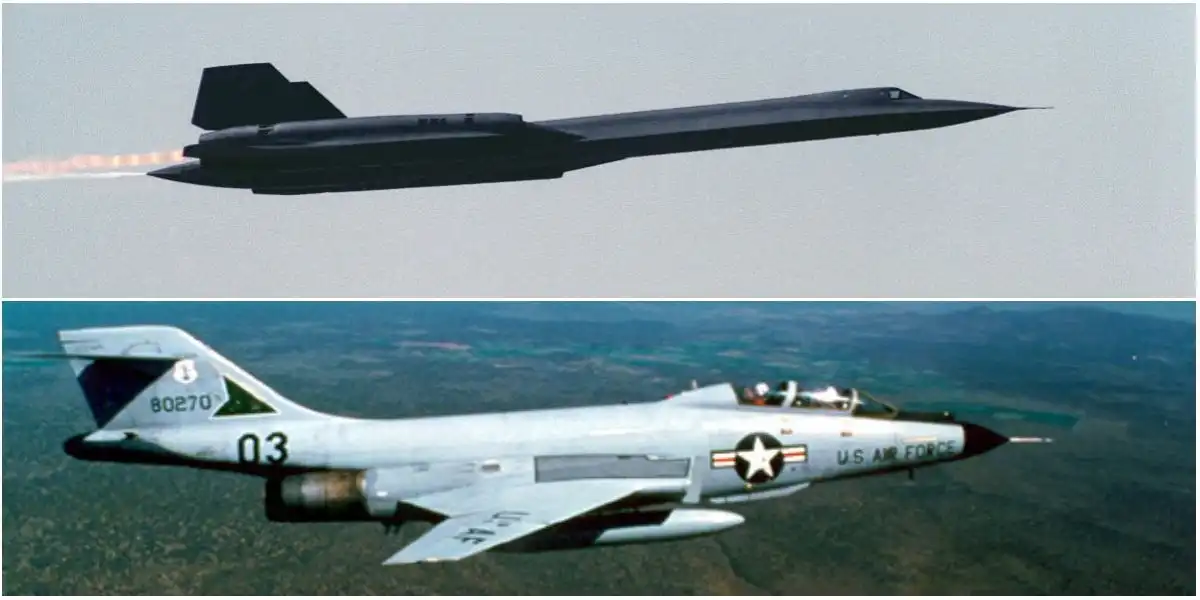
Developed from the XF-88 penetration fighter, the F-101 originally was designed as a long-range bomber escort for the Strategic Air Command. However, when high-speed, high-altitude jet bombers like the B-52 entered active service, escort fighters were not needed. Therefore, before production began, the F-101’s design was changed to fill both tactical and air defense roles.
The F-101 made its first flight on Sept. 29, 1954. The first production F-101A became operational in May 1957, followed by the F-101C in September 1957 and the F-101B in January 1959. By the time F-101 production ended in March 1961, McDonnell had built 785 Voodoos, including 480 F-101Bs, the two-seat, all-weather interceptor used by the Air Defense Command. In the reconnaissance versions, the Voodoo was the world’s first supersonic photo-reconnaissance aircraft. These RF-101s were used widely for low-altitude photo coverage of missile sites during the 1962 Cuban Crisis and during the late 1960s in Southeast Asia.
Once an F-101 Voodoo even tried to rage against an SR-71 Blackbird Mach 3+ spy plane as my dad, SR-71 Blackbird Reconnaissance Systems Officer (RSO) Colonel Richard “Butch” Sheffield, recalls in his book “Ohio to Supersonic: Flying the SR-71 Blackbird to the secret world of the Skunk Works;”
‘Sometime, early in the program, in January 1967, I believe, we aborted and landed at Buckley Air National Guard (ANG) Base near Denver. The base was home to an F-101 squadron. The F-101 was an interceptor assigned to defend the US in case of war. The fighter community considered it a “hot” aircraft.
‘After we got out of our pressure suits and arranged for the take-off the next day, we went to the Officer’s Club wearing loaned flying suits and our white pressure suit boots. The fighter pilots who came around wanted to know all about our aircraft, like; how fast, how high, and the rate of climb. What they really wanted was to race us as we climbed out after takeoff. We declined all offers of information and races.
‘The next day, on takeoff roll, an F-101 came upon our wing; he was going to race us whether we wanted to or not. Apparently, the F-101 had been orbiting the field just waiting for our take-off.
‘The SR could climb fast but was no match for the F-101 at those altitudes. He stayed right on our wing up to 25,000 feet where we leveled off to hit a tanker that we always did. About the time we leveled off, someone from the F-101 came on UHF and said, “You guys aren’t so hot.” So I replied, “How fast can you climb above 80,000 feet?” The F-101 made a quick exit.’
Be sure to check out Linda Sheffield Miller (Col Richard (Butch) Sheffield’s daughter, Col. Sheffield was an SR-71 Reconnaissance Systems Officer) Twitter Page Habubrats SR-71 and Facebook Page Born into the Wilde Blue Yonder for awesome Blackbird’s photos and stories.
Photo credit: U.S. Air Force


