
In this article:
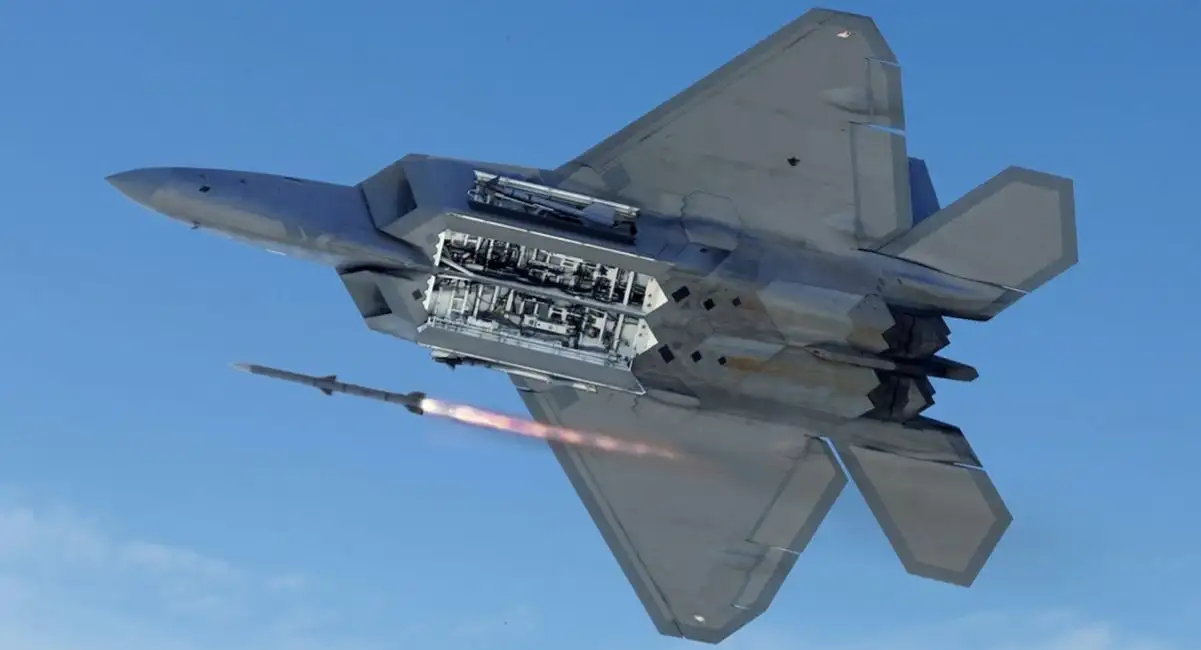
Raytheon and the US Air Force’s Air Combat Command have successfully executed the longest known AMRAAM air-to-air missile shot by a fifth-generation fighter during a series of tests in Eglin Air Force Base (AFB) airspace.
The tests, conducted in the fall of 2024 on an F-22, demonstrated AMRAAM’s extended time of flight capability, proving the munition can significantly increase the lethality of fifth-generation aircraft. This is the result of the US Air Force’s form, fit, function refresh (F3R) development effort, which continues to enhance AMRAAM’s performance, and Raytheon’s investment in the research, development and production of AMRAAM.
“Achieving air superiority in the future, highly contested battlespace depends on the precision and lethality of air-to-air missiles,” said Sam Deneke, president of Air & Space Defense Systems at Raytheon, in a company news release. “AMRAAM is already known as the gold standard for the air dominance arena, and these tests prove it will continue to play a critical role for the U.S. and its allies for decades to come.”
As already reported, in March 2021 the 28th Test and Evaluation Squadron (TES) partnered with the 83d Fighter Weapons Squadron (FWS) to execute the longest known air-to-air missile shot.
In that instance, an F-15C Eagle fired an AIM-120 AMRAAM at a BQM-167 subscale drone, resulting in a “kill” of the aerial target from the furthest distance ever recorded. The test took place out of Tyndall AFB, Fla., in conjunction with Weapons Systems Evaluation Program (WSEP) East.
Noteworthy these tests bring to our memory the famous six-on-six missile shot test that took place on Nov. 21, 1973 to prove that that both US Navy F-14 Tomcat and AIM-54 Phoenix long-range missile were ready to enter active service. That time six missiles were fired against six different targets simultaneously.
The targets against which the AIM-54s were launched were three QT-33s (the drone version of the old jet trainer), two aerial target BQM-34As and one BQM-34E. The missiles were in flight together under guidance from the fire control system in the Tomcat and four targets, which were simulating bombers (two QT-33s, one of the BQM-34As and the BQM-34E), were directly hit. The other BQM-34A experienced a failure at the flight control module which led the Phoenix radar to break lock, while the last AIM-54 missed the last QT-33 due to a failure of the Phoenix radar antenna.
The six-on-six missile shot was considered a huge success since the AIM-54 had an impressive range of about 100 miles (160 km), a great improvement over the 15 miles of range possessed by the Sparrow. The Phoenix was the first “fire and forget” missile, meaning that the Tomcat had not to keep its radar locked on the target during the flight of the AIM-54 towards it, a feature possible thanks to the small Phoenix radar, which guided the missile in the final stages of its flight.
The AIM-120 advanced medium-range air-to-air missile (AMRAAM) instead is the follow-on to the AIM-7 Sparrow. The missile is faster, smaller and lighter, and has improved capabilities against low-altitude targets. It incorporates active radar with an inertial reference unit and micro-computer system, which makes the missile less dependent upon the fire-control system of the aircraft. Exactly like the AIM-54, once the missile closes on a target, its active radar guides it to intercept. This enables the pilot to aim and fire several missiles simultaneously at multiple targets. The pilot may then perform evasive maneuvers while the missiles guide themselves to their targets.
For more than 30 years, AMRAAM has been a trusted and combat-proven air dominance weapon for air-to-air and surface-to-air missions for the United States’ Air Force, Navy and allies. It is integrated on 14 platforms in 43 countries, has completed more than 6,000 successful live fires, and has had near-perfect success in active conflicts with more than 13 air-to-air combat victories.
The AMRAAM missile has been integrated onto the F-15A/B/C/D/E Eagle/Strike Eagle, F-16 Fighting Falcon, F/A-18 Super Hornet, F-22 Raptor, Eurofighter Typhoon, JAS-39 Gripen, Tornado and Harrier. The newest version of AMRAAM is operational on all F-35 Joint Strike Fighter variants. It is the only radar-guided, air-to-air missile cleared to fly on the F-35.
Photo credit: Raytheon, U.S. Air Force