
In this article:
Originally known as the TFX (Tactical Fighter “X”), the F-111 Aardvark was conceived to meet a US Air Force requirement for a new tactical fighter-bomber. In 1960 the Department of Defense combined the USAF’s requirement with a Navy need for a new air superiority fighter. The USAF’s F-111A first flew in December 1964, and the first production models were delivered to the USAF in 1967. Meanwhile, the Navy’s F-111B program was canceled. In all, 566 F-111s of all series were built.
An interesting feature of the aircraft was its variable-geometry wings. While in the air, the wings could be swept forward for takeoffs, landings or slow speed flight, and swept rearward for high-speed flight. The F-111 could also fly at very low level and hit targets in bad weather.
The F-111 served in the USAF from 1967 through 1996.
As told by Bob Archer in his book F-111: Fort Worth Swinger, the USAF F-111s were in operational service for around a quarter of a century. Those close to the type will readily agree that the unfavorable reputation during the period of development and early operations was turned around by the manufacturer (and also by those who flew and maintained the aircraft). Seemingly, the expensive (for the time) F-111, which was at the peak of deterrence one day, was placed into storage in the Arizona desert the next.
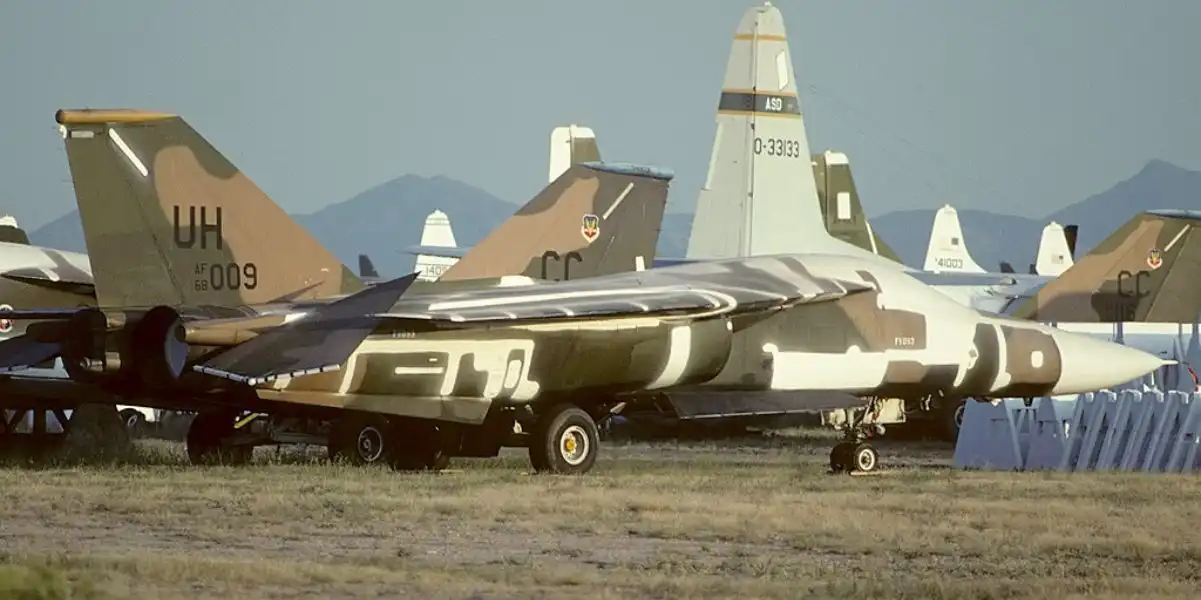
A total of 39 F-11 1s escaped the baking heat of Davis-Monthan Air Force Base (D-M AFB) and are displayed at Air Force bases or museums in the US. A further three are preserved outside of the US, with an F-111E mounted on a plinth at RAF Lakenheath but wearing the markings of an F-111F of the 48th TFW, another F-111E is with the Imperial War Museum at Duxford and an F-111F is preserved at RAF Cosford.
The remaining 330 plus airframes were flown into D-M AFB at regular intervals. At the completion of the one-way flight, the crews were met by personnel from the Military Aircraft Storage and Reclamation Center (MASDC), later renamed AMARC, who officially accepted the aircraft along with all necessary paperwork. The process was fairly straightforward and once complete, the delivery aircrew usually returned to their home station. Most F-111s were declared surplus after a fairly lengthy period in storage. Regular defence sales ensured that military hardware, including aircraft and helicopters, are disposed of following the removal of all relevant mission equipment. Understandably, carcasses are snapped up by businesses which have opened compounds adjacent to D-M AFB.
In the case of the Air Force F-111s, early test examples were flown to D-M AFB from December 1969 onwards. Following the delivery of production aircraft, the need for development airframes ceased, enabling them to be retired.
The RDT&E aircraft, along with the ten pre-production examples were constructed to a different configuration from production versions. Therefore, it would not have been most effective to upgrade the survivors to operational configuration. A dozen were retired to D-M AFB with the majority being sold to a private contractor for scrap. The remainder were transferred to other military facilities for non-operational ground duties.
During November 1989, the Berlin Wall was breached. This single symbolic act enabled Soviet dominance within Eastern Europe to evaporate, leading to the majority of satellite nations becoming independent and eventually the Soviet Union itself breaking up, Furthermore, former adversaries now became allies as the Cold War dissolved along with the Warsaw Pact. The removal of the tense stand-off across a divided Europe allowed most NATO nations to significantly reduce their military composition The USAFE was included in this wholesale reduction. The two wings of F-111s were among the units which no longer had an effective role.
Whereas the 20th FW was transferred home, and Upper Heyford closed, the 48th FW at Lakenheath with four squadrons of F-111Fs fared differently. Instead of being inactivated following the retirement of the 80 plus aircraft, the Wing was slated to switch to two versions of the McDonnell Douglas F-15 Eagle. The 493rd FS transitioned to the F-15C/D version, assuming the air defence mission, while the 492nd and 494th FSs gained the F-15E Strike Eagle, thereby retaining the fighter-bomber role. The fourth squadron, the 495th FS, had performed the aircrew training role and was therefore the first and only unit to inactivate. This commenced in December 1991. The 492nd FS sent their F-111s home beginning in May 1992, with the 494th following from October 1992. The 493rd FS completed the process in December 1992.
Despite no longer having a role within USAFE, the F-111F remained a highly capable weapons delivery platform. Therefore, instead of being retired, more than 70 were transferred to the 27th FW, assigned to three squadrons. The delivery of the newer version, which began in May 1992, enabled the F-111D model to be retired, However, the F-111F had only a short-term career in New Mexico, as the F-16C/D began to arrive with the 27th. The acquisition of newer equipment enabled the F-111 to begin the retirement process in October 1995, with this being completed at the end of July 1996.
The final four aircraft departed Cannon AFB and flew to Fort Worth for a retirement ceremony. The event was staged between 26 and 28 July 1996 as a reunion for former F-111 aircrew, maintainers and other personnel associated with the type. For the occasion, the nose of 524th FS F-111F 74-0187 was decorated with a Statue of Liberty and ‘FAREWELL,’ while streamers for combat operations Constant Guard V- Combat Lancer, El Dorado Canyon, and Desert Storm were in place.
Tail codes of the primary operators were also applied to the large nose decoration, while ‘380th BW’ and ‘509th BW’ represented SAC. 74-0187 was selected as this was the second from last F-111 built – the final example being 74-0188 which was lost in an accident on 26 April 1983. The other three aircraft were 70-2362, 71-0888 and 74-0178. The four departed Fort Worth on 29 July bound for D-M AFB, and storage.
F-111: Fort Worth Swinger is published by Key Publishing and is available to order here.
Photo credit: Mike Freer – Touchdown-aviation, kitmasterbloke and Andrew Thomas from Shrewsbury, UK via Wikipedia
Aviation History


