In this article:
X-59 maximum afterburner testing

NASA’s X-59 quiet supersonic research aircraft took another successful step toward flight with the conclusion of a series of engine performance tests at Lockheed Martin Skunk Works in Palmdale, California. According to the article Diamonds from NASA’s X-59 by Monika Luabeya, NASA, during maximum afterburner testing, a test demonstrating the engine’s ability to generate the thrust required for supersonic flight, the aircraft showed off a phenomenon known as Mach diamonds. Mach diamonds, or shock diamonds, appear in the exhaust of supersonic aircraft like the X-59.
Additionally, the X-59 cleared electromagnetic testing, confirming its systems will work together safely, without interference across a range of scenarios.
“Reaching this phase shows that the aircraft integration is advancing,” said Yohan Lin, NASA’s X-59 avionics lead, in the article NASA’s X-59 Completes Electromagnetic Testing, by Nicolas Cholula NASA Armstrong Public Affairs Specialist. “It’s exciting to see the progress, knowing we’ve cleared a major hurdle that moves us closer to X-59’s first flight.”
Electromagnetic testing
Electromagnetic interference occurs when an electric or magnetic field source affects an aircraft’s operations, potentially impacting safety.
The tests, conducted at contractor Lockheed Martin Skunk Works’ facility in Palmdale, California, ensured that the X-59’s onboard systems – such as radios, navigation equipment, and sensors – did not interfere with one another or cause unexpected problems. During these tests, engineers activated each system on the aircraft one at a time while they monitored the other systems for possible interference.
“This testing helped us determine whether the systems within the X-59 are interfering with each other,” Lin said.
Other electromagnetic interference testing involved the team looking at the operation of the X-59’s landing gear, ensuring this critical component can extend and retract without affecting other systems.
Electromagnetic compatibility was also assessed during this testing – making sure the X-59’s systems will function properly when it eventually flies near NASA research aircraft.
Researchers staged the X-59 on the ground in front of NASA’s F-15D, placing them 47 feet apart, then 500 feet apart. The proximity of the two aircraft replicated conditions needed for the F-15D to use a special probe to gather measurements about the shock waves the X-59 will produce.
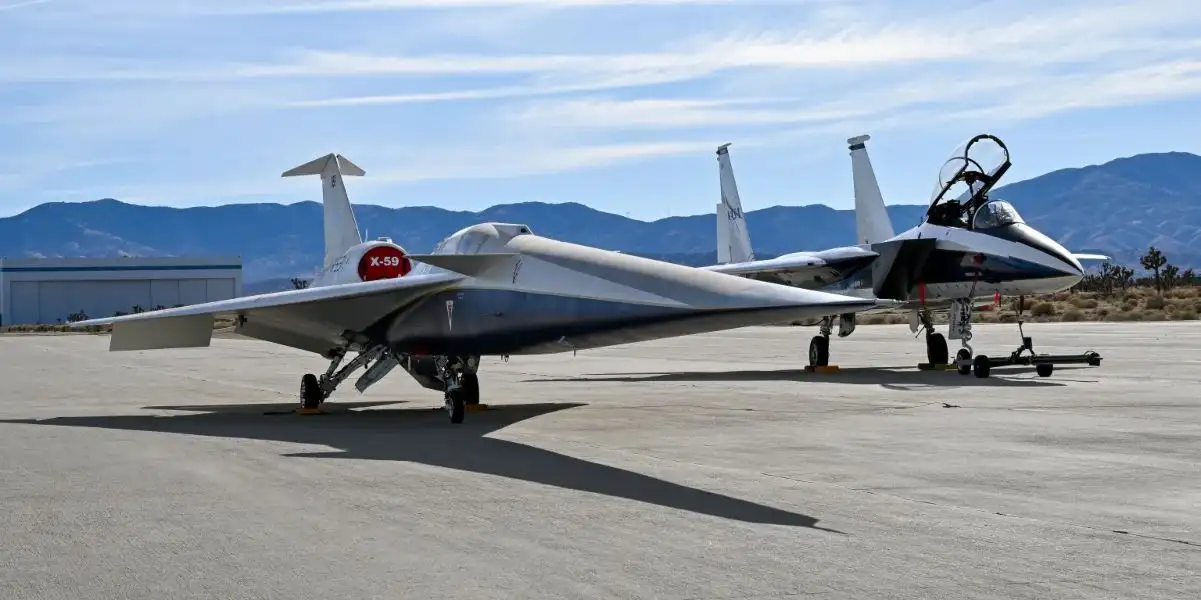
“We want to confirm there’s compatibility between the two aircraft, even at close proximity,” Lin said.
For the electromagnetic compatibility testing, the team powered up the X-59’s engine while turning on the F-15D’s radar, C-band radar transponder, and radios.
Now that electromagnetic testing is complete, the X-59 is ready to move on to aluminum bird tests – during which data will be fed to the aircraft on the ground under both normal and failure conditions – and then taxi tests before flight.
QueSST
For more than a decade, Lockheed Martin Skunk Works and NASA have collaborated to solve one of the most persistent challenges of supersonic flight – the sonic boom. Lockheed Martin Skunk Works is leading the design, build and flight test of the X-59 quiet supersonic technology (QueSST) X-plane. The technology demonstrator will be flown over populated areas to provide U.S. and international regulators with statistically valid data required to help approve new rules that could allow quiet commercial supersonic flight over land, which could bring us one step closer to quiet supersonic travel for passengers around the globe.
The X-59 is an experimental supersonic aircraft shaped to reduce the loudness of a sonic boom reaching the ground to that of a gentle thump. The X-plane accomplishes this by a tailored design that separates the shock waves that produce sonic booms, making them quieter. The resulting supersonic “heartbeat” is dramatically quieter than the disruptive N-wave boom generated by today’s supersonic aircraft. We look forward to supporting NASA in the effort to obtain the data regulators will need to make informed decisions on appropriate sonic boom levels in the quest to remove the prohibition on supersonic over land flight.

Photo credit: Carla Thomas / NASA and Gary Tice / Lockheed Martin


