In this article:
The Wooden Wonder

The de Havilland DH.98 Mosquito was one of the most versatile British combat aircraft of the Second World War. It was known affectionately as the “Mossie” to its crews and was also nicknamed “The Wooden Wonder” or “The Timber Terror” as the bulk of the aircraft was made of laminated plywood. It saw service with the Royal Air Force (RAF) and many other air forces in the European, Pacific, and the Mediterranean theatres of operations, as well as for some years following the war.
Originally conceived as an unarmed (no defensive weapons) fast bomber, the Mosquito was adapted to many other roles during the air war, including: low to medium altitude daytime tactical bomber, high altitude night bomber, pathfinder, day or night fighter, fighter-bomber, intruder, maritime strike, and fast photo reconnaissance aircraft carrying out aerial reconnaissance. It was even used by the British Overseas Airways Corporation (BOAC) as a transport. It was also the basis for a single-seat heavy fighter, the de Havilland Hornet.
Manufacturing innovations
As explained by Jeremy Walsh in his book Mosquito Units in the Far East, detailed design work on the DH 98 Mosquito commenced, and on 1 March 1940, as the development progressed, the Air Ministry placed an order for 50 Mosquitos to replace the Blenheim in the reconnaissance role. In May 1940 the Air Ministry issued specification F.21/40 calling for a fully armed long-range fighter. As a result, de Havilland was authorised to start building a fighter version of the Mosquito.
Both the design and construction of the Mosquito were radical. The composite wood structure, combining lightness with strength, was made of spruce, Canadian birch plywood, Ecuadorean balsa, ash, Douglas fir stringers and walnut, using traditional milk-based casein wood glue to bond pieces together. As well as its innovative composite wood structure, the Mosquito featured drag-reducing ducted radiators, rubber block suspension and interchangeable noses for different variants.
Another major manufacturing innovation was the concept of splitting the fuselage down the centreline. Each half fuselage shell was formed from an inner and outer spruce plywood skin sandwiching a balsa wood core with wood formers. Because the two halves were manufactured separately, the internal equipment and services could be installed before they were joined together. The moulds and jigs were designed to facilitate dispersed manufacturing, harnessing the capacity of cabinet makers and carpenters across the country, with much centred around the furniture industry in High Wycombe, Buckinghamshire.
Outpacing the Spitfire
The design and development team worked at break-neck speed on the prototype, designing, manufacturing and testing components to ensure they exceeded the design requirements. The prototype was constructed in one of the barns near Salisbury Hall, Hertfordshire, which had been home to the de Havilland design team from September 1939. By the late autumn of 1940, the prototype was ready to move from Salisbury Hall to de Havilland’s Hatfield aerodrome, also in Hertfordshire, for flight testing.
In early November 1940, a few weeks after the Battle of Britain had ended, the Mosquito prototype arrived at Hatfield. Then, on 25 November, Geoffrey de Havilland Jnr, de Havilland’s Chief Test Pilot, together with John Walker, the Chief Engine Development Engineer, undertook the first test flight in the prototype, with Geoffrey de Havilland watching. The latter noted, ‘The great moment had come after only 11 months from the start of the design of the fastest aeroplane we had ever built – a speed record in itself’.
The test programme progressed quickly, identifying relatively few design changes, the most significant being splitting the flaps and extending the engine nacelles to reduce buffeting on the tailplane. Trials continued, and on 16 January 1941 at Boscombe Down, Wiltshire, the prototype delivered on de Havilland’s promise to Air Council through Air Marshal Wilfrid Freeman – it outpaced the Spitfire, giving birth to the Mosquito legend. The first flights of the aircraft demonstrated its outstanding performance, which immediately overcame any opposition in official circles to its unconventional construction. Government orders started to be placed, initially in limited numbers.
Farmer taking down a fence allowing de Havilland Mosquito second prototype to fly
On 15 May 1941, Geoffrey de Havilland persuaded the neighbouring farmer to Salisbury Hall to take down a fence, allowing the second completed prototype (W4052 – the fighter version) to be flown from there to Hatfield. Just a month later, on 16 June, George Gibbins flew the photo-reconnaissance prototype (W4051) out of another adjacent field and on to Hatfield.
Production orders increased rapidly, with Mosquito construction taking place in parallel with development testing. De Havilland had somewhat rashly promised to produce the first batch of 50 bomber and reconnaissance aircraft by December 1941. The company was also convinced that the fighter would be required sooner or later. Sure enough, as flight testing continued, the Air Ministry changed the second order for 150 aircraft exclusively to the fighter variant.
Mosquito Units in the Far East is published by Osprey Publishing and is available to order here.
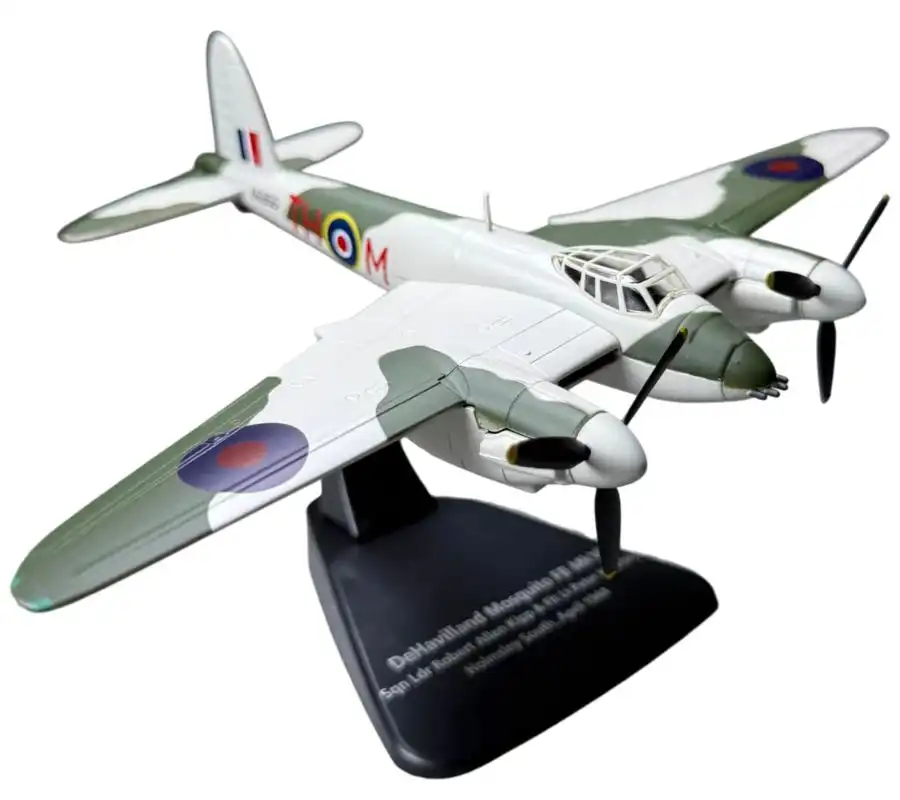
Photo credit: Crown Copyright


