In this article:
The Aardvark
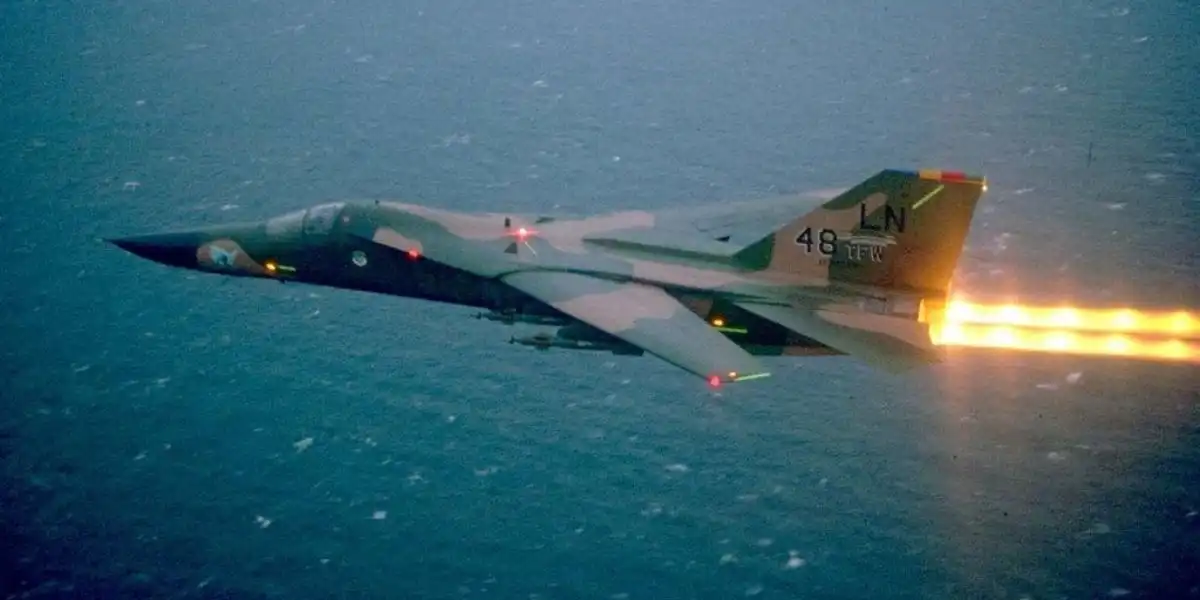
Originally known as the TFX (Tactical Fighter “X”), the F-111 was conceived to meet a U.S. Air Force requirement for a new tactical fighter-bomber. In 1960 the Department of Defense combined the USAF’s requirement with a Navy need for a new air superiority fighter. The USAF’s F-111A first flew in December 1964, and the first production models were delivered to the USAF in 1967. Meanwhile, the Navy’s F-111B program was canceled. In all, 566 F-111s of all series were built; 159 of them were F-111As. Although the F-111 was unofficially referred to as the Aardvark, it did not receive the name officially until it was retired in 1996.
The versatile “swing wing” F-111 entered the USAF inventory in 1967. The F-111’s wings are straight for takeoffs, landing or slow speed flight, but by sweeping its wings rearward, in can exceed twice the speed of sound (Mach 2).
Low level dash at Mach 1.3 – 1.4
The F-111 could also fly at very low level and hit targets in bad weather.
But how does it feel to travel 1500mph in an F-111?
Paul Ghiron, former USAF F-111 pilot, recalls on Quora;

‘I only saw that speed once in the F-111 since most of our missions were low level dash where we could only get up to about Mach 1.3 – 1.4 depending on how the engines were tweaked. Yep that is really fast down low at sea level, where basically no one could catch us, and we could see the shock wave as it traveled over the water.
F-111 exceeding Mach 2 at 50,000 ft
‘Very rarely we would fly Functional Check Flights (FCF) post maintenance and we were “permitted” to do a 50,000 ft speed run. That was the time I got to see that 1500 number and then some. We got to Mach 2.15 and the airplane was still accelerating when the total temperature gauge reached max and the 5 minute countdown timer started. We immediately started to slow rather than have the maintenance guys give us hell for bubbling the skin, which has happened on other FCF rides.’
Ghiron concludes;
‘So how did it feel at that speed? Not much different than at slower speeds other than at that altitude the sky is a dark blue.’

Photo credit: U.S. Air Force


