In this article:
The centerpiece of America’s Naval forces
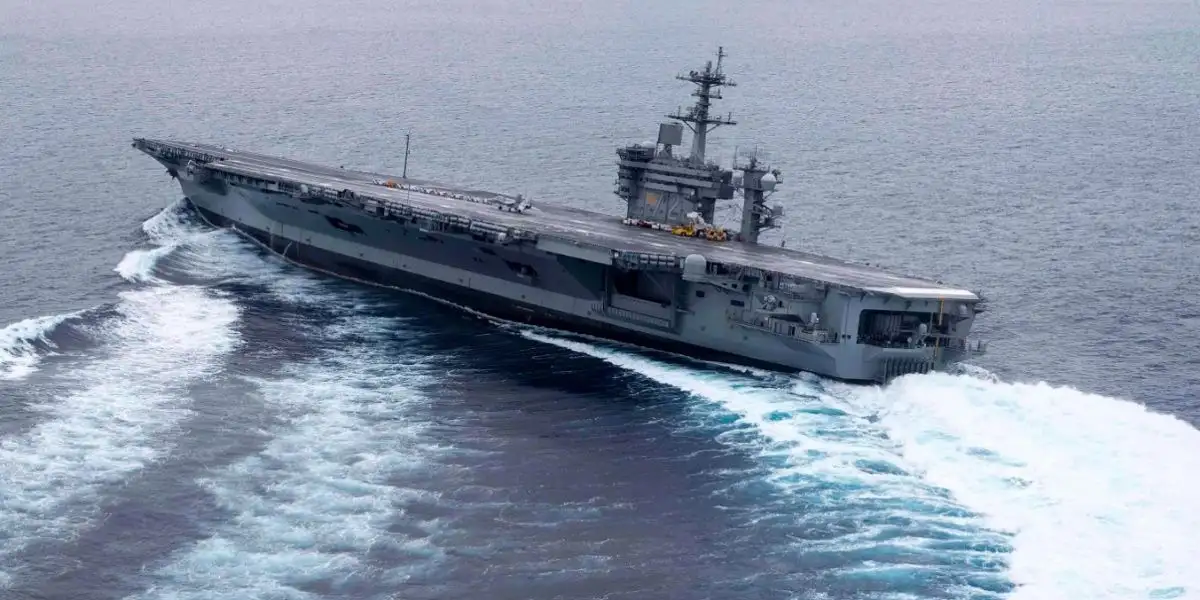
Aircraft carriers are the centerpiece of America’s Naval forces – the most adaptable and survivable airfields in the world. On any given day, Sailors aboard an aircraft carrier and its air wing come to the fight trained and equipped across a full range of missions. They are ready to control the sea, conduct strikes, and maneuver across the electromagnetic spectrum and cyberspace. No other naval force fields a commensurate range and depth of combat capabilities.
Today the US Navy operates 11 carriers, all nuclear-powered: ten 101,000-ton, 1,092 ft long Nimitz class carriers and Gerald R. Ford (the lead of the class Gerald R. Ford) 110,000-ton, 1,106 ft long carrier.
All these carriers are powered by two nuclear reactors.
With a speed of 30+ knots (34.5+ miles per hour) Nimitz and Gerald R. Ford-class aircraft carriers are very fast.
Backing down the engines of an aircraft carrier in shallow waters
Why is backing down the engines of an aircraft carrier so risky in shallow waters, and what problems can arise?
Roderick Grant MacLeod, former US Navy Submarine Nuclear Propulsion Officer, explains on Quora;
‘Here’s a side view of two subclasses of Nimitz class aircraft carriers.
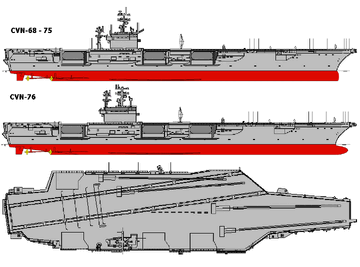
‘On the left, below the waterline you’ll see the propellers and their shafts. Note that the shafts are not level. They slope downward a few degrees. This means that their thrust is not perfectly horizontal. When moving forward, this actually helps to keep the bow down and the deck level, especially when accelerating. (Ever notice that speed boats tend to run with their bows high?)
‘With all four propellers in reverse, this shaft angle will pull the stern downward. The potential exists to pull it down far enough that the rudders, the propellers and the keel all dig into the bottom. This could prove to be very expensive to fix in both dollars and time. The navy doesn’t keep spare propellers lying around. They’re 25′ in diameter, weight about 30 tons, and they’re very precisely machined and balanced. The rudders are about 50 tons. Shaft bearings are very large and expensive. It would be a long and slow trip to one of the few US shipyards where that kind of work can be done and the damage would probably take a couple of years to repair and test.

‘I’m going to add a bit of information here for more clarity.
‘The downward sloping propulsion shaft is pretty common in boat and ship design. It’s not specific to aircraft carriers, much less warships in general.
Exceptionally deep draft
‘Aircraft carriers have exceptionally deep draft. Deeper even than the largest cruise ship, Icon of the Seas, which dwarfs a Nimitz or Ford class carrier in displacement. Pretty much only large tankers draft more but they have a different design that protects the running gear but they don’t have the maneuverability that an aircraft carrier has.’
MacLeod concludes;
‘This deep draft puts a carrier’s running gear closer to the bottom, making it more likely to be damaged when backing.
‘Add to this the fact that carriers have four shafts and propellers. That’s a lot to damage.’

Photo credit: U.S. Navy


