In this article:
Hank Kleemann, Commanding Officer, Fighter Squadron FORTY-ONE

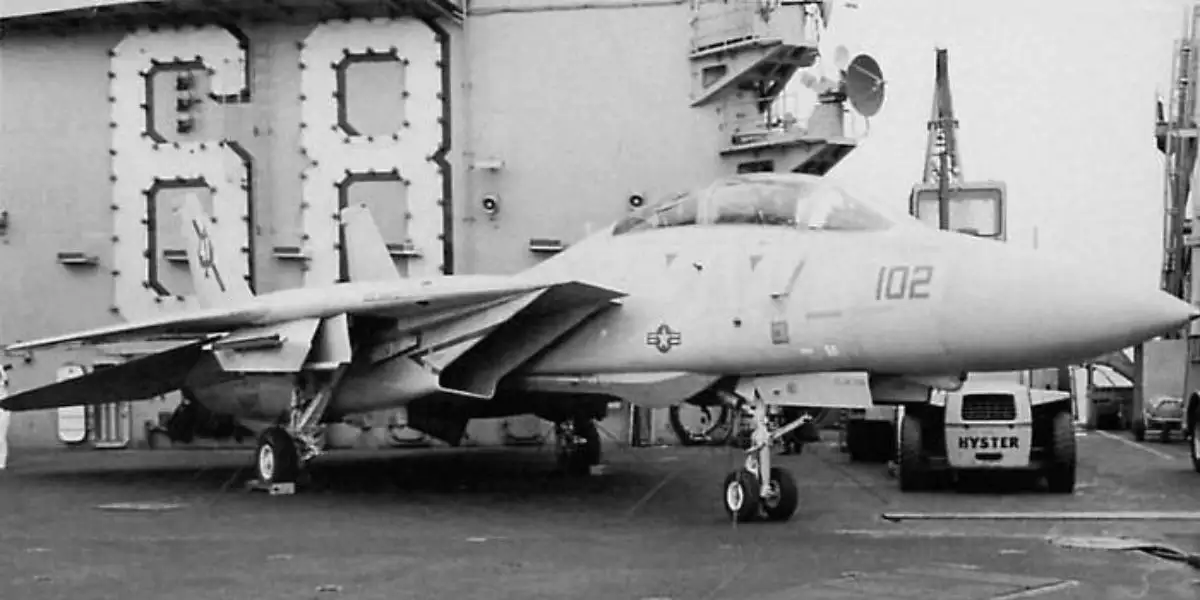
The Tomcat roared down the number 1 catapult in full afterburner after the catapult officer of the USS Nimitz had touched his extended left hand to the flight deck (the signal for the launch). The aircraft was flown by Commander “Hank” Kleemann, Commanding Officer, Fighter Squadron FORTY-ONE. The airplane’s side number was 102. The time was 0615 on Aug. 19, 1981. Seconds later another of the Black Aces’ F-14As roared down catapult number 2.
Rear Admiral Paul t. Gillcrist, who has over four hundred flight hours in the F-14, recalls in his book Tomcat! The Grumman F-14 Story;
‘Nimitz, at the time was steaming off the coast of Libya conducting the second day of an air-to-air live missile firing exercise. In the back seat of Kleemann’s airplane was his radar intercept officer (RIO) Lieutenant Dave Venlet. The second F-14, piloted by Lieutenant Larry “Music Muczynski with Lieutenant Dave Anderson in his back seat bore the side number 107.

‘About an hour after launch Kleemann’s RIO picked up a radar contact [The first detection of the Su-22s was by a VAW-124 E-2C] on the inbound leg of their combat air patrol (CAP) station race track pattern. The CAP was assigned an altitude of twenty thousand feet and the two F-14s were in a combat spread with Kleemann, the flight leader on the left. A good abeam position for a combat spread at that altitude was about one and one-half miles
A “down the nose” intercept
‘The radar contact became a “down the nose” intercept with the contact climbing to their altitude, leveling off and accelerating to 540 knots. Kleemann called his wingman for an offset turn to the right thirty degrees followed by a return to base course. This was intended to give the F-14s a little angle off their bogeys and therefore a bit of advantage. There was an almost immediate matching maneuver by the radar contact which put them again nose-to-nose. Obviously either the bogey’s radar was as good as theirs or the Libyan ground controllers observed the F-14s maneuver, correctly assessed it and countered with the necessary directions to the bogeys.
‘Years later in the Pentagon Hank described the engagement and opined that in earlier incidents between Libyan fighters and F-4s from the USS Forrestal similar initial maneuvers had been successful. “I guess those Libyan air controllers have a pretty good learning curve because I don’t believe their airplanes radars were that good.” Convinced that another offset attempt would not work, Hank ran the throttles to full afterburner (zone five) and directed his wingman to step up. Muczynski climbed about five thousand feet higher than his flight leader and dropped back slightly in the process.’

Altitude advantage
He continues;
‘If they had to “meet them at the pass” (head-on) Kleemann wanted to have his wingman with an altitude advantage. Venlet locked up the contact and with the help of the tracking diamond in the head up display (HUD), Kleemann was able to visually acquire the radar contact and identified them at eight miles as Sukhoi Su-22 Fitters in a very close formation. They were almost “at the pass” in a classic left to left passing situation when Kleemann started a left roll intended to keep the planes in sight as they passed down his left side.
‘At that moment his airplane was about one thousand feet from the Fitter flight leader and slightly higher closing fast he saw a flash as a missile was fired by the flight leader. Kleemann, call sign Fast Eagle 102, called on the radio for his wingman to execute a hard left break climbing turn. Just before the two Fitters flashed past and momentarily out of sight both F-14 pilots observed them start what looked like a splitting maneuver. About twenty-five degrees into the turn (two or three seconds) Kleemann saw the defensive splitting maneuver developing and directed his wingman to “take the one on the left.”

“Hank” Kleemann, the first man to fight the F-14 and the man who also got it fixed
‘They rolled out after essentially a one hundred eighty degree turn in trail of the Fitters (at their six o’clock position) with Kleemann’s wingman, Muczynski in a firing position on the Fitter which had fired. For some reason the leader reversed his turn back toward his wingman who was now being pursued by Kleemann in a hard nose-down turn. Muczynski, now closing fast on the lead Fitter fired an AIM-9L Sidewinder heat-seeking missile which made a direct hit in the tailpipe.
‘Muczynski executed a high-speed yo-yo maneuver up and back toward Kleemann’s airplane. As he did so he saw an explosion and pieces of airplane coming off the lead Fitter. Kleemann’s quarry continued the hard right turn pulling up into the sun. Knowing the sun would decoy his own heat seeking Sidewinder, Kleeman held his shooting position until his own missile guidance tone told him the sun was no longer a factor, and fired. Kleeman’s missile struck the Fitter in the tailpipe. The airplane went out of control and the pilot ejected almost immediately. The entire engagement lasted between forty and fifty seconds from the first firing until the third missile struck its target.

‘Only four years later “Hank” Kleemann walked down the fourth floor E-ring of the Pentagon with me to the Blue Room to get the Secretary of the Navy’s approval for the F-14D program. He came out victorious in both engagements. He will always be known in my “book” as the first man to fight the F-14 and the man who also got it fixed.
More than a single four plane encounter
‘But there was more to the event than a single four plane encounter. It was a two carrier exercise in the Gulf of Sidra during which Nimitz’s air wing exercised their weapons systems, and there had been other incidents. Just the previous day the air wing commander, Commander “Bad Fred” Lewis had mixed it up with a pair of Libyan Mirage F1 fighters and ended up with both of his F-14s sitting in the saddle”; each in trail of his opponent. The opponents departed the scene.
‘On the day of the shoot down two F-4s from USS Forrestal (also in the area) were mixing it up with two Libyan MiG-25s. CAG Lewis was in the combat information center listening to both events which were on the same ultra-high frequency (UHF) radio channel. He heard “Music” ask excited over the radio (when he was in the saddle), “Skipper, what should I do?”
‘The F-4 pilot from Forrestal, who was maneuvering with the MiG-25 must have heard the question because he came up on the air with, “Shoot him, shoot him, shoot him!” “Music” shot him!’
Gillcrist concludes;
‘The return to the carrier after a shoot down is traditionally a triumphant event with a fly by victory roll and a smart recovery. Hank must have a little too much adrenalin pumping through his veins because, there before the watchful eyes of the battle group commander, Rear Admiral Jim Service, the ship’s Captain, Jack Batzler and his own CAG, he boltered (missed a wire and went around for another landing attempt).’
Tomcat! The Grumman F-14 Story, is published by Schiffer Publishing and is available to order here.

Photo credit: U.S. Navy


