In this article:
The Tomcat

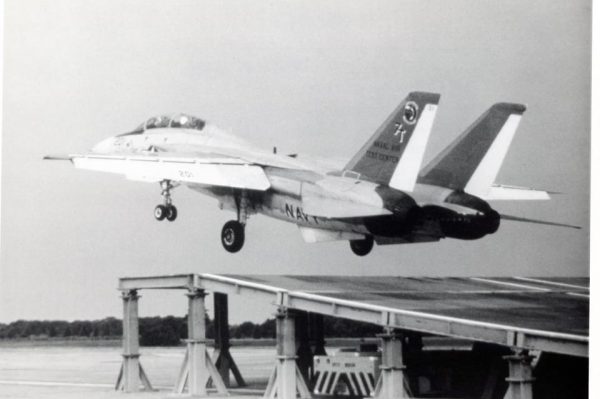
Advancements during the Cold War in Soviet long-range patrol and bomber aircraft dictated a requirement for a fleet defense fighter that could engage high-altitude bombers from well beyond visual range. The iconic F-14 Tomcat was Grumman’s answer. Equipped with long range AIM-54 Phoenix air-to-air missiles, F-14s could engage multiple hostiles over 90 miles away.
For medium-range combat, AIM-7 Sparrow missiles were carried; AIM-9 Sidewinders and a M61-A1 20mm gun were available for dogfighting.
Needing an interceptor’s high speed while carrying this heavy ordnance, Grumman produced the highly effective variable sweep wing of the F-14, enabling it to operate at a wide range of airspeeds.

How to move the F-14 wings in oversweep
The Tomcat’s variable sweep wing also features an oversweep position that sweeps the wings back to 75 degrees. This configuration is not for flight as the wings interfere with the elevators when swept that far.
Chuck Hunter, former US Navy F-14 Tomcat pilot, explains on Quora;
‘The Tomcat was already a large aircraft on the deck, the oversweep made it smaller. They actually stack well when they don’t need to be ready to fly:

‘You can’t fly in oversweep, it is only for parking. But the 68 degrees sweep angle was more than enough to get you over Mach 2.
‘Just an added detail, when we pulled up the wingsweep lever to get it into oversweep, a jack screw would move into position to keep the elevons from impacting the wings. Effectively limiting their movement. The wings would not move into the oversweep position until those jack screws were out.
‘Moving the wings to oversweep was a manual operation using the wingsweep lever (black/yellow), it cannot be done electronically. We had to lift the guard, push the button, and pull it back into the oversweep position.

Central Air Data Computer
‘This black and yellow lever is direct control of the wings and overrides all electrical control of the wings. It can be used to move the wings with a failure of the CADC (Central Air Data Computer) control of the wing position. I don’t know anybody that ever had to do that. We knew where to put them for the appropriate speed, so you could bring them forward to land if there was an issue.’
Hunter concludes;
‘We would generally put the wings in oversweep even when parking on the airfield. Saved space and just habit pattern. From NAS Oceana when I was flying there:

‘Of course it wasn’t required, and you might leave them in 68 or even 20 for maintenance reasons.’
Photo credit: Photographer’s Mate Airman Apprentice Nathan Laird and Robert J. Sitar / U.S. Navy and Worthpoint