In this article:
The Tomcat

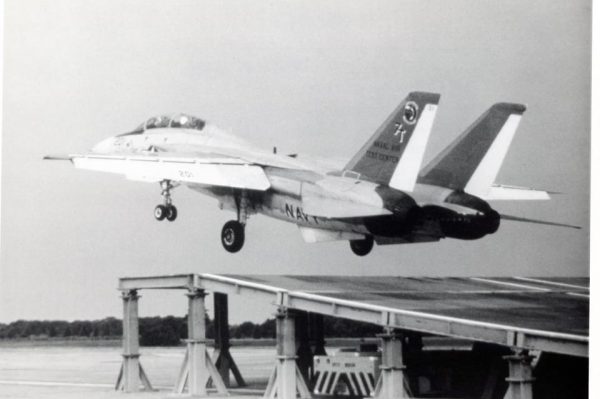
Advancements during the Cold War in Soviet long range patrol and bomber aircraft dictated a requirement for a fleet defense fighter that could engage high-altitude bombers from well beyond visual range. The iconic F-14 Tomcat was Grumman’s answer. Equipped with long range AIM-54 Phoenix air-to-air missiles, F-14s could engage multiple hostiles over 90 miles away. Needing an interceptor’s high speed while carrying this heavy ordnance, Grumman produced the highly effective variable sweep wing of the F-14, enabling it to operate at a wide range of airspeeds.
The F-14 saw its first combat in August 1981, downing two Libyan Su-22 fighters over the Gulf of Sidra. It saw considerable duty in the Gulf War, Iraq and Afghanistan. The last F-14D Super Tomcat retired from active service with in 2006, when it was replaced by the F/A-18E/F Super Hornet, an evolutionary upgrade to the F/A-18C/D.
F-14 Tomcat VS F/A-18 Hornet
John Tartaglione, former US Navy F-14 Tomcat and F/A-18 Hornet pilot, recalls on Quora;
‘I have over 1,000 hours in the Tomcat and perhaps 450 hours in the Hornet. My Tomcat time was largely operational. My Hornet time was all in flight test. Some days I would fly one bird in the morning and another one if the afternoon or evening. The Hornet was newer, and newer is often better. I could only pull 6.5g in the Tomcat, but in the Hornet when I burnt my fuel down a bit, I could go to 7.5g.

‘The F404 engine in the Hornet was far better than the TF30 that we had in the Tomcat and I never had to worry about a compressor stall with the F404. I should know as I did a lot of the initial out-of-control flight test on the 2 seat Hornet where I would intentionally depart the airplane from controlled flight. The engines never even hiccupped at all.’
The TF30 engine
A little known fact is that the TF30 engine in the F-14 Tomcat was never intended for the production Tomcat. It was an existing engine with some modifications made to enable it to fit and work in the F-14 to support flight testing of the airframe, avionics, weapons systems, etc. on a short schedule.
Tartaglione explains;
‘I believe the 1st 60 or so birds were supposed to have the TF30 and then the F-100. But the budget axe nixed all of those plans – sadly. IT would have been an even more formidable machine, but it just was not meant to be.
‘The TF30s were prone to compressor stalls. However, the loss of 1 engine did not automatically lead to loss of the aircraft. If I was at a high angle of attack, the loss of 1 engine could result in a rapid loss of control. If I was at a low altitude and a high AOA – i.e. off of the catapult, if action was not taken immediately, the yaw rate would build up quickly and the aircraft would depart controlled flight. An aircrew was lost off of USS Nimitz in 1981 because of this very situation.’

Interestingly, a lot of the pre-cancellation F-14 engine development transferred to the then-future F100 engine which, with it’s General Electric-equivalent F110, has had decades of success world-wide in the F-16 and F-15 aircraft.
F/A-18 in peacetime, F-14 in combat
Tartaglione adds;
‘The Hornet was far more nimble than the Tomcat, but the Hornet did not have the range, endurance or speed of a Tomcat. Each was designed for a different mission. I would often say to colleagues that in peacetime, I loved the agile Hornet. But were I to go into combat, I would much rather be in the Tomcat. My RIO and I were a great team. Having that extra set of eyes was invaluable. One afternoon, my wingman and I engaged a pair of Libyan MiG-23s. During the engagement, I lost sight of one of the MIGs. While I kept my eyes on the Libyan in front of me, I knew my RIO could help me to get my eyes on the other MIG. That extra set of eyes is invaluable when all hell breaks loose.’
He concludes;
‘The F-14 is far from perfect, but there is none better on the planet. And it was a dream to fly the magnificent Tomcat – as flawed as they were.’

Photo credit: U.S. Navy