In this article:
Voodoo

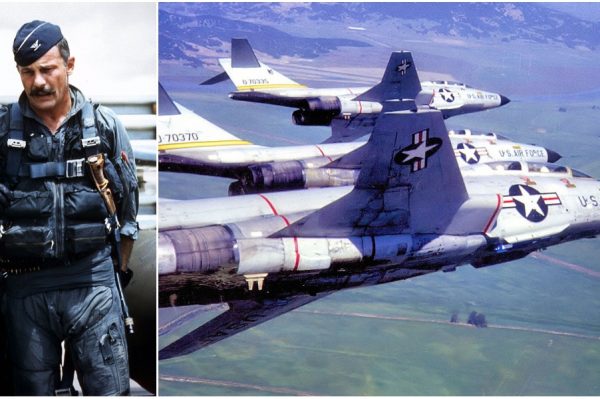
Designed to serve with the Strategic Air Command as a long-range escort and “penetration” fighter, the F-101 Voodoo was developed subsequently for both tactical and air defense roles. At the time of its introduction into service, it was the heaviest single-seat fighter ever accepted by the USAF. McDonnell engineers began design studies of a penetration fighter in 1945, and detailed design work started in June 1946. Two prototypes of this design were built as the XF-88 and XF-88A, flight trials started on October 20, 1948, but a change in tactical requirements and a shortage of funds led to the cancellation of the project in 1950.
In 1951, a new USAF requirement for a long-range fighter to serve with SAC as a B-36 escort led to a revision of the original XF-88 design. With an additional fuselage bay for extra fuel and J57 turbojets in place of J34s, it was designated as the F-101.
The F-101 made its first flight on Sept. 29, 1954. The first production F-101A became operational in May 1957, followed by the F-101C in September 1957 and the F-101B in January 1959. By the time F-101 production ended in March 1961, McDonnell had built 785 Voodoos, including 480 F-101Bs, the two-seat, all-weather interceptor used by the Air Defense Command. In the reconnaissance versions, the Voodoo was the world’s first supersonic photo-reconnaissance aircraft. These RF-101s were used widely for low-altitude photo coverage of missile sites during the 1962 Cuban Crisis and during the late 1960s in Southeast Asia.
A great deal of neglect
In the aftermath of the nuclear confrontations over Berlin and Cuba, the 1960s began to see both sides backing away from the threshold. The F-101 Voodoos of the 81st TRW at the twin bases of RAF Bentwaters and RAF Woodbridge continued to stand Victor Alert with live nuclear weapons, but the nature of the confrontation was changing. The set of consequences that nuclear weapons imposed were seen to restrict political and military options rather than acting as a stabilizing force of unquestioned American strength in the face of the large numerical superiority of Soviet and Warsaw Pact conventional ground forces.
As told by Ronald Easley in his book The F-101 Voodoo an Illustrated History of McDonnell’s heavyweight Fighter, since the 1950s, Air Force tactical fighter units depended upon the nuclear delivery mission as their only means of demonstrating the relevancy upon which their survival depended. The traditional skills of dogfighting and conventional warfare had, by the early-1960s, suffered from a great deal of neglect. Many recognized this deficiency and its potential consequences within the different branches of the American military, but their views went nowhere within an ossified bureaucracy. Among these young mid-level commanders was World War II ace Robin Olds, who took command of the 81st TFW in August 1963.

Lt. Col. Daniel “Chappie” James becomes Robin Olds executive officer
The 81st TFW had long held reputation of being one of the finest units not only in USAFE, but the entire Air Force. Charismatic, aggressive, and above all, capable, Colonel Olds began to put his stamp on the 81st TFW and hone and polish the unit to an even sharper edge. He brought on Lt. Col. Daniel “Chappie” James as his executive officer and together they set to work. Realizing both the need to maintain proficiency in the skills of conventional warfare and the limitations of the Voodoo, Olds began training the pilots of the 81st TFW in gunnery and conventional weapons delivery for potential close air support missions. However, the nuclear delivery mission remained paramount as the unit sharpened its skills.
By the middle of his two-year tenure as wing commander in the summer of 1964, the decision had been made to replace the F-101s of the 81st TFW with far more capable F-4C Phantoms. Just as capable in the nuclear delivery role as the F-101, the F-4C could also carry a mind-boggling array of short to long-range air-to-air missiles and conventional ordnance to perform the much broader set of missions that NATO would require in the coming years.
Thunderbirds-style show with F-101s
In his mid-40s as his tenure with the 81st TFW was coming to a close in 1965, the war in Vietnam was heating up. Although he had what was arguably the best job in the Air Force, the only thing that Col. Olds wanted to do while a fight was on was to lead men in combat. After World War II, he was assigned to an air defense unit when the Korean War broke out and could never manage to find his way there.
At the stage of his career in 1965, he knew that the next step ahead of him would be to become a general and remain at a desk, rather than leading from the front as was his nature. Almost desperate to get into the fray in Vietnam, Robin Olds took a tremendous gamble. He saw an opportunity to not only enhance the proficiency and esprit de corps of his pilots, but to publicly demonstrate their capabilities and at the same time, use what he saw as the risk-averse mindset of his leadership to get off of the promotion list for brigadier general and remain a colonel, by remaining in position to become a combat wing commander in Vietnam.
Removed from the promotion list to general

With the spring Open House season coming up, Col. Olds decided to form and lead an aerial demonstration team of four F-101s. C.R. Morgan, Tom Hirsch, and “Ski” Fantaski would be the other pilots of the four-man group, with Fantaski designated as the “slot” pilot.
As they practiced their routines, the story goes that the reports got all the way up to General Gabriel P. Disosway, the USAFE commander and an old friend, who quietly relayed back to Olds that what he was doing was against safety regulations and that he should cease immediately before someone got hurt. Olds and his team showed up for their scheduled appearance at the open house at RAF Mildenhall, but rather than the standard fast low-level pass, they performed what Olds has since termed a “nice, safe formation barrel roll” over the runway, then returned to Bentwaters to put on a spectacular Thunderbirds-style show ending with the signature “bomb-burst” maneuver. The performance had the desired effect.
While his immediate superior demanded a court martial for Olds, USAFE Commander Disosway called the famously obdurate colonel into his office for an epic reaming. His Legion of Merit citation to be presented at his change-of-command ceremony was torn up, an extremely negative performance review was filed, and Olds was then notified that he was removed from the promotion list at which point Olds stood up, saluted smartly, told General Disoway that was what he wanted all along, and dismissed himself from the general’s office.
Robin Olds combat wing commander in Vietnam
Col. Olds’ change of command in August 1965 coincided with the retirement of the F-101 from the 81st TFW. Sent to 9th Air Force headquarters at Shaw AFB to cool off until the matter blew over, the wild old combat ace made arrangements to transfer to a unit in Southeast Asia and six months later was on his way to command the 8th Fighter Wing, an F-4C unit in Thailand that was experiencing morale problems, among other issues. Given the excellent leadership team forged at the 81st TFW, Olds brought in Chappie James once again, and as “Blackman a and Robin” they began to turn things around.
Meanwhile, the old Voodoos were destined for conversion into reconnaissance aircraft to serve out their remaining years with the Air National Guard. For both men and machines, the rest is history.
The F-101 Voodoo an Illustrated History of McDonnell’s heavyweight Fighter is published by Schiffer Publishing and is available to order here.

Photo credit: U.S. Air Force and RuthAS Own work via Wikipedia