In this article:
U-2G

The US Air Force (USAF) jointly managed U-2 Dragon Lady development, testing and missions with the CIA from the start. Pilots for overflights of the USSR, though, were civilians working for the CIA. President Dwight D. Eisenhower believed sending military pilots over the USSR would be perceived as an act of war, so USAF Reserve fighter pilots voluntarily quit the service and went to work as CIA pilots. Officially, they were Lockheed test pilots.
Eventually the CIA flew 24 U-2 missions over the USSR, and numerous flights over other communist nations.
However, in the 1960s, U-2s could not reach certain remote targets because political difficulties prevented basing the aircraft in some foreign nations. The CIA and US Navy, therefore, studied the idea of launching U-2s from aircraft carriers.
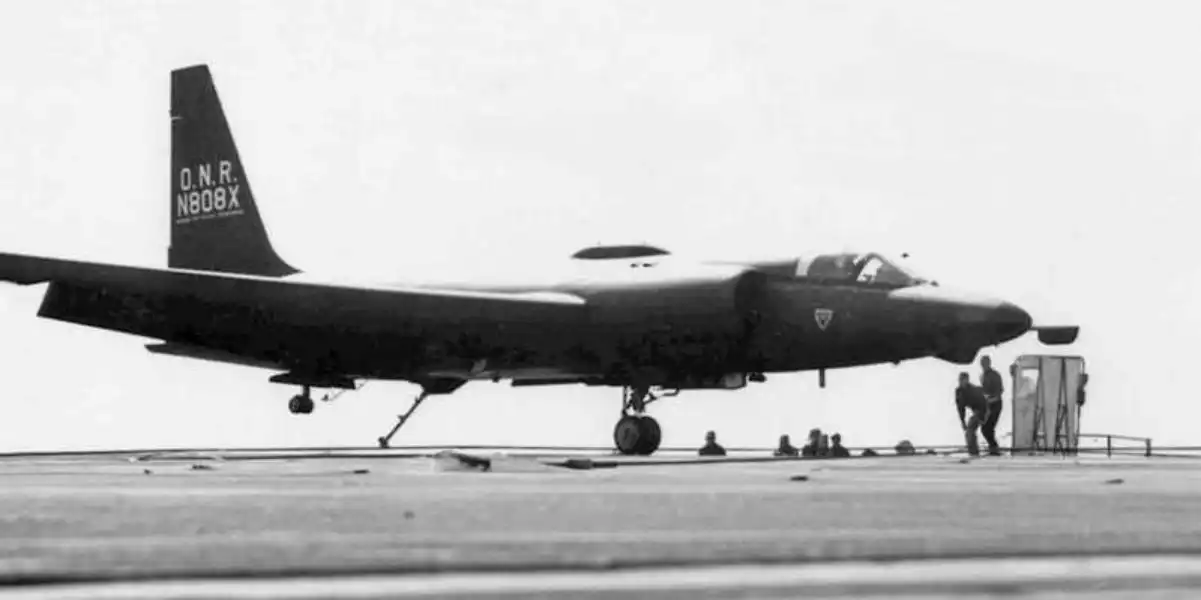
Project Whale Tale fitted a few U-2s with arresting hooks at the rear of the fuselage. The hooks would snag cables strung across aircraft carrier decks and “capture” aircraft, bringing them to a quick stop.
To withstand rough carrier landings, Project Whale Tale U-2s were given stronger landing gear, and also wing spoilers to overcome the U-2’s tendency to glide instead of landing on the carrier deck. Aircraft thus modified were designated U-2G.
The first U-2 takeoff from a carrier took place on Aug. 5, 1963, from the USS Kitty Hawk, off San Diego, Calif. The first U-2 carrier landing occurred on March 2, 1964, aboard the USS Ranger.

U-2 aircraft carrier operation concept
As told by Kevin Wright in his book We Were Never There Volume 2: CIA U-2 Asia and Worldwide Operations 1957-1974, little more than two months later in May 1964, the US Navy and the CIA conducted the only operational use of the U-2 carrier operation concept under the unclassified code name Fish Hawk.
Det H commander Colonel William Gregory, was on board USS Ranger for the voyage, having selected personnel and much of the required equipment for the mission. The U-2s had quietly flown to Hickham AFB, Hawaii. Then the two U-2Gs (Art 348 and 362) flew out to join USS Ranger, piloted by Jim Barnes and Buster Edens. Arriving from Hawaii the two flew approaches and trapped landings onto USS Ranger to renew their carrier qualification. Their aircraft were equipped with the newly delivered 112B/Delta II and B cameras.
The aircraft had made radio silent arrival onto USS Ranger in an attempt to hide the operation. Even on the carrier, the two U-2s were kept in a secure area protected by Marines. Representatives from Eastman Kodak and NPIC were on board Ranger to process and assess the tracker camera imagery. The main mission film was to be returned to San Diego by A-3B Skywarrior as soon practicable.
French Polynesian nuclear test site at Mururoa atoll
Their target was the newly constructed Polynesian nuclear test facility at Mururoa atoll in the Tuamotu archipelago. The French switched to the south Pacific after abandoning their original nuclear test site in Algeria.
US intelligence development agencies monitored the development of the French weapons programme. Following an announcement that Prime Minister Georges Pompidou would visit the site in July 1964, the CIA seized the opportunity to photograph the new facilities in the period before nuclear tests began.
The mission plan called for a single sortie, with the new 112B camera, and a small ELINT payload, with two backup flights in case of weather or technical issues. As USS Ranger approached 800 miles from the archipelago the aircraft was readied for the first flight. Two missions were planned. W224A flown by James Barnes on May 19, 1964 with Colonel Gregory recording W224A’s departure at precisely 0700L.
U-2 missions that spied over French Polynesian nuclear test site
Ranger’s radar soon lost contact with him as Barnes climbed to 68,000ft. His task was to cover the primary objective on Mururoa, and several secondary targets, mostly other atolls including Hoa which became an advanced support base. No opposition was expected as Barnes broke the usual cardinal rule of aerial opposition photo-reconnaissance and passed over the main target area twice. He flew over other atolls before imaging the settlement at Papeete, then turned north-eastwards to rendezvous with USS Ranger. He began his let down 100 miles before reaching the carrier and landed straight on.

The second mission, W234A, a repeat of the first, was flown on May 22 by Buster Edens. There had been significant cloud over some of the first mission’s target areas, but by combining both days imagery coverage of all the primary and secondary target areas was achieved.
After the completion of operations, USS Ranger headed to San Francisco. The U-2s departed as they arrived within range of land to touch down at NAS Almeda, then flying on to Edwards AFB.
Crash during aircraft carrier landing practice
On Apr. 26, 1965 veteran CIA pilot Buster Edens died when his U-2G crashed at Edwards AFB. He was due to carry out carrier landing practice on the simulated deck constructed there. On his first approach, he was told to cut power and extend spoilers by the LSO. On touchdown, his left wing touched the runway and dragged along it for some 50ft. Edens applied power and got airborne again and was told to gain altitude and check his aircraft. Just two miles from the control tower he appeared to enter a low-level spin and hit the ground.
We Were Never There Volume 2: CIA U-2 Asia and Worldwide Operations 1957-1974, is published by Helion & Company and is available to order here.
Photo credit: CIA, U.S. Air Force and U.S. Navy


