In this article:
The Tomcat

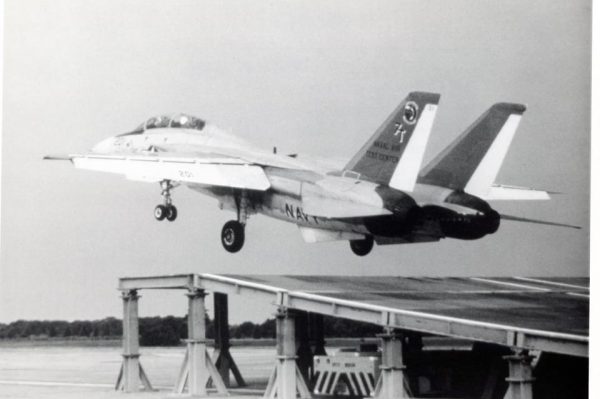
Advancements during the Cold War in Soviet long range patrol and bomber aircraft dictated a requirement for a fleet defense fighter that could engage high-altitude bombers from well beyond visual range. The iconic F-14 Tomcat was Grumman’s answer. Equipped with long range AIM-54 Phoenix air-to-air missiles, F-14s could engage multiple hostiles over 90 miles away. Needing an interceptor’s high speed while carrying this heavy ordnance, Grumman produced the highly effective variable sweep wing of the F-14, enabling it to operate at a wide range of airspeeds.
Following Grumman’s tradition of naming its aircraft after cats, the new “Tomcat” made its first flight in December 1970. After a number of changes following flight testing, the first F-14As were delivered to the Navy in June 1972, with Fighter Squadron (VF) 124 designated to provide crew training. On the West Coast, VF-1 and VF-2 were the first operational squadrons to receive the new aircraft, while on the East Coast VF-14 and VF-32 became the first Atlantic fleet Tomcat squadrons. In 1974, the Marine Corps prepared to stand up VMFA-122 at NAS Miramar, but the program was cancelled when the Marine Corps decided to retain modified versions of the dependable F-4J Phantom II.
The F-14 saw its first combat in August 1981, downing two Libyan Su-22 fighters over the Gulf of Sidra and then it saw considerable duty in the Gulf War.
F-14 strafing an Iraqi ground target
As told by Tony Holmes in his book F-14 “Bombcat”: The US Navy’s Ultimate Precision Bomber, the Tomcat’s performance as an air superiority fighter in Operation Desert Storm was disappointing. Although the units committed to the campaign undertook countless CAPs and vital TARPS missions, the jet was prevented from engaging Iraqi Air Force (IrAF) aircraft due to its crews’ inability to solve all the Rules of Engagement (RoE) requirements independently of AWACS support.
This was because, at the time, the older F-14A/B (unlike the F-14D, which was not yet in operational service) lacked the very latest IFF systems and software fitted in the USAF’s F-15Cs.
Clearly frustrated at not being able to play a more active part in the war effort a handful of Tomcat pilots resorted to strafing ground targets with the M61A1 Vulcan cannon. On one such occasion, according to a crew from CVW-3’s VAQ-130, embarked in John F Kennedy sailing in the Red Sea, they were flying an EA-6B deep into Iraq and approaching their target when their F-14 escort left them in full afterburner without warning. Unperturbed, the Prowler crew pressed on and made their jamming orbit, shot a HARM and egressed safely with a pair of A-7Es from CVW-3 that had joined on them – each of the Corsair IIs were armed with Sidewinders, thus offering the unarmed Prowler a modicum of protection from IrAF fighters.
Grounded after leaving an EA-6B unescorted
The Tomcat crew, meanwhile, had descended to strafe buildings, and they only saw the EA-6B again when they were receiving backside fuel from a tanker over Saudi Arabia. Upon returning to the carrier, the crew of the Prowler vociferously protested to the CAG (Capt A Hardin White) about being abandoned over enemy territory. He in turn spoke to the CO of the F-14 squadron about it, and the pilot and RIO of the fighter were admonished for leaving their high value unit unprotected. They subsequently visited the VAQ-130 ready room and apologized to the Prowler crew.
Referring to the same episode, a source from within CVW-3 noted “a VF-14 Tomcat descended and strafed an Iraqi observation post on egress. ‘Ordies’ from both fighter units in the air wing [VF-14 was paired with VF-32] asked crews to test fire the gun on every sortie, and on this particular occasion a jet that was being flown by a Flag staff member who had just joined the ship rather overdid his hiring ‘test’, resulting in him being grounded by the admiral. Prior to the start of Desert Storm, all F-14 crews had been told that there was a standing policy in effect preventing jets from descending below 20,000ft over enemy territory due to the density of AAA.”
The policy was firmly restated to all squadrons within CVW-3 as a consequence of this isolated incident.
F-14 “Bombcat”: The US Navy’s Ultimate Precision Bomber is published by Key Publishing and is available to order here.

Photo credit: U.S. Navy