EB-66 protecting AQM-34 Firebee drones over North Vietnam
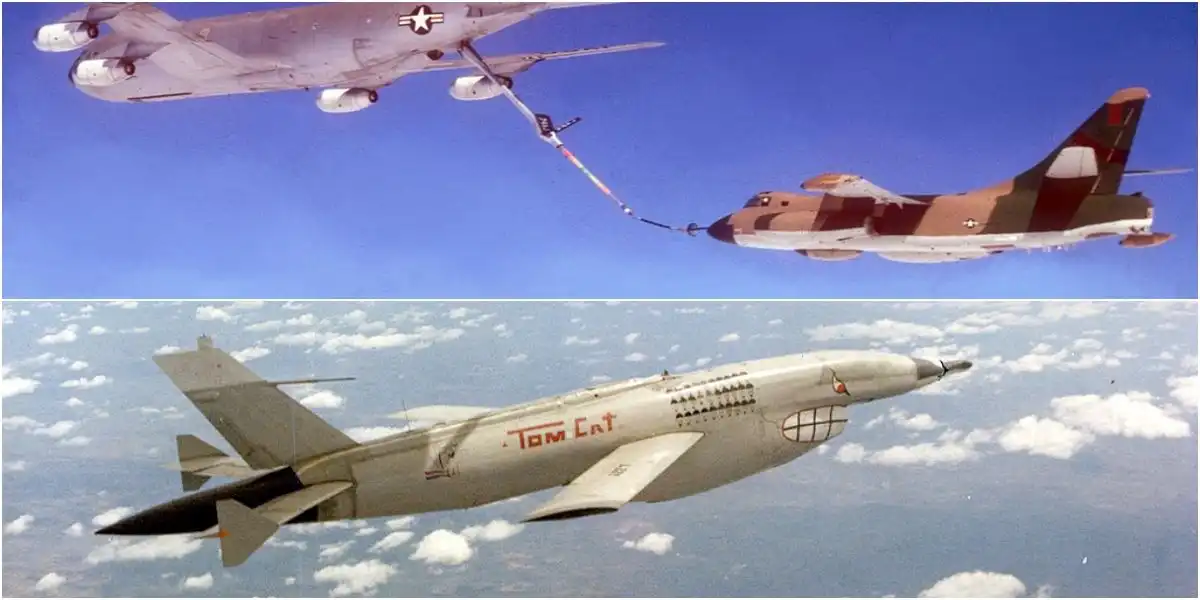
The B-66 was developed from the US Navy A3D Skywarrior as a tactical light bomber and photo reconnaissance aircraft. The RB-66B photo reconnaissance version became the first production series and totaled 145 of the 294 B-66s built. The USAF also developed a weather reconnaissance version, and various electronic countermeasures (ECM) versions.
ECM B-66s (EB-66s) became very important elements in strikes against North Vietnam. They could detect enemy radar emissions and jam their signals, thereby confusing enemy defenses. In addition, some B-66s flew pathfinder missions, guiding F-105 and F-4 bombing strikes through bad weather.
As told by Peter E. Davies in his book B/EB-66 Destroyer Units in Combat, pairs of EB-66C/Es protected AQM-34 Firebee reconnaissance drones over North Vietnam, jamming any radars that attempted to direct interceptions against them. They often flew parallel to the drone’s flightpath at a safe distance offshore.
Many drones were programmed to fly near Haiphong and Hanoi at around 500 ft, requiring up to four EB-66s to project jamming directly at ‘Fan Songs’ or other acquisition radars. On one occasion in July 1969, a drone launched from above Laos, and supported by EB-66C/Es, succeeded in flying across Hanoi at low altitude unchallenged.

‘Training targets’ for MiG-21 pilots
The majority, normally launched offshore, met opposition. An EB-66C with steerable antennas was the most effective platform for this kind of targeted jamming, and it always gave ‘Ravens’ opportunities to study the many radars that would be trying to catch a Firebee.
Improved secure communications equipment installed in EB-66s and the DC-130A Hercules drone launchers facilitated tracking of the drones. Some drones with deception jammers known as Rivet Bounder and Hat Rack flew at high altitude over lower-threat areas, but the majority, at low altitude over Hanoi and Haiphong, needed greater protection, particularly towards the end of their flights when they climbed across the coast to their recovery altitude. Vietnamese People’s Air Force (VPAF) pilots sometimes intercepted them at that point, and they became ‘training targets’ for many MiG-21 pilots.
MiG pilots were allowed periods of several weeks in which they took over the interception task from the SA-2 batteries. From Mar. 3, 1968 to Jul. 27, 1970, VPAF pilots claimed 34 drones out of the 50 monthly launches. Many Firebees contained their own deception jammers, or devices to initiate automatic anti-SAM or anti-MiG manoeuvres when triggered by a radar emission from a ‘Fan Song’ or a VPAF fighter. ECM assistance for drones was provided by EA-6As from May 1969, and these aircraft, with steerable antennas, coped with modifications to ‘Fan Songs’ that enabled them to use the higher frequency I-Band bandwidth. EB-66Es were also subsequently given that capability. Jamming by EA-6As ended on Jun. 27, 1970, leaving drone protection to the EB-66s.
B/EB-66 Destroyer Units in Combat is published by Osprey Publishing and is available to order here.

Photo credit: U.S. Air Force


