In this article:
The Bombcat

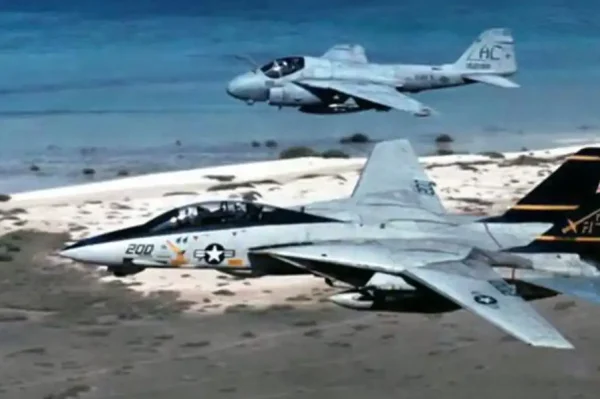
Few aircraft of the Cold War era have attained such cult status and adoration among those that flew it, wanted to fly it or kept it flying as the mighty Grumman F-14 Tomcat.
The jet was the final fighter created by the Grumman Aircraft Corporation and it had a reputation for being a tenacious interceptor that proved its durability in combat.
With the thawing of the Cold War in the late 1980s, the Tomcat community was faced with a stark choice. Turn the aircraft into a multirole strike fighter platform, or retain the fighter mission only and face almost certain extinction.
In a mere five years, the F-14 transitioned from guarding against improbable Cold War scenarios to becoming the LANTIRN-equipped, self-escorting strike fighter of choice.
With its two-seat cockpit, substantial payload and superior speed, range and recovery capabilities compared to the F/A-18 Hornet, the F-14 transformed into the formidable “Bombcat.”
SEAL JTAC on the F-14 and CAS

Senior Chief Andy “Senior” Nelson, who was a US Navy SEAL for 27 years prior to becoming a JTAC (Joint Terminal Attack Controller, which was the terminology officially adopted towards the end of Operation Enduring Freedom (OEF) to replace the more familiar FAC title), provides an illuminating insight into the Tomcat as a strike fighter from the end user’s perspective in Tony Holmes’ book F-14 “Bombcat”: The US Navy’s Ultimate Precision Bomber:
‘Some observations from my time as a SEAL JTAC working Close Air Support (CAS), and instructing at NSAWC on Naval Special Warfare (NSW) and JTAC (Joint Terminal Attack Controller) COI. One early spring, I was working with students from the JTAC course during an Air Wing det.
‘On one CAS event, Capt Dave Roy’ Rogers, then NAS Fallon CO [1998-2001] and former N5 [Director, Plans, Program and Tactics in 1996-98] at NSAWC, asked to bring some visitors out to the range to observe the CAS Event. When he arrived, I briefed the visitors on range safety and the schedule of events.
‘Shortly thereafter a division of F-14s arrived on station armed with live Mk82 and 83 bombs and GBU-16 LGBs. The F-14 squadron was hammering everything in sight. All bombs were on the correct target array with TOTs under ten seconds. Capt Rogers (a former A-6 Pilot) was standing next to me. I commented on how accurate the F-14s were with timing and bombing accuracy. He replied, “For an organization that was designed solely for fleet air defence, and air-to-air, they have wrapped their arms around the CAS mission and mastered it.”
‘Compared to the Navy F/A-18, the F-14s were the most reliable for showing up for CAS in questionable weather. The only exception to this was the USMC F/A-18s Marine Air lives for CAS.’
SEAL JTAC paying off bets to the F-14 crews
Nelson continues;

‘While briefing of the CAS events during CVW training, the standard or acceptable error for the TOTs was plus or minus ten seconds. I would challenge the aircrews to a plus or minus five seconds on the first pass of each section. The bet was a six-pack of beer or first round at the club. I spent a lot of money paying off bets to the F-14 crews.
‘Navy F-14 FAC (A) aircrews were a welcome boon to special operations. A LANTIRN- equipped F-14 with a FAC (A) trained aircrew was a major force multiplier for small special operations forces. They could do it all from controlling fixed and rotary wing air support to calling in sea and shore based artillery. The only other FAC (A) aircrews that could do that were the USMC F/A-18Ds. However, the shortfall for them was having to use the NITE Hawk pod. I would always tell the Army Special Forces and SEAL operators to always request a Navy FAC (A) for support on combat operations.’
The Dick Butkus of the strike fighters
Nelson concludes;
‘One thing I always observed with the F-14 crews was that they were all big guys usually over 5ft 11in. Most looked like they played football for the Naval Academy. F/A-18 crews were generally 5ft 9in and under. The F-14s and the crews that flew them were the Dick Butkus of the strike fighters… big guys and big powerful planes ready to crush anything that came into their zone.
‘They just looked scary when they were coming at you down low, and most F-14 flight crews looked like they could handle a good bar brawl. The F/A-18 were more of a stiletto of the aircraft and acted like they should be wearing dockers and polo shirts with a cardigan sweater tied around their neck. The latter description does not apply to US Marine Corps F/A-18 pilots, who are an entirely different breed.’
F-14 “Bombcat”: The US Navy’s Ultimate Precision Bomber is published by Key Publishing and is available to order here.

Photo credit: LTJG Stephen P. Davis and LCDR Dave Parsons / U.S. Navy