In this article:
F-111F

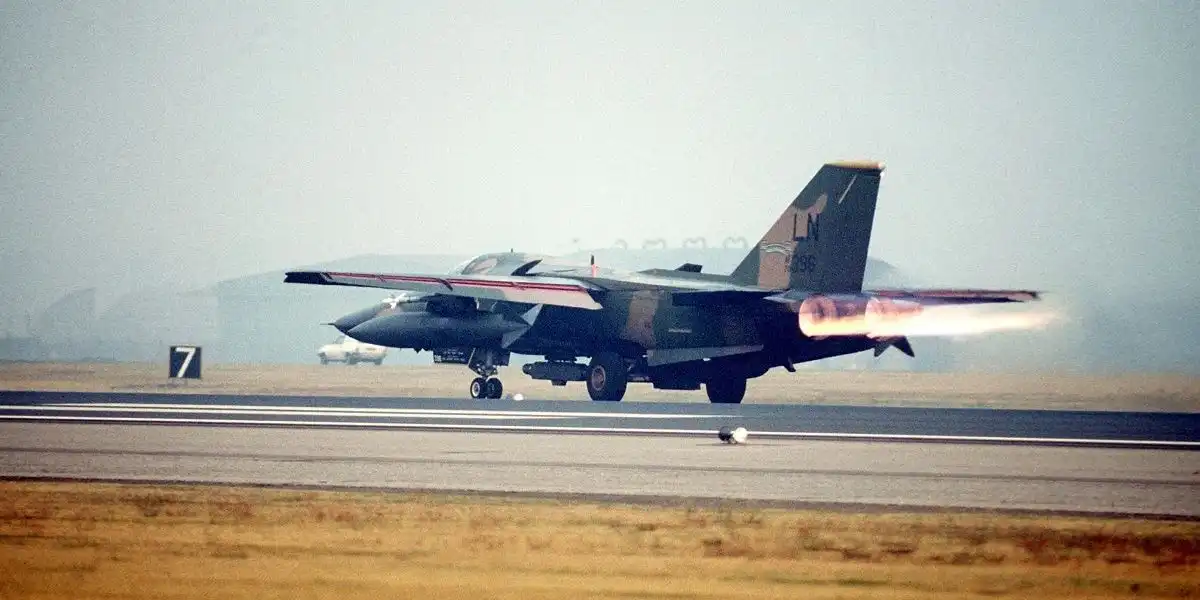
Originally known as the TFX (Tactical Fighter “X”), the F-111 was conceived to meet a U.S. Air Force requirement for a new tactical fighter-bomber. In 1960 the Department of Defense combined the USAF’s requirement with a Navy need for a new air superiority fighter. The USAF’s F-111A first flew in December 1964, and the first production models were delivered to the USAF in 1967. Meanwhile, the Navy’s F-111B program was canceled. In all, 566 F-111s of all series were built.
An interesting feature of the aircraft was its variable-geometry wings. While in the air, the wings could be swept forward for takeoffs, landings or slow speed flight, and swept rearward for high-speed flight. The F-111 could also fly at very low level and hit targets in bad weather.
With the introduction of the F-111F with its upgraded avionics and terrain-following radar, more powerful engines, and armed with laser-guided bombs that the F-111 emerged as a superb long-range strike aircraft.
On Apr. 14, 1986, at 5:13 p.m., U.S. Air Force (USAF) F-111F Aardvarks from the 48th Tactical Fighter Wing (TFW) took off from Royal Air Force (RAF) Lakenheath on the orders of President Ronald Reagan.
F-111 strike mission: Operation El Dorado Canyon
Support for anti-American terrorist groups was sponsored by several Arabic leaders, with Colonel Muammar Gaddafi of Libya being at the forefront. He openly financed these groups and made no secret of his assistance whenever these factions struck at defenceless targets. President Ronald Reagan, backed by UK Prime Minister Margaret Thatcher, chose to carry out an air strike to silence the vociferous colonel.
As told by Bob Archer in his book F-111: Fort Worth Swinger, a contingency plan (codenamed Operation El Dorado Canyon) was formulated whereby a mixed force of US Navy carrier-borne fighters would attack one set of targets while USAF fighter-bombers would strike elsewhere in Libya. Strategic reconnaissance assets were deployed to the Mediterranean, including a pair of 17th RW TR-1As and at least two additional RC-135s. The gradual build-up of sizeable numbers of McDonnell Douglas KC-10A Extenders and KC-135s to Fairford and Mildenhall was a more obvious sign that a strike against Libya was imminent. At Fairford were eight KC-10s, along with ten KC-135s, while a further 15 KC-10s were at Mildenhall together with 20 KC-135s.
All transient air traffic at both bases was halted as personnel readied the tankers for their mission. Furthermore, most F-111 training flights at Lakenheath and Upper Heyford ceased as aircraft were armed and maintained ready for the raid. The presidential directive was issued on Apr. 14, 1986, with tankers beginning to depart shortly after darkness fell. In customary fashion the French and Spanish refuse the armed aircraft permission to overfly their territory, so instead the fighter-bombers and their tanker support were forced to fly out over the eastern Atlantic Ocean to enter the Mediterranean Sea through the Straits of Gibraltar. The KC-10s positioned themselves in racetracks west of Portugal, with their endurance extended through aerial refuelling by the KC-135s.
Operation El Dorado Canyons: F-111 strike mission targets
At the same time as the tankers were departing, the 48th TFW began launching four cells of six aircraft each, drawn from all four squadrons. Among these were air spares which began returning to Lakenheath once the main strike packages were safely on their way. Five EF-111A of the 42nd ECS launched from Upper Heyford around the same time, consisting of four mission aircraft and an air spare. The US Navy contingent was flown from the aircraft carriers CV-43/USS Coral Sea and CV-66/USS America. Both vessels were off the Libyan coast.
The two dozen F-111s met with their tankers at predetermined racetracks off the Iberian Peninsula and refuelled in radio silence. Once in the Mediterranean area, the USAF contingent flew well to the north of the African coast, to avoid detection and to maintain the element of surprise. The EF-111As commenced jamming radars and other Libyan air defences as the strike elements initiated their attacks. The Navy contingent was tasked with striking targets in the Benghazi area, while the USAF was assigned various objectives in Tripoli. In a matter of minutes, barracks, training areas as well as both airports were attacked. Ordnance used included 2,000lb laser-guided bombs, and 500lb high drag gravity bombs by the F-111s, whereas HARM and Shrike missiles were fired at air defence radars by the Navy aircraft.

While the Navy fighters all returned safely to their aircraft carriers, the USAF did not fare so well, with F-111F 70-2389 being lost. Some reports implied the aircraft flew into the sea, while others have suggested that it was hit by ground fire. The two crew were killed.
Mission symbols
As soon as the F-111s had expended their ordnance, they climbed to altitude to meet with their tankers, and reverse the course back to the UK. The EF-111As were first to return, followed later by the F-111Fs which commenced touching down at Lakenheath at 0730hrs local time.
Subsequently, the F-111 crew chiefs wished to mark their aircraft with the time-honoured tradition of a mission symbol. Some aircraft did display a small white bomb on the port side below the cockpit window. However, the Air Force decided later that it might make the aircraft a reprisal target for terrorists. Therefore, most of the bomb symbols were removed, with, instead, all 48th aircraft displaying a distinctive Libyan campaign banner applied across the tail. Despite this directive, 70-2413 was still displaying the mission marking in March 1989!
Post-strike, the two SR-71As of Detachment 4, 9th Strategic Reconnaissance Wing (SRW) were launched from Mildenhall to obtain photographs of the damage inflicted. Eventually, the details filtered through to Lakenheath, enabling participants to analyse details of the target damage.
F-111: Fort Worth Swinger is published by Key Publishing and is available to order here.

Photo credit: U.S. Air Force


