In this article:
The Mustang

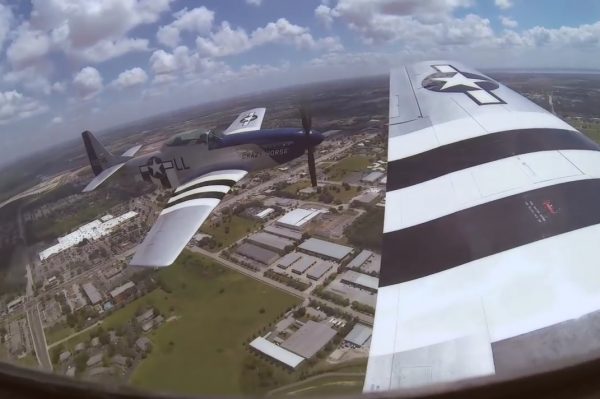
The Mustang was among the best and most well-known fighters used by the US Army Air Forces during World War II. Possessing excellent range and maneuverability, the P-51 operated primarily as a long-range escort fighter and also as a ground attack fighter-bomber.
In 1940 the British approached North American Aviation to license-build Curtiss P-40 fighters for the Royal Air Force. North American offered to design a better fighter, which flew as the NA-73X in October 1940. Production of the aircraft — named Mustang I by the British — began the following year.
Impressive performance at low altitudes
As told by Calum E. Douglas in his book The Secret Horsepower Race Western Front Fighter Engine Development, however, while its performance was impressive at low altitudes, the Mustang’s V12 Allison V-17I0 engine had only been equipped with a single-stage single-speed centrifugal supercharger. The V-1710 had been earmarked as an airship engine before the great depression halted development; the Allison engine was therefore only configured for low level operations. The effective American exhaust driven turbo-super-chargers would simply not fit an aircraft as small as the Mustang.
The RAF and the test pilots at Farnborough were enthusiastic about its low-level performance and its long-range potential- but what would they do with the Mustang? It could not perform well enough at high-altitude to cope with German fighters and did not pack as much firepower as the Typhoon, which also outpaced the Mustang even at low level.
What if we put a Merlin into the Mustang?
Thankfully, the obvious question was asked: what if we put a Merlin into the Mustang? MAP (Ministry of Aircraft production, created in 1940) asked Rolls Royce to provide performance graphs for the Mustang with a Merlin XX or the latest two-stage supercharged and intercooled Merlin 61 and the initial predictions were unequivocal; based on the speed obtained with the Allison, Rolls-Royce predicted a giant performance leap with the Merlin 61-(see below).

The theoretical results were astonishing and when the graphs showing the speeds of the two aircraft were presented they were met with incredulity.
“It is far from clear as yet why the Mustang performance is so high. I took the opportunity of examining it alongside Spitfire when I saw it at RAE [Royal Aeronautical Establishment-Farnborough] yesterday, and it is far from obvious why it should have a drag of only 501b at 100ft per second, as indicated by the Boscombe Down trials, as compared with 65.5lb, the average for the later Spitfires … as regards the Rolls-Royce estimates in this folder, I cannot agree the absolute values they show.
A.D./R.D.T.1
R. N. Liptrot
04.06.42.”
Mustang Vs Spitfire: could the Spitfire be beaten by a brand-new aircraft from America?
Captain R. N. Liptrot, Assistant Director of Research and Development (Aircraft) and others considered it almost an affront that the Spitfire could be beaten by a brand-new aircraft from America. The results were clearly a mistake, it was surmised, and judgement would have to be reserved until a Mustang could be flown with a Merlin installed.

“Rolls are going flat out on this job and proof of their contentions will be forthcoming as soon as the aircraft flies. Till then I do not think we need spend much more time arguing the whys and wherefores.
C.R.D.
15.6.42.”
After some political wrangling the project was approved and an RAF Mustang was converted. It is never a straightforward proposition to swap an engine type and the project required significant resources to complete quickly.
Mustang Vs Spitfire
On Oct. 13, 1942, the Mustang first flew with the Merlin 61.
A Spitfire IX and a Mustang, both fitted with the Merlin 61, were flown to high-altitude and both throttles fully opened. The Mustang ‘walked away’, the Spitfire pilot reported. He was told to push the throttle all the way through the gate, to +15lb/sq in supercharger boost emergency power but even this was not enough and the Mustang simply disappeared into the distance.
As early as Jun. 1, 1942, the British had correctly projected that the Mustang’s top speed would rise from 370mph to nearly 430mph simply by removing the Allison V-1710 engine and installing a Merlin 61-even more astounding was that at 25,000ft the Mustang with a Merlin 61 was nearly 100mph faster than with the Allison.

The conception of the Mustang and the resulting performance proved so outstanding that the Mustang story was used by the US Military in 2010 as an official case study in demonstrating successful future fighter aircraft procurement lessons.
Supermarine embarrassment
If any embarrassment was felt by Allison, it was also shared by Supermarine; up to about 30,000ft the Mustang was a constant 25mph faster than the new Mk.IX Spitfire.
“D.T.D.
The speed realisation is most encouraging. Soon we shall have a scream for Mustangs instead of Spitfire IXs!
C.H.D
October 17, 1942.”
The Secret Horsepower Race Western Front Fighter Engine Development is published by Mortons Books and is available to order here.

Photo credit: Unknown and Ronnie Macdonald from Chelmsford, United Kingdom via Wikipedia