In this article:
Tomcat or Bombcat?

Designed to carry the formidable long-range AIM-54 Phoenix missile, the Grumman F-14 Tomcat was first flown on December 21st, 1970. Made famous by the Hollywood film Top Gun, the F-14 replaced the F-4 Phantom II as the US Navy’s primary maritime air superiority fighter. Its design includes a variable geometry wing that can sweep back for high speed supersonic intercepts and forward for improved positioning in air to air dogfights. Nicknamed “Bombcat,” the F-14 spent much of its late career in an air-to-ground role, carrying the Low Altitude Navigation and Targeting Infrared for Night (LANTIRN) system.

But even though the Tomcat performed the air-to-ground role only in her twilight years, the AWG-15 fire-control system [AWG-9 only refers to the radar, while AWG-15 is the whole fire-control system of the Tomcat] of the F-14A Tomcat was always equipped with the CCIP-mode, and the jet was always capable of deploying ‘dumb’ bombs.

Indeed, Grumman run the related flight-testing in 1973-1974, as can be seen in the main photo of this post (showing one of 10+1 prototypes armed with Mk.82s, AIM-7 Sparrows and AIM-9 Sidewinders).
That’s also why all the 80 F-14As made for Iran were all manufactured and delivered (minus one that was never delivered) equipped with the CCIP-mode plus all the shackles and other equipment necessary to carry and deploy bombs in combat (i.e. this was no ‘Iranian modification, even if, yes, the Iranians were the first to deploy the F-14A as a ‘bomber’ – either in 1982 or in 1986, seems even they cannot agree about this).
F-14 jets loaded with bombs running exercise in 1970s
Indeed, VF-32 Squadron of the USN even run some exercises with bombs, shortly after its conversion to the new jet, in 1973-1974.

Only the contemporary ‘flags’ (admirals) of the USN have developed the idea about the F-14 being a ‘pure interceptor’, and this was then repeated in almost all the related English-language publications, until it became a dogma. It was a similar dogma like ‘AIM-54 is only good to kill bombers and cruise missiles’ – while the weapon was perfectly capable (and thoroughly tested, and then proven as such in combat) in deployment against ‘small and nimble’ fighters (which was no surprise: already the AIM-54’s predecessor, AIM-47 Falcon – which was to be armed with a nuke, and then installed on the stillborn YF-12A Mach-3-capable interceptor – scored 7 direct hits in 9 tests).
Unsurprisingly, when a new generation of flags came to their senses, slightly over 10 years later, it was no problem for USN’s F-14-units to (re-)start ‘flight testing’ and even do some training in release of bombs, in the late 1980s – thus opening the way for what eventually evolved into the ‘Bombcat’ of the late 1990s and early 2000s, as youngsters know it.
AGM-53 Condor
Ah yes, and….
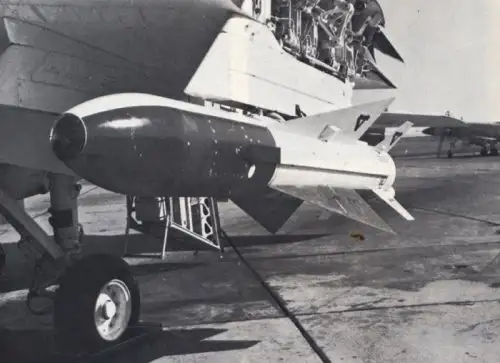
When placing orders for its F-14s, Iran was very keen to get these armed with the Rockwell International AGM-53 Condor. Condor was something like ‘predecessor’ of what we nowadays know as ‘precision guided munition’ (PGM): a TV-guided missile with a range of about 60km (over 30 miles), under development for the USN since the late 1960s.
Sure, as such it might sound as ‘not much more than the contemporary AGM-62 Walleye’, but Condor was far more sophisticated and, as indicated above, also had a much better range (AGM-62 was, essentially, a glide-bomb).
Alas, before the Iranians could place any orders, in 1976, Condor was cancelled because of its excessive cost: a single round went at a higher price than AIM-54A Phoenix.
Check out Helion & Company website for books featuring interesting stories written by The Aviation Geek Club contributor Tom Cooper.

Photo credit: U.S. Navy


