In this article:
Boeing and Lockheed Martin X-planes that paved the way to F-47

Under research and development contracts with the Defence Advanced Research Projects Agency (DARPA), Boeing and Lockheed Martin designed two X-planes as risk reduction for the Next Generation Air Dominance (NGAD) Platform. According to a DARPA news release, these aircraft first flew in 2019 and 2022, logging several hundred hours each.
As reflected in the statement from Chief of Staff of the Air Force Gen. David Allvin: “For the past five years, the X-planes for this aircraft have been quietly laying the foundation for the F-47 — flying hundreds of hours, testing cutting-edge concepts, and proving that we can push the envelope of technology with confidence.”

DARPA’s involvement began with its Air Dominance Initiative study in 2014, which resulted in the agency’s Aerospace Innovation Initiative. “It is often only in future decades when DARPA’s disruptive impact can be unveiled – today, we’re proud to be able to share the 10-year DARPA research arc that has culminated in the F-47 program, defining the next era of American air dominance,” said DARPA Acting Director Rob McHenry.

From “Black X-planes” to F-47
Hence the mass of technology guessed as being used in the F-47 project was envisaged, researched, and developed secretly. See: as a part of different ‘black projects’. Projects funded by the Pentagon, but never officially revealed in the public.
Arguably, a few of these did become known in the meantime. That’s a few of different projects run by the DARPA. Perhaps one of the best-known results of these is the Aurora Flight Sciences X-65: a full-scale technology demonstrator for what is known as the CRANE. That stands for Control of revolutionary Aircraft with Novel Effectors:
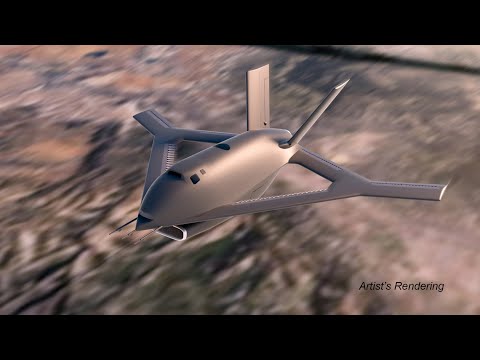

Essentially, the CRANE is a design made to demonstrate something called ‘active flow control’. This means that contrary to what the aircraft are using ever since the Wright Brothers catapulted their Flyer down the beach at Kitty Hawk, back in 1903, aircraft with the ‘active flow control’ are not using control surfaces (fins/rudders, flaps, canards, leading edge extensions, slats, etc.), this new design is using a sort of ‘jets’ – pipes blowing hot air – from a pressurized source, to shape the flow of air over the aircraft control surface. The control of the aircraft in roll, pitch, and yaw is thus obtained by distributing several such jets around the airframe, and these blowing as and when necessary.
Why doing this?
Because it’s eliminating the necessity for moving parts in form of control mechanisms and steering surfaces. Because that’s making the construction of the aircraft simpler and lighter: no need for steering controls, no need for complex hydraulics and servos moving the control surfaces, just for example. That, so they say, is ‘significantly reducing weight, complexity, and thus the maintenance requirements’ of the aircraft, while – at least theoretically – promising to improve its flight performances.
The Looks of the NGAD
How comes?
Ah, that part is simple physical laws, resulting in the fact that any aircraft with lighter construction can fly faster, higher and – especially – further.
…on the other hand, one is left to wonder if anybody really wants to fly a ‘stealth’ fighter jet that’s full of hot holes blowing hot air all over its structure in order to enable it to manoeuvre…
Except for the Aurora, another of contracts for such designs is known to have been issued to the BAE Systems, which designed the MAGMA drone, demonstrated in 2019. That one looks like this:

How about the ‘looks’ of the F-47?
The – heavily photoshopped – illustrations released show a design blending some of Boeing’s earlier experimental designs, ‘but’ – with canards:

I.e. plan-form-wise, something like this:

Overall, one can expect this F-47 to be a single-seater, slightly smaller than F-22 (but with, apparently, an unusually large cockpit transparency for a jet of its size… guess, that’s ‘yet another pro-stealth’ feature); less than 20m long; to weight between 20 and 40 tons empty and full, respectively; to be capable of reaching – and maintaining over extended periods of time – speeds well over Mach 2 at operational altitudes up to 70,000ft (21,300m), perhaps even higher; while carrying either 6-8 air-to-air-, or 2-4 air-to-surface weapons in its internal bays… and still be relatively manoeuvrable at slower speeds.
NGAD Platform
As already reported, the Department of the Air Force recently announced the contract award for the Engineering and Manufacturing Development (EMD) of the Next Generation Air Dominance (NGAD) Platform, marking a major milestone in the advancement of air superiority. The contract, awarded to Boeing, will lead to the development of the F-47, the world’s first sixth-generation fighter aircraft.
The F-47 represents a significant advancement over the F-22 and F-35, which is currently the US Air Force’s primary air superiority fighter.
Hailed as the world’s first crewed sixth-generation fighter, the F-47 is the cornerstone of the NGAD Family of Systems and is designed to integrate next-generation stealth, sensor fusion, and long-range strike capabilities to counter the most sophisticated adversaries in contested environments. Its adaptability and modular design ensure seamless integration with emerging technologies, positioning it as a dominant platform for decades to come.
Check out the blog Sarcastosaurus and Helion & Company website for books featuring interesting stories written by The Aviation Geek Club contributor Tom Cooper.
Photo credit: U.S. Air Force, Aurora Flight Sciences and BAE Systems


