In this article:
F-14

Advancements during the Cold War in Soviet long range patrol and bomber aircraft dictated a requirement for a fleet defense fighter that could engage high-altitude bombers from well beyond visual range. The iconic F-14 Tomcat was Grumman’s answer. Equipped with long range AIM-54 Phoenix air-to-air missiles, F-14s could engage multiple hostiles over 90 miles away. Needing an interceptor’s high speed while carrying this heavy ordnance, Grumman produced the highly effective variable sweep wing of the F-14, enabling it to operate at a wide range of airspeeds.
Designed in 1968 to take the place of the controversial F-111B, then under development for the Navy’s carrier fighter inventory, the F-14A used the P&W TF30 engines and AWG-9 system and carried the six Phoenix missiles that had been intended for the F-111B. A completely new fighter system was designed around these with emphasis on close-in fighting “claws” along with standoff missile fighting.

From its first flight on 21 December 1970, the F-14A has come through five years of development, evaluation, squadron training and initial carrier deployments to become the carrier air wings’ most potent fighter. Technical and financial problems that received a great deal of publicity have been overcome in achieving this goal.
Grumman F-14A Tomcat No. 3
F-14A [Aircraft No. 3, Bureau Number (BuNo.) 157982], the third Tomcat produced and one of the prototypes used in the early testing of the aircraft, is currently on display at the Cradle of Aviation Museum at Mitchel Field, Long Island.

Several things make this particular Tomcat significant. First, she is the oldest surviving F-14 in the world.
No. 3 first flew on Dec. 28, 1971 with Grumman Test Pilots Don Evans (pilot) and Dennis Romano (Weapon Systems Officer). As told by David F. Brown in his book Tomcat Alley: A Photographic Roll Call of the Grumman F-14 Tomcat, she was then delivered on Jan. 4, 1972.
The second interesting thing about BuNo. 157982 is that while operating out of the Grumman Flight Test Facility at Calverton, New York, No 3 was primarily used for determining the entire structural envelope for the F-14 and investigating certain flight characteristics under extreme conditions.
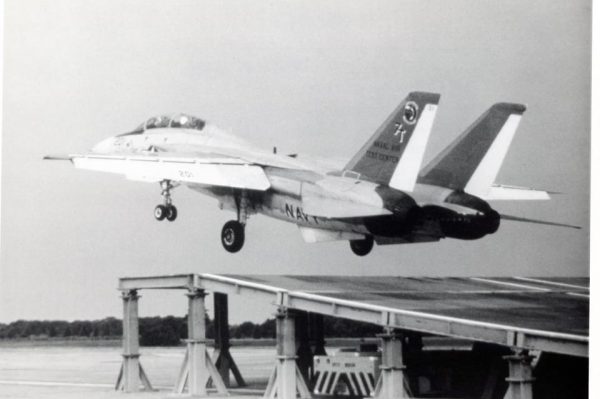
One of these was in response to concerns raised by the US Navy regarding asymmetrical wing sweep. The asymmetrical wing sweep program came as a result of an incident in the fleet where the wings on one Tomcat in flight experienced a slight misalignment with the degree setting for each wing. This resulted in concern by the Navy if this problem persisted could the F-14 safely land as well as take off. No. 3 is best remembered for the photo shown above (The presence of a star and bar on both wings led some to believe that this was a cleverly-faked piece of photographic trickery, but in fact the photo really does show Tomcat 3 with her wings swept differentially, with the starboard wing locked fully forward, and the port wing swept fully aft).
Tests

As explained by William Barto, F-14 NATOPS illustrator, Historian and on the Board of Directors of the F-14 Tomcat Association and museum associate, Cradle of Aviation Museum, in an article for the F-14 Tomcat Association, a series of flight tests were conducted from December 19, 1985 to February 28, 1986. Grumman’s Chief Test Pilot, Chuck Sewell, conducted several trials with the right wing locked in the forward position of 20 degrees, and positioned the left wing at 35, 50, 60 and 68 degrees of sweep in flight. 60 degrees was determined as the maximum for landing. In the event of an operational in-flight malfunction, Sewell found the aircraft to be acceptable for carrier landings in this configuration.

The famous photo of asymmetrical wing sweep with the right wing at 20 degrees and the left wing at 60, proved in an extreme way that the jet could still perform.
Tomcat No. 3 flew for the last time in 1990 and she was stricken on Sep. 20, 1994. Acquired by the Cradle of Aviation Museum in 1995, No. 3 is shown here on display in Hangar 2. It is also interesting to note that Tom Gwynne, Vice President for External Relations for the “Cradle”, and Grumman Test Pilot No. 72, flew No. 3 on several occasions.

Photo credit: Grumman and William Barto