In this article:
The Wooden Wonder

The famous British Mosquito was a versatile aircraft used extensively during World War II. Constructed primarily of plywood with a balsa wood core (and because of this it became affectionately known as ‘The Wooden Wonder’), it had excellent speed, altitude and range. First flown on November 25, 1940, the Mosquito entered production in mid-1941 and was produced until well after the end of the war. Almost 8,000 Mossies were built in Great Britain, Canada, and Australia.
Although best known for its service with the Royal Air Force, the Mosquito flew in several US Army Air Force units as a photographic and weather reconnaissance aircraft, and as a night fighter.
Probably the Mosquito was the most feared allied warplane in WWII by the Axis.
Attacking Berlin on 10th anniversary of the Nazi Party
As told by Calum E. Douglas in his book The Secret Horsepower Race Western Front Fighter Engine Development, on the cold morning of Jan. 30, 1943, three two-man crews left the 105 Squadron briefing room at RAF Marham in Suffolk and walked towards a trio of de Havilland Mosquitos. Pilot Officer E. B. ‘Ted’ Sismore and Squadron Leader ‘Reggie’ W. Reynolds, leading the mission about to take place, climbed aboard their aircraft and started up its two supercharged Merlin 12-cylinder engines.
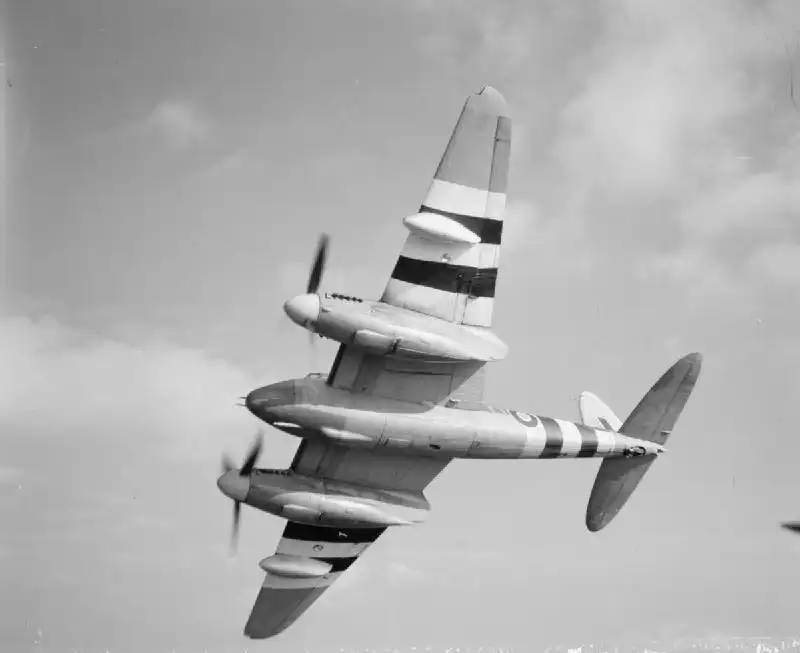
At exactly 8.45am the first of the three machines took off and set course for Berlin, the engines settling into a hypnotic thrum. No Allied aircraft had ever flown over the capital of Hitler’s Third Reich in daylight before-the strength of German air defences making such a mission tantamount to suicide.
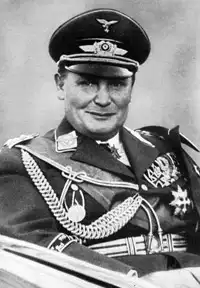
The mission had been carefully planned to coincide with the 10th anniversary of the Nazi Party’s rise to power in Germany. As the Mosquitos flew in, the man charged with the Reich’s aerial defence, Hermann Göring, was at the RLM building in Berlin preparing his speech.
Mosquito delays Göring speech
Göring prepared to begin his speech at 11am to be broadcast via the Nazi state broadcasting company Reichs-Rundfunk-Gesellschaft. Berliners going about their morning looked up as air raid sirens blared out. High above, the Mosquitos raced over Berlin. The RAF aircraft quickly dropped their bombloads and streaked for home.
In the chaos below, Göring’s speech was delayed. The pompous Reichsmarschall was furious, for not only had the party been embarrassed on its anniversary, but his flippant boast of three years earlier that he might be addressed as “Meyer” if a single Allied aircraft flew over the Reich had backfired. Worse still for Göring, all three English aircraft escaped despite flying over the German capital city in broad daylight. No German aircraft had been able to catch them; by virtue of pure speed the Mosquitos had proven almost invulnerable.
Another group of three Mosquitos, this time from 139 Squadron, took off at 1.25pm on the same day and headed towards the occupied island of Heligoland. They flew at 34omph, barely skimming above the waves of the North Sea to avoid enemy radar.
Morris and McGeehan recorded: “BERLIN appeared in brilliant sunshine on E.T.A … heavy flak encountered … two fighters seen but these were evaded.” The other Mosquito flown by Massey and Fletcher noted: “Only one Fw 190 seen, which was evaded.”
Attacked twice in the same day

Later that afternoon Göring headed to the Sportpalast in Berlin to attend a Nazi rally where Hitler’s Minister of propaganda Joseph Goebbels was speaking to the huge crowds assembled.
‘Since the seizure of power on January 30, 1933 every year the Führer personally has spoken from the Sportpalast to the German people …’
Again, the sirens sounded and the Mosquitos of 139 Squadron streaked over Berlin dropping their bombs.
Of the three Mosquitos, only DZ367 did not return. Crewed by Wright and Darling, it had also eluded the German fighters but was hit by flak.
German engineers had been able to put together details on the Mosquito from one of the rare occasions when one was brought down. The Merlin engines were sent to be tested, and the power curves in the German report are from their own engine test-cells.
Göring asking German aviation engineers to build the Mosquito
Much later, deep in the Schorfheide forest at his vast hunting lodge, Carinhall, Göring gathered together the technical heads of the German aviation industry and raged. A stenographer recorded every word for posterity:
“I go mad when I look at the Mosquitos. I’m green and yellow with envy. The Englishman, who has more aluminium than we do, is building a wooden machine, and with a speed which he now increases again!”
In 1943 Germany had fallen behind in the race to lower aircraft drag by the adoption of high-pressure, high-temperature cooling systems, using the most thermally efficient practical mixture of just 30% glycol. Problems in Germany’s aviation programmes had reached Gӧring’s ears and on Mar. 18, 1943, he summoned his technical heads to Carinhall for a tirade of insults lasting six hours.
At one point he turned to face Professor Messerschmitt and told him what he thought of the Mosquito, with barely disguised sarcasm regarding the so called “primitive” wooden materials it employed:
‘Everyone should come and look at this amazingly primitive aircraft-then they might learn something. Also, I’ll say this: why spend any more time searching? Let’s build the Mosquito! That’s the simplest thing we can do.’
Not just Gӧring extolling the Mosquito
In 1943 it was not just Gӧring extolling the virtues of the Mosquito; its performance had been increased in regular stages as Merlin engine performance had increased. Now fitted with the two-stage Merlin 61 which had been signed off for +18lb/sq in boost pressure the Mosquito V reached 350mph with its Merlin set to cruise at 30,000ft while carrying 2000lb of bombload. Without bombs it easily exceeded 410mph. With the same engine the Mosquito virtually matched the Spitfire IX for level speed, and utterly eclipsed it in terms of range and versatility.
For fast climbing and dogfighting prowess, the Spitfire IX was preeminent-but virtually any other duty, from photo-reconnaissance, to anti-shipping, precision bombing, tree-top level sneak raids under the radar or path-finding, the Mosquito did them all.
The level speed of certain models even outstripped that of the latest Messerschmitt Bf 109 G. No other Allied aircraft is mentioned so many times in the RLM correspondence. The Mosquito was also the only Allied aircraft to warrant a conference item all to itself, though this was simply to say that one has been successfully shot down (for example on Dec. 14, 1943, by Captain Meurer in a Junkers 88 with use of nitrous oxide).
The Secret Horsepower Race Western Front Fighter Engine Development is published by Mortons Books and is available to order here.
Photo credit: Unknown, BAE Systems, Crown Copyright, De Havilland photographer for Ministry of Aircraft Production


