
In this article:
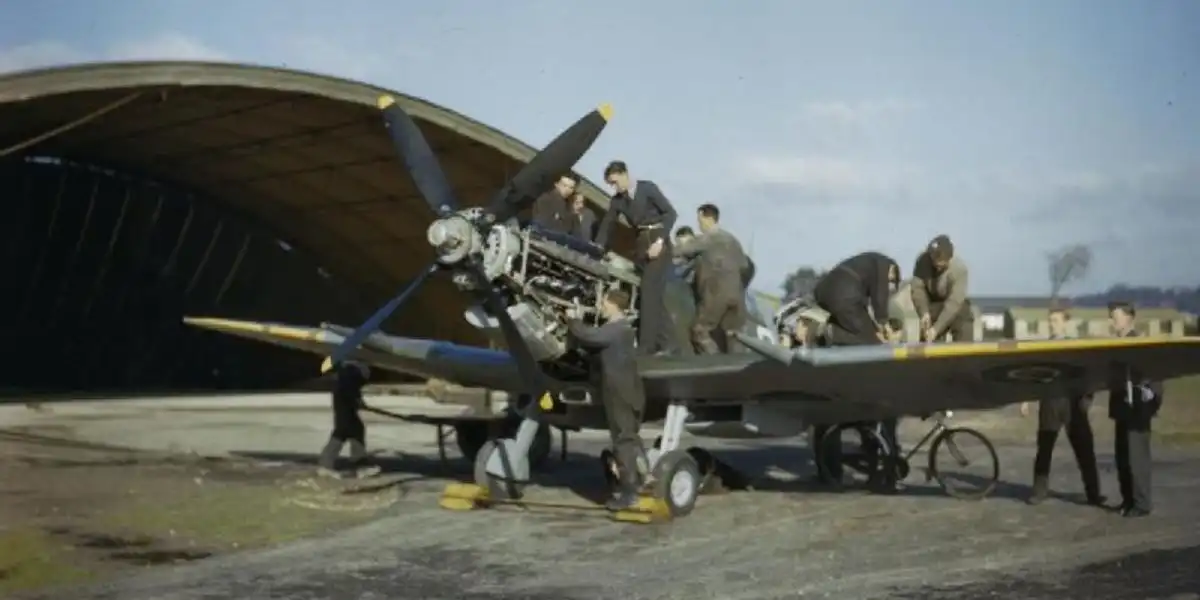
Formed in 1906 to produce automobiles, Rolls-Royce was asked to begin designing and building aircraft engines at the outbreak of World War I in 1914. According to Smithsonian National Air and Space Museum, design of the Merlin began in 1933 following the similar Kestrel design. Early Merlin Mk II and Mk III engines, which produced about 7,457 kw (1,000 horsepower), powered Hawker Hurricanes and Supermarine Spitfires in the Battle of Britain.
According to ShortFinals.org, in 1941, in Trafford Park, Manchester, Ford UK had two assembly plants where they were told to build Rolls-Royce Merlins – lots of them! At the time, this engine was in the vast majority of British fighters and bombers, including the two which had just won the Battle of Britain, the Supermarine Spitfire and the Hawker Hurricane.
In his book Not Much Of An Engineer, Rolls Royce supercharger designer Stanley Hooker states that Ford UK looked at the Merlin engine drawings and said “we can’t build an engine to those tolerances.” Hooker said loftily (his words) “I suppose the tolerances are too tight for you?” ” No, they are much too loose – we use much tighter tolerances for car engines so all the parts are truly interchangeable without any hand adjustment needed.”
Ford re-drew the blue-prints for the Merlin, making it more suitable for mass production, and by 1944, over 400 engines a week were flowing out of the plants.
“And they were very good engines too” said Hooker.
The final total came to 30,428. This was only 2,000 less than the main Rolls-Royce plant at Nightingale Road, Derby (although there were several other plants producing Merlins in the UK).
The first Merlin engine developed 880hp but by the time the last mark of Merlin was produced the power output was 2030hp.
The Merlin engine was then enlarged still further and named the Griffon. Aircraft which were powered by the Merlin engine include the Lancaster, Spitfire, Halifax, Hurricane, Battle, Defiant, Whitley, Mosquito, Hornet, York, Lincoln and North American Mustang.
Hooker’s book is an excellent read about the development of the Merlin engine and then the early jet engines. Hooker eventually saved Rolls Royce after it went broke developing the RB211 three-shaft jet engine, which became today’s very powerful and very fuel-efficient Trent engine.
Photo credit: Crown Copyright
Aviation History
