
In this article:
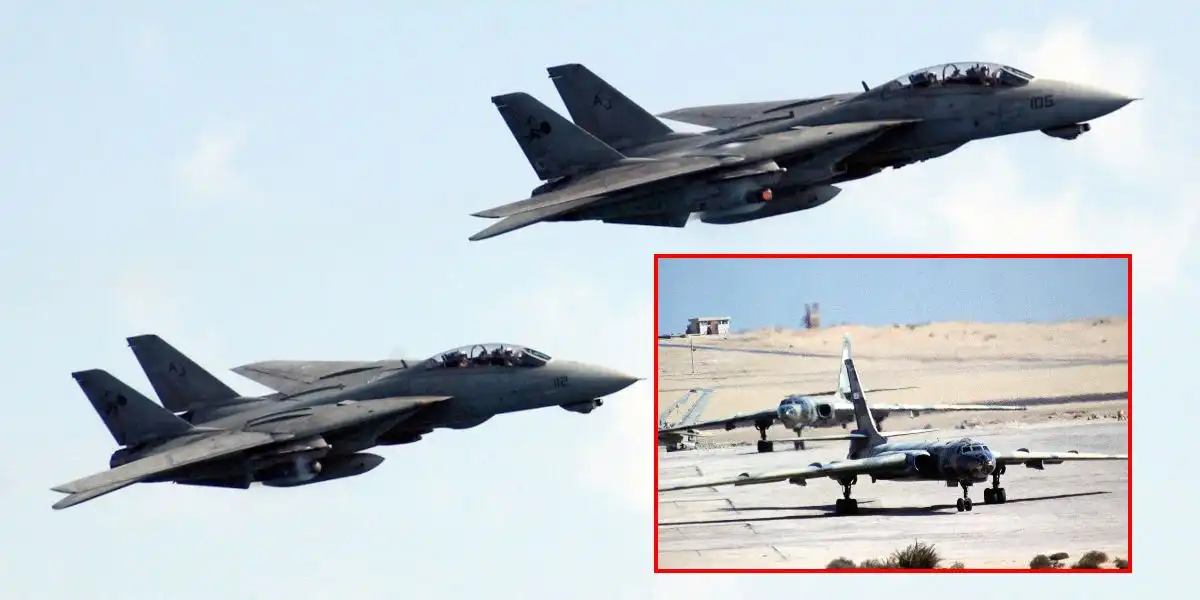
Few aircraft of the Cold War era have attained such cult status and adoration among those that flew it, wanted to fly it or kept it flying as the mighty Grumman F-14 Tomcat.
The jet was the final fighter created by the Grumman Aircraft Corporation and it had a reputation for being a tenacious interceptor that proved its durability in combat.
With the thawing of the Cold War in the late 1980s, the Tomcat community was faced with a stark choice. Turn the aircraft into a multirole strike fighter platform, or retain the fighter mission only and face almost certain extinction.
In a mere five years, the F-14 transitioned from guarding against improbable Cold War scenarios to becoming the LANTIRN-equipped, self-escorting strike fighter of choice.
With its two-seat cockpit, substantial payload and superior speed, range and recovery capabilities compared to the F/A-18 Hornet, the F-14 transformed into the formidable “Bombcat.”
Its contribution in Operations Enduring Freedom (OEF, 2001–02) and Iraqi Freedom I–IV (OIF, 2003–06) proved its worth.
As told by Tony Holmes in his book F-14 “Bombcat”: The US Navy’s Ultimate Precision Bomber, things did not get off to a great start when CVW-14’s first strike wave in OIF was stymied by a lack of “big wing” tanker support. The latter was so hard to come by that the entire strike package was forced to turn around and return to Abraham Lincoln with bombs still on their racks. Strike lead Cdr Don Braswell, XO of VFA-25, had “told the CAOC prior to launch that there was not going to be enough fuel on-station for everyone to press on into Iraq, and that was exactly what happened.”
However, the second and third waves sent to hit targets in and around Baghdad included elements from Abraham Lincoln, and on the night of March 22-23 more Tomcats, Hornets and Super Hornets from the carrier ventured into southern Iraq against targets listed on the CAOC’s ATO. CVW-14 CAG Capt Kevin Albright (at the controls of an F/A-18E Super Hornet from VFA-115) was on one of those strikes;
‘The mission called for four F/A-18E Super Hornets and two F-14D Tomcats to strike a missile production facility in the Karbala area, approximately 40 miles [64km] south-west of Baghdad. I was flying as “Dash 3” in the Super Hornet division. The ATO was well constructed by the CAOC, which had the monumental task of co-ordinating and scheduling thousands of sorties every day. Tanker tracks, offload fuel amounts and timings were all spot on.
‘The Super Hornets were loaded with a mix of 2,000lb [907kg] JDAM that included a penetrator variety, as well as the standard Mk 84 bomb body. The F-14Ds were loaded up with two 2,000lb [907kg] JDAM each. All strike fighter aircraft also carried a self-defense air-to-air load-out as well.
‘Brief, man-up and launch went as planned. We were assigned a USAF KC-10 tanker, along with a US Marine Corps EA-6B, which had sortied from Prince Sultan Air Base in Saudi Arabia. In addition, we were also slated for a section of USAF F-16CJ HARM-equipped fighters. Everyone was full-up, mission ready, on time and on station. No small feat, and a tribute to the ATO planners in the CAOC and the maintainers in all the services who kept this huge armada airborne “24/7.”
‘Shortly after the strike package established communications with our AWACS controller, he advised us that an Iraqi bomber – a Tu-16 “Badger” – had been located at Al-Taqaddum Air Base, about 30 miles [48km] north-west of our assigned target. The controller passed co-ordinates for the bomber, and we assigned them to the two Tomcats. The mission commander, the F-14D lead and the VF-31 CO [Cdr Paul Haas] quickly worked out a new timing plan en route that allowed the F-16C) and the EA-6B to provide coverage for both strike packages. The Tomcat crews also reprogrammed the aim points in their JDAM thanks to the weapon’s Target Of Opportunity [TOO] mode.
‘As we flowed north toward the Baghdad area, I was surprised by how eerily quiet the radios were. I was also amazed at how tranquil the Iraqi air defenses seemed to be. We could see downtown Baghdad as we approached from the south-west. When wearing NVGs, any weapons fired could easily be seen – there was no activity, That would soon change, however.
‘As the Tomcats approached their targets, the F-16CJs prepared to launch several HARM against Iraqi air defense radars. It was easy to spot the missiles coming off the F-16CJs from our position some 20 miles [32km] south-west of their location – I was impressed by the sheer speed of the HARM as they raced towards their targets. After their shots supporting the F-14Ds, the F-16CJs quickly repositioned south-east to protect the F/A-18Es. The Prowler aircrew had previously set up an orbit that allowed them to cover both targets nearly simultaneously.
‘The Tomcats were on target just as we hit our IP. The four Super Hornets had a great nose-on view of some of the most impressive secondary explosions I have ever witnessed. Clearly the Tomcats “shacked” the bomber, which appeared to be fully loaded with both fuel and ordnance. Those JDAM woke up the entire Al-Taqaddum air defense force, because a huge barrage of AAA and ballistic SAMs began to streak skyward. Fortunately, the Tomcats were able to egress without taking any hits, although they did have at least one SAM come within several hundred yards of their fight as it split their section.
‘I was impressed with the radio discipline from all the flights. Aircrew were calling SAMs and AAA in calm, clear voices, and keeping leads informed of their intentions. This allowed us to keep the flights together and continue to press home the attacks.
‘The F/A-18Es hit their assigned target approximately three minutes behind the F-14Ds. Once we completed our off-count and verified eight weapons had been released, the entire package began to egress south-east. The Super Hornet division observed multiple SAM launches on the way home but none of us were illuminated by target-tracking radars and none of the SAMs appeared to guide on us. We saw significant AAA in the southern Baghdad area, with many secondary explosions from a large coalition strike that was underway.’
Albright concludes;
‘Return to the post-mission ranking location was uneventful, and we recovered aboard Abraham Lincoln four hours after launching following a very satisfying mission.’
F-14 “Bombcat”: The US Navy’s Ultimate Precision Bomber is published by Key Publishing and is available to order here.
Photo credit: MSGT Donald Sutherland / U.S. Air Force and Photographer’s Mate Airman Apprentice Nathan Laird / U.S. Navy

