
In this article:
When an ejection seat may represent a crew member’s last chance to survive, there can be no compromise.
Ejection seats are placed into the cockpit and usually attach to rails via a set of rollers on the edges of the seat. During an ejection, these rails guide the seat out of the aircraft at a predetermined angle of ascent. Like any seat, the ejection seat’s basic anatomy consists of the bucket, back and headrest.
In most designs, the aircraft canopy comes off and the seat is propelled out of the aircraft by an explosive charge or rocket motor, carrying the pilot with it. Once clear of the aircraft, the ejection seat deploys a parachute. In two seat aircraft, the seats are ejected at different angles to avoid a collision.
Before ejection seats, pilots would have to remove the aircraft canopy manually to climb and jump out.
Ejection seats can save lives.
But does a military pilot get some kind of “punishment” if he ejects from a plane?
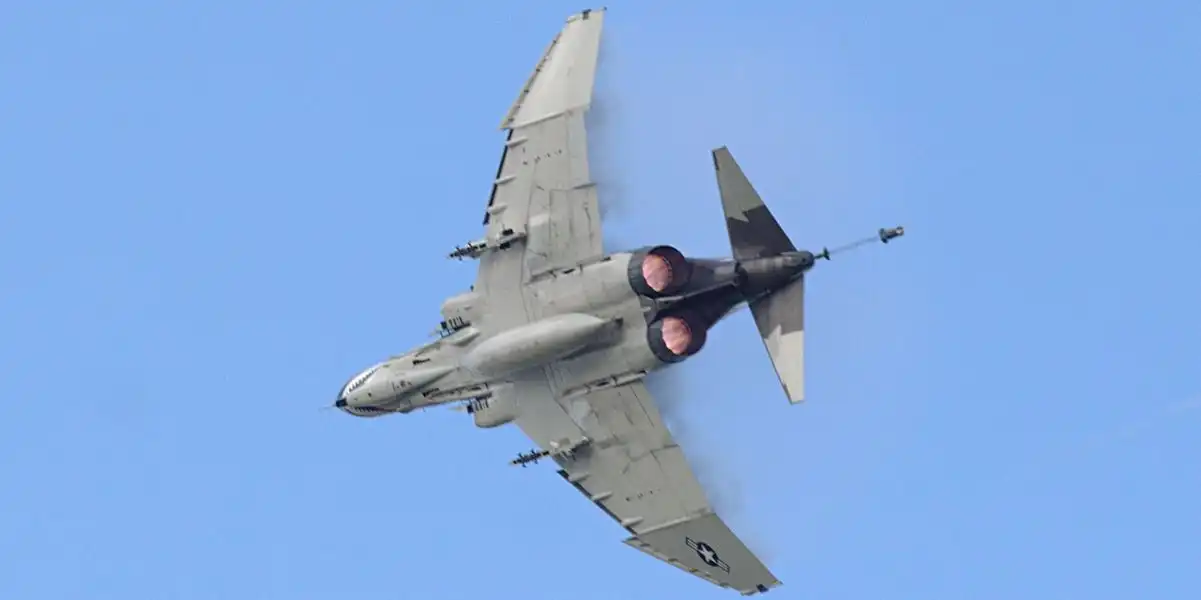
‘Other than the physical punishment, none that I know of. I was once punished for not ejecting from an F-4,’ Charlie Noak, former USAF F-4 Phantom II pilot, recalls on Quora. ‘In 1987 my right-engine had a massive overspeed due to its Fuel Flow Controller (this had never occurred in an F-4 before) failing to the full flow position. The engine’s exhaust gas temperature (EGT) went from normal to over 1,500 degrees F so quickly that by the time I pulled the throttle back to the close position, the engine had already exploded due to the high heat causing the turbine blades expanding and breaking off as they chewed into the engine’s protective casing.
‘The fireball extended from 100+ feet in front to 300+ feet out the back. The broken off turbine blades were twinkling in the afternoon sunshine. There was no continuing fire, so I headed back in a slow turn to land at the airfield I had just left. During my approach, the utility hydraulic pressure, which makes most every control surface of the plane work, began dropping in fits and starts, going to zero pressure slightly before I landed.
‘Single engine failure with loss of utility hydraulic failure was the most dreaded of all F-4 emergency procedures – if you get low on glideslope on final, you would need to use afterburner on the good engine to climb back to the correct glideslope. If you apply afterburner, however, the plane will flip over, and drive you into the ground.
‘I stayed on the correct glide slope, and made a smooth landing (I was motivated). The deputy commander for operations (DCO) wanted to give me an article-15 (nonjudicial punishment) for not ejecting. However, the Phantom (F-4) fleet was grounded worldwide for FFC inspections, and seven were found to be on the verge of failure. Those were all replaced, and a new item was added to all major inspections. Twelfth Air Force thought I should be recognized for saving the airplane so that the problem was identified. As is usual in such cases, the “bad boy,” and the “atta boy” canceled each other out.’
Noak concludes;
‘Faced with the same problem today, I would do the exact same thing.’
Photo credit: U.S. Air Force and Michael Pereckas from Milwaukee, WI, USA via Wikipedia
Cold War Era
