In this article:
F-14 Tomcat

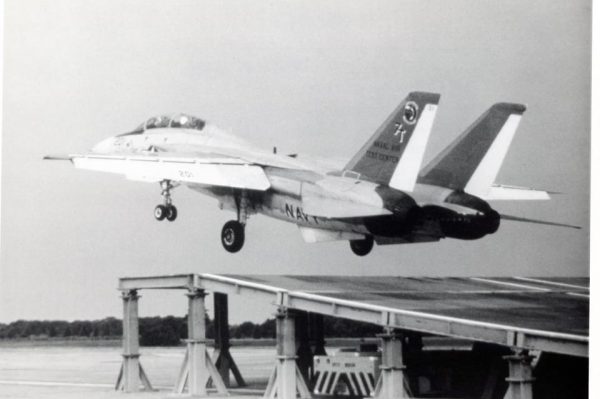
Advancements during the Cold War in Soviet long range patrol and bomber aircraft dictated a requirement for a fleet defense fighter that could engage high-altitude bombers from well beyond visual range. The iconic F-14 Tomcat was Grumman’s answer. Equipped with long range AIM-54 Phoenix air-to-air missiles, F-14s could engage multiple hostiles over 90 miles away. Needing an interceptor’s high speed while carrying this heavy ordnance, Grumman produced the highly effective variable sweep wing of the F-14, enabling it to operate at a wide range of airspeeds.
The Navy’s search for an advanced carrier-based air superiority fighter led to evaluation of General Dynamics’ F-111B, an aircraft that would promote the Department of Defense’s aim of commonality with the Air Force and its F-111A. The F-111B, having been modified to meet Navy mission requirements, was deemed too heavy for carrier operations and the contract was cancelled in April 1968. Subsequently, the Navy inaugurated a new design contest for what was termed the VFX program, the two primary competitors being McDonnell Douglas and Grumman.
According to the National Naval Aviation Museum, while McDonnell Douglas evaluated a navalized version of the F-15, Grumman’s Model 303 proposed a variable-geometry, two-seat, twin-engined design built around the Hughes AWG-9 weapons system. Grumman had gained considerable experience with “swing-wing” technology from its earlier XF10F Jaguar that had been built only as a prototype. The need for rapid development and fielding of the aircraft dictated adoption of Pratt & Whitney TF-30 turbofans similar to those used in the F-111.
The carrier air wings’ most potent fighter
From its first flight on Dec. 21, 1970, the F-14A went through five years of development, evaluation, squadron training and initial carrier deployments to become the carrier air wings’ most potent fighter.
After a number of changes following flight testing, the first F-14As were delivered to the Navy in June 1972, with Fighter Squadron (VF) 124 designated to provide crew training. On the West Coast, VF-1 and VF-2 were the first operational squadrons to receive the new aircraft, while on the East Coast VF-14 and VF-32 became the first Atlantic fleet Tomcat squadrons. In 1974, the Marine Corps prepared to stand up VMFA-122 at NAS Miramar, but the program was cancelled when the Marine Corps decided to retain modified versions of the dependable F-4J Phantom II.
Moreover, before the Islamic Revolution the Shah of Iran, Mohammad Reza Pahlavi arranged to arm the Imperial Iranian Air Force with 80 Grumman F-14A Tomcats and 714 AIM-54 Phoenix missiles in a deal worth US$2 billion, out of which 274 were delivered for US$150 million.
Significantly, and virtually unknown in the West, Irani-piloted F-14s reportedly achieved 150 air kills in the 1980–88 Iran-Iraq War.
F-14 Tomcat: without equal among Cold War Era’s Free World fighters
Overall, the F-14 was without equal among Cold War Era’s Free World fighters. Six long-range AIM-54A Phoenix missiles could be guided against six separate threat aircraft at long range by the F-14’s AWG-9 weapons control system. For medium-range combat, Sparrow missiles were carried; Sidewinders and a 20mm were available for dogfighting. In the latter role, the Tomcat’s variable-sweep wings gave the F-14 a combat maneuvering capability that could not have been achieved with a “standard” fixed planform wing.

Originally it was planned that the F-14B with the advanced P&W F401 would be the major production version. However, performance of the TF30-P-412 exceeded expectations while development of the F401 was delayed. One F-14B was flight tested, showing that an F401-powered Tomcat would be a potential future option.
The Tomcat capped a long line of Grumman Cats. In the hands of Navy pilot/NFO teams, it provided the carrier task force with its first-line offense and defense against any enemy air threat in the tradition of its predecessors.
The US Navy inventory included F-14As, F-14Bs and F-14Ds.
Top Gun Movie Star
In addition to its outstanding fighter capabilities, the Tomcat had been configured as a potent, adverse weather, medium-range strike aircraft that was fielded through cost-effective upgrades to F-14A/Bs. According to Naval History and Heritage Command, with the ability to launch Joint Direct Attack Munitions (JDAM), coupled with an INS/GPS integration and off-the-shelf electronic countermeasure improvements, the Tomcat provided a multi-mission strike/escort capability.
The F-14 saw its first combat in August 1981, downing two Libyan Su-22 fighters over the Gulf of Sidra. It saw considerable duty in the Gulf War, Iraq and Afghanistan. The last F-14 retired from active service in 2006.
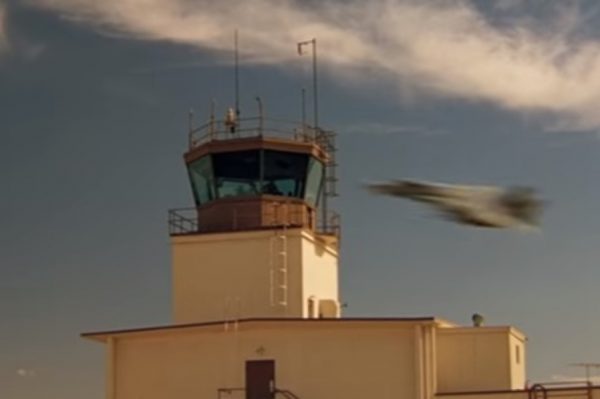
The Tomcat became the symbol of an era through its engagements with Libyan aircraft in the 1980s and flashing across the silver screen in the blockbuster motion picture Top Gun, which featured the F-14 crewed by Maverick and Goose buzzing the tower in one of the most memorable scenes of the movie.
Persian Cats’
The F-14A remains in service with the Islamic Republic of Iran Air Force (IRIAF).
The Persian Cats’ safety record has generally been excellent given their operational age and lack of support from the manufacturer since 1979.
In January 2007, US Department of Defense (DoD) announced that sales of spare F-14 parts would be suspended over concerns of the parts ending up in Iran and in Jul. 2007 the remaining US F-14s were shredded to ensure that any parts could not be acquired.
However, in Oct. 2010 IRIAF commander stated that his country was overhauling its F-14s and mentioned that Iran-made radar system had been installed on the fighter.
Moreover, in the summer of 2010, Iran requested to the US to deliver the 80th F-14 purchased by the country in 1974, whose delivery was denied after the Islamic Revolution.

Photo credit: Photographer’s Mate 3rd Class (AW) Jayme Pastoric and Photographer’s Mate 3rd Class John E. Woods / U.S. Navy