In this article:
Boeing 747

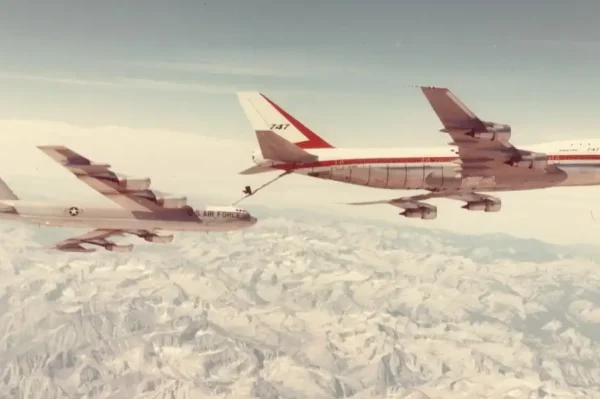
The 747 was the result of the work of some 50,000 Boeing people. Called “the Incredibles,” these were the construction workers, mechanics, engineers, secretaries and administrators who made aviation history by building the Boeing 747 — the largest civilian airplane in the world — in roughly 16 months during the late 1960s.
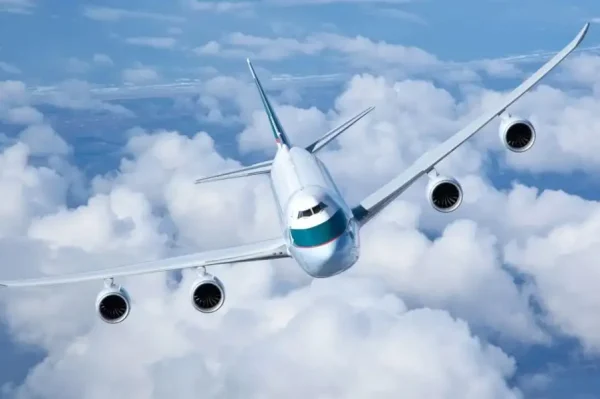
The 747 was truly monumental in size. The massive airplane required construction of the 200 million-cubic-foot (5.6 million-cubic-meter) 747 assembly plant in Everett, Wash., the world’s largest building (by volume). The fuselage of the original 747 was 225 feet (68.5 meters) long; the tail as tall as a six-story building. Pressurized, it carried a ton of air. The cargo hold had room for 3,400 pieces of baggage and could be unloaded in seven minutes. The total wing area was larger than a basketball court. Yet, the entire global navigation system weighed less than a modern laptop computer.
First flight occurred on Feb. 9, 1969, followed by an extensive test program and it became a mainstay of the world’s international airlines.
The 747 was the first airplane called a “Jumbo Jet” as the first wide-body airliner.
The 747 triggered a revolution in air travel and represents a significant milestone in the evolution of aviation design.
How to barrel roll the Jumbo Jet
Can a Boeing 747 do a barrel roll?
Mark Hilsen, former Boeing 747 pilot, explains on Quora;

‘Never knew a pilot training on the 747–400 to not roll the airplane while in the simulator. None of us were completely sure of the simulation’s fidelity but the control inputs and roll/pitch responses looked about right. Of course, there was no simulation of felt-Gs*, either lighter or heavier in the seat, nor was there any vestibular feedback of the actual rolling motion; the visuals were awe inspiring, however, and persuasively realistic.
‘Technique? Pretty straight forward. Start at 280–300 kias, pitch to about 20° nose up and put in full aileron, control wheel to the locks. As the bank angle goes through about 60° let the nose fall and it will keep falling until about 20° nose low at the lowest point, perfectly inverted. Use slight forward pressure when upside down to keep the second half descent rate reasonable. Use about half rudder, no more: the sim didn’t like more than that.
‘As the wings came level, return to straight and level cruise flight (on heading, back on altitude, call “maneuver complete” like you do that for a living). Or! Pitch right back up to 20° and “unwind” your previous roll by going in the opposite direction. In the sim, kids. In the sim.’
Not a 1-G Maneuver
Hilsen concludes;
‘I’ve flown the real jet at Max Gross Takeoff Weight of 875,000 lbs (at the point we pushed the power up to start the takeoff), and while I loved the jet heavy, I think that trying to roll it even given 340 kias would be “sporty” at best. Pretty sure you’d exceed every load limit Boeing had calculated before you got even 25% into your roll. Jesus! just, don’t.’
*The barrel roll is not a 1-G Maneuver. Unless you mean that your frame of reference is hanging in space in a photo airplane or hot air balloon, watching another airplane go that maneuver: then the world around you is then 1-G. But a barrel roll always incurs a “G-debt” when you’re upside down and trying to hold a positive, approximate 1-G feeling in your pilot seat. That acceleration towards earth (2G being 64 ft per second per second) has to be pulled against as you return to upright (to straight and level, accelerated flight).

Photo credit: Cory W. Watts from Madison, Wisconsin, United States of America via Wikipedia and Unknown