In this article:
The B-52 Stratofortress

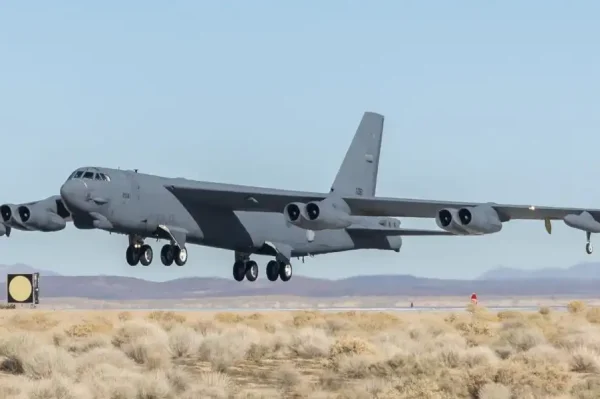
The first B-52A flew Aug. 5, 1954. With each variant, the B-52 increased in range, power and capability. In all, 744 B-52s were produced by Seattle, Wash., and Wichita, Kan., plants between 1952 and 1962.
Throughout the 1950s, the B-52 chalked up many distance and speed records. It cut the round-the-world speed record in half, and in January 1962, flew 12,500 miles (20,117 kilometers) nonstop from Japan to Spain without refueling. This flight alone broke 11 distance and speed records.
In June 1965, B-52s entered combat in Southeast Asia. By August 1973, they had flown 126,615 combat sorties with seventeen B-52s lost to enemy action and several damaged, as George Holmes, former B-52 tail gunner with 113 Combat Missions over S.E.A., remembers on Quora.
B-52 Tail Gunner recalls flying in monsoon clouds
‘We were inbound to Vietnam on a bombing mission. Must have been around 1966. I was sitting in my station, the tail gunners seat all the way in the back of the plane.
‘All of a sudden I notice what I think is our number two aircraft in a three aircraft formation doing a 50 degree bank. Which was not allowed normally.
‘Well as it turns out it wasn’t number two it was our plane doing a 50 degree to the opposite direction. We had lost all electronics, we were in monsoon clouds. And carrying a full load of 500 pound bombs. All the forward cockpit had was the starter battery. Also had a compass with an oil filled body for bank and turn indicators.
‘So number two changed places with us in our formation. They lead us to a spot in the ocean reserved for dumping ordnance only. When we dumped all of our bombs both from the bomb bay and under the wings, it felt like we upward for about 100 feet.
‘Then the new lead plane, listening to the tower, for the Base that we were going to make an emergency landing at started leading us to the end of the run way.

‘The runway was ONLY 8,000 FEET LONG!!!
‘Our normal runway was 2 miles long. Our pilot touch the wheels down at the very start of the run so he could use it all. We did have flaps and popped the drogue chute on landing at the very start of the runway with high speed.’
B-52 emergency landing
He continues:
‘This is how good a pilot Dan Roark Was, he had to apply engine power half way down the runway.
‘THANK YOU MAJOR ROAK!
‘8000 feet is still quite long even for a big, heavy bus like the B-52 – especially with payload gone, because that markedly lowers the minimum required LDG speed.
‘But that is not the point. Major Roark did indeed do a damn fine job. Firstly, by keeping the a/c reasonably stable immediately after virtually all instruments were lost in stormy IMC. Assume the 50° bank was mostly deliberate; 30° would have been safer but then a B-52 is not an airliner. Secondly, by retaining presence of mind to understand, without comms or much in the way of signals, how the others were trying to help. Thirdly, executing what would normally be an instrument approach (without any) good enough to touch down right on the “piano keys”, at the right speed. And then completing a safe landing.’
Holmes concludes:
‘It may sound easy to some, but pile on the stress, uncertainties, and responsibility resting almost 100% on the PICs shoulders – it can get tough and some do get overwhelmed. Not Major Roark, however.’
Photo credit: U.S. Air Force