In this article:
Egon Mayer

German World War II Fighter Ace Egon Mayer joined the Luftwaffe at the age of 20 and spent two years in training until he was transferred to the Jagdgeschwader 2 in December of 1939 and since the beginning of November 1942 he commanded III./JG 2.
By Nov. 22,1942, the Eighth Air Force had mounted 22 daylight bombing raids on targets in the Netherlands and western France – mainly airfields, industrial centres and U-boat pens.
As told by Robert Forsyth in his book Defenders of the Reich The Luftwaffe’s War Against America’s Bombers, Mayer may have been slight of stature, but aside from being a 52-victory fighter ace, he had a keen, analytical mind and an eye for tactics. For weeks, 72 while serving in his post as Stafelkapitän of 7./JG 2, he had been studying as many of the combat reports lodged by pilots who had engaged American heavy bombers as he could. He compared their tactics, their gunnery techniques and their methods of formation flying. Mayer also took the occasional ‘field trip’, going out to inspect the wrecks of downed enemy bombers at their crash sites. From such visits, he realised that although some B-17s were equipped with a single 0.30-in. rife calibre machine gun in the nose, this would be largely ineffective when contending with a high-speed fighter attack.
Attack from the front: the most effective way to destroy a B-17 Flying Fortress
From such analysis, Mayer concluded that the most effective way to destroy or cripple a Viermot (the German/Luftwaffe contraction of ‘four-engines’) was to approach in a diving attack from the front. Due to the high combined closing speeds of the bomber and the fighter, this would place the latter in potential danger for the shortest possible time. At such an angle, a bomber’s pilots became vulnerable in the lightly protected and lightly armoured cabin area. Additionally, a bomber’s forward arc of defensive fire was its most restrictive and, therefore, weakest.6 The attacking fighter would then proceed straight through an enemy formation, its pilot continuing to fire.

Mayer also believed that the high speed of a Bf 109 or Fw 190 meant that the enemy tail and waist gunners would not be able to track the fighter. In any case, the gunners would be reluctant to fire because of the risk of hitting their fellow aircraft in formation (although, sadly, this did happen on a number of occasions throughout the war).
The acid test
The acid test came in the early afternoon of 23 November, when a force of 36 unescorted heavy bombers attacked the Saint-Nazaire U-boat pens. This time, a force of 28 B-17s was accompanied by eight of the recently arrived B-24 Liberators of the 93rd BG.
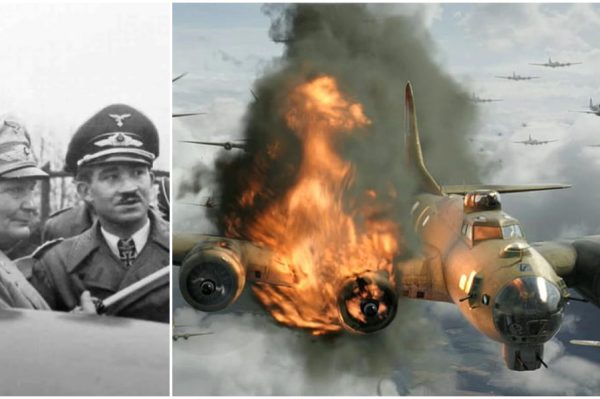
As the B-17s made their bomb run, Fw 190s from Oberleutnant Mayer’s Gruppe swept in to meet them. The attack provided Mayer with the perfect opportunity to put his new tactic into practice. Forming into Ketten of three aircraft, initially the Focke-Wulfs went into attack from ahead and to the left, with Mayer leading one Kette. When in range, he opened fire with a no-defection burst that gave him the impression that his cone of fire was reaching the area in front of the enemy aircraft. In pulling up to the left, Mayer observed hits in the starboard wing area of the B-17. The wing broke of and the Flying Fortress turned over and spun in, exploding as it went.
As Mayer’s Kette made sharp pulls up to the left or right, initially there was no defensive fire. The bombers’ gunners soon reacted, however, and both of the other pilots in his element received hits and one Focke-Wulf was shot down. The heavy defensive fire continued as the fighters moved over or beneath and behind the bombers using a climb or half-roll. Crucially, however, Mayer had experienced no defensive fire as he made his initial head-on approach.
Attack from the front: the B-17 was obsolete as a self-defending bomber’
After this initial pass, several more attacks were mounted from front low against other B-17s in the formation. On a final attack, strikes were seen in the fuselage areas and wing roots. When turning under one Flying Fortress, Mayer saw a ‘light ball of fire’ beneath the aircraft, moments after which the bomber ‘spun in, twisting and turning and exploding after receiving more hits from the rear’.

Next, although his machine gun ammunition had been expended, Mayer aimed for the B-24s, attacking one from ahead and to one side with his cannon, keeping his speed as low as possible. As he opened fire on the Liberator, Mayer ‘skidded’ his Fw 190 in the direction of fight of the B-24 by applying simple rudder movement. Violent explosions were seen from the first shots, and the American bomber ‘pulled up slightly and dived straight down without spinning. No one bailed out’.
The HQ of the Eighth Air Force noted after the mission, ‘A change of enemy fighter tactics was observed in this operation, nearly all attacks being frontal and apparently aimed at the right side of the nose. ‘From that moment’, one historian recorded, ‘the B-17 was obsolete as a self-defending bomber’. Indeed, it seemed that Mayer had devised a way in which an initial head-on attack could be made with the aim of breaking up a formation after which other fighters operating in strength could concentrate on making attacks from the rear against a more dispersed enemy whose defensive firepower had been weakened.
Tactical Regulations
Encouraged by Mayer’s initial success, recently promoted Generalmajor Adolf Galland circulated a set of new Tactical Regulations to all his fighter units in which he listed five ‘object lessons’:
- The attack from the rear against a four-engined bomber formation promises little success and almost always brings losses. If an attack from the rear must be carried through, it should be done from above or below and the fuel tanks and engines should be the aiming points.
- The attack from the side can be effective, but it requires thorough training and good gunnery.
- The attack from the front, front high or front low, all with low speed, is the most effective of all. Flying ability, good aiming and closing up to shortest possible range are the prerequisites for success.
- The exit can succeed only in a sharp, diving turn in the direction of the bomber formation or single bomber. The most important factor is the angle of curve in which the fighter leaves the bomber formation.
- Basically, the strongest weapon is the massed and repeated attack by an entire fighter formation. In such cases, the defensive fire can be weakened and the bomber formation broken up.
Defenders of the Reich The Luftwaffe’s War Against America’s Bombers is published by Osprey Publishing and is available to order here.

Photo credit: WWII US Bombers YouTube channel