In this article:
The Tomcat

Advancements during the Cold War in Soviet long range patrol and bomber aircraft dictated a requirement for a fleet defense fighter that could engage high-altitude bombers from well beyond visual range. The iconic F-14 Tomcat was Grumman’s answer. Equipped with long range AIM-54 Phoenix air-to-air missiles, F-14s could engage multiple hostiles over 90 miles away. Needing an interceptor’s high speed while carrying this heavy ordnance, Grumman produced the highly effective variable sweep wing of the F-14, enabling it to operate at a wide range of airspeeds.
The F-14A was a variable-geometry, two-seat, twin-engined design built around the Hughes AWG-9 weapons system. The need for rapid development and fielding of the aircraft dictated adoption of Pratt & Whitney TF30 turbofans similar to those used in the F-111.
Later models of the Tomcat, in the form of the F-14B and F-14D, were powered by General Electric F110 engines.
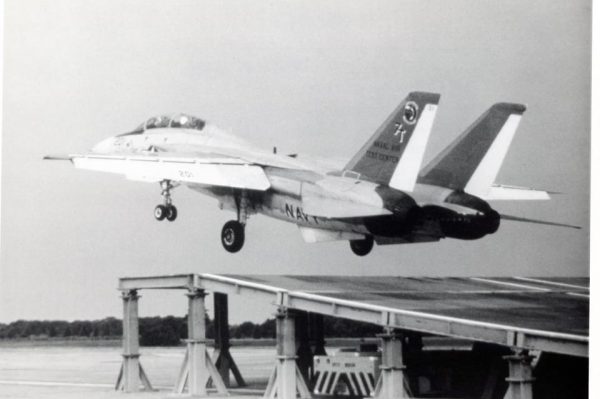
F-14A afterburner takeoffs
John Chesire, former US Navy F-4 Phantom II and F-14 Tomcat pilot, recalls on Quora;

‘I always did in afterburner aircraft, releasing the brakes before applying full ‘military’ and afterburner power in the F-4 and the F-14A. However, from the copy below I learned that an F-14 takeoff in afterburner was “prohibited” even though I did them often. I then realized I could do an afterburner takeoff with my TF30 engines in the “A” model, but not with later models with the F110 engines…
‘From my F-14 NATOPS Manual:
“Hold in position for takeoff using the toe pedal brakes with nosewheel steering engaged. Perform engine checks at 85 to 90−percent rpm. Select MIL on the roll and monitor engine performance.”
“After takeoff power checks are completed and at a safe interval behind the preceding aircraft, release the toe pedal brakes. Nosewheel steering should be used for directional control during the initial takeoff roll. Although the rudder becomes effective at 40 to 60 knots, to ensure adequate directional control in the event of an engine failure, nosewheel steering should remain engaged until 100 KCAS.”
F-14B/D with F110 engines
11.8.5.1 Takeoff Configuration

“Afterburner takeoffs are prohibited specifically because of controllability concerns in the event of an engine failure during takeoff. An engine failure during a MIL power takeoff with the F110 engine will produce significant thrust asymmetry. The high compression ratio of the compressor section will result in very rapid spooldown during an engine failure and rotor lock can be anticipated within several seconds of the engine failure.
“An engine failure in the takeoff configuration produces rapid nose movement in the direction of the failed engine. The pilot’s first impression is usually that the aircraft will depart the runway. Even if the aircraft’s heading swerve is corrected, the aircraft may continue to skid sideways across the runway. The wing on the side of the failed engine may rise 10 to 15. This is noticeable to the pilot, but easily corrected with lateral stick. If the airspeed is high enough to allow correction of the heading swerve, all lateral drift can be stopped.”
F-14A full zone-5 afterburner takeoffs
Chesire concludes;
‘Thankfully I was allowed to do full zone-5 AB takeoffs with the less potential asymmetric thrust of the TF30 engine. They were unbelievably exhilarating! Awesome power with just a little movement of your left hand and then, what a ride! One could feel each greater zone of afterburner kick in, one through five in less than a couple of seconds.
‘What a ride! Man, do I miss that!’

Photo credit: Nathan Laird, Mass Communication Specialist 3rd Class and Photographer’s Mate 3rd Class (AW) Jayme Pastoric / U.S. Navy