
In this article:
Fighter pilots are not allowed to carry electronic devices with them. That includes music players. The chances of a gadget interfering with onboard avionics are rather slim, but it could happen.
However, many fighter pilots break that rule. Especially on long (and boring) ferry flights. They just get earbuds that won’t conflict with the radio earphones in the helmet.
Lynn Taylor, former A-10 Pilot, Joint Firepower Course Instructor and ALO at U.S. Air Force (1995-2005), recalls on Quora;
‘I… er, “someone I know”… had a “patch cord” (courtesy of a savvy comm guy in exchange for a case of his favorite). It plugged in between the oxygen hose communications connection and the jet comm receptacle. It had a toggle switch that allowed me to patch a music player into the headset.
‘I only ever used it a few times, and even then, only on cross country flights where the only thing to do was enjoy the scenery. We had an interflight frequency that I could transmit over to share tunes with wingmen, but it required holding the mic button continuously. Whenever we started getting close to congested airspace, I’d turn it off to make sure we didn’t miss anything from Air Traffic Control.
‘Any other time, you really don’t want anything distracting. Any other kind of mission, training or otherwise, is very task intensive. Especially in combat, you don’t want any more distractions than already get thrown at you.’
Taylor concludes;
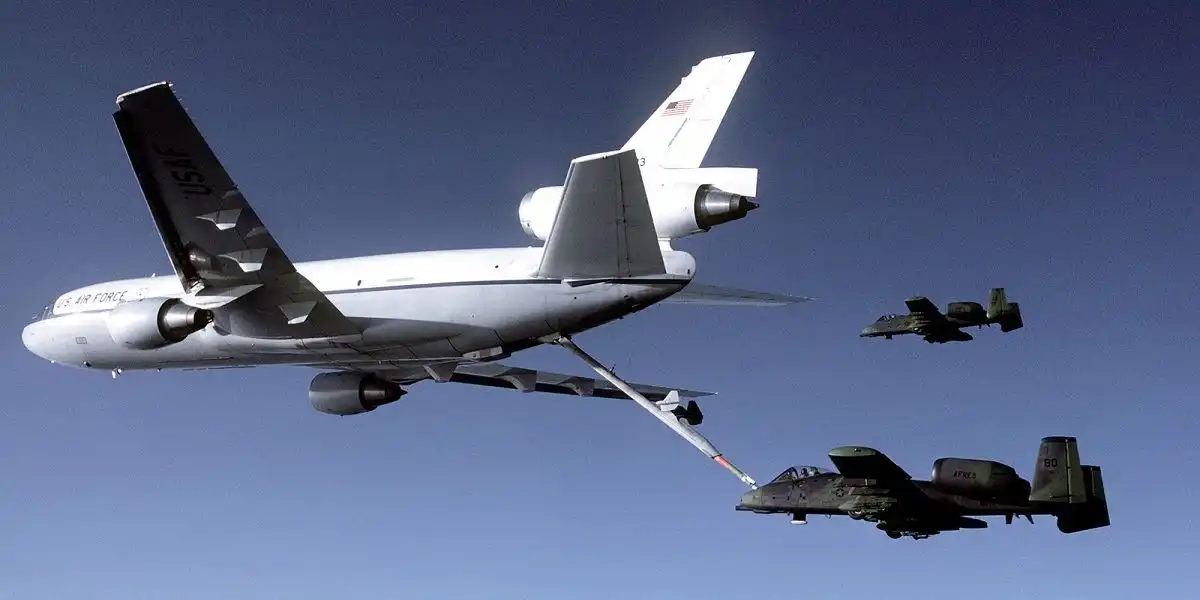
‘One other note… whenever we had a tanker dragging us across the pond, it was nice when we had a KC-10. They often had music they’d patch into the formation frequency, which really helped on the long flights.’
The A-10 Warthog is the first US Air Force (USAF) aircraft specially designed for close air support of ground forces. They are simple, effective and survivable twin-engine jet aircraft that can be used against light maritime attack aircraft and all ground targets, including tanks and other armored vehicles.
The aircraft can survive direct hits from armor-piercing and high explosive projectiles up to 23mm. Their self-sealing fuel cells are protected by internal and external foam. Manual systems back up their redundant hydraulic flight-control systems. This permits pilots to fly and land when hydraulic power is lost.
Photo credit: Ken Hackman / U.S. Air Force
Cold War Era
